2

This keeps confusing me. I keep imagining "permittivity" as being "The ability for a substance to permit electricity", when it is the opposite. High permittivity means it is hard (requires a lot of charge) for electric fields to be produced, while low permittivity means it is easy. I can't find the etymology on the internet.

Although it's not a traditional English word, I keep hearing it like it's just a normal English word and deducing "ability to permit" just like "morality" or "similarity". High "A-ity" meaning more A/easier to do A.

The inverse doesn't make much sense, such as more permittivity => more charge, as the field doesn't create the charge - the charge creates the field.

1 Answers1

4

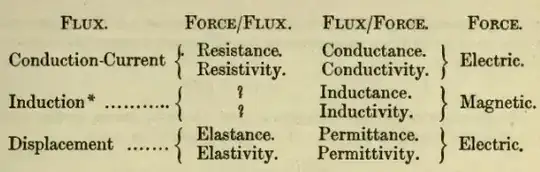
Heaviside coined the term "permittivity". He explains it and related terms in his Electrical Papers (vol. 2) pp. 124-5, ยง "Nomenclature Scheme":

To explain the word "permittance" that I used in the last Section, I may remark that in stating my views in 1885 in several communications to this journal on the subject of a systematic and convenient electrical nomenclature based upon the explicit recognition of the three fluxes, conduction-current, magnetic induction, and electric displacement, proposing several new words, some of which have found partial acceptance, I remarked upon the unadaptable character of the word "capacity." It must be the capacity of something or other, as of permitting displacement. I did not then go further in connection with the flux displacement than to use "elastance," for the reciprocal of electrostatic capacity. The following shows the scheme so far as it is at present developed:

Nomenclature Scheme

Geremia
  • 5,329
  • 1
  • 21
  • 46