3

The second half of 19th century and first half of 20th century are golden age of modern mathematics and science, as many important ideas and theories were proposed and developed within that period of time. I think that German and French were the main languages for the mathematical papers published in that period. After World War II, it is well known that English has gradually become the predominant language for mathematical papers until this date.

I would like to have more statistics such as articles published in major journals in German/French/English/Others between 1850 and 1950 and beyond. Thanks.

mdewey
  • 596
  • 3
  • 20
Eugene Zhang
  • 793
  • 6
  • 15
  • See your previous post : What was the main language in science/mathematics before 1850. The century from 1850 to WWII was the era of Nationalism. Thus, I suppose that the English-German-French triad of the previous century has the leadership. Before and after WWII many German mathematicians moved to US; this means that around 1940 the shift must be dramatically towards English. – Mauro ALLEGRANZA Sep 18 '18 at 08:07
  • “Statistics” have problems discussed at the other question. If you are so inclined, one thing you might try yourself is to sort the MacTutor index (declared “representative”) by language(s) used. – Francois Ziegler Sep 19 '18 at 12:12
  • See the link in the downvoted answer to that earlier question. It is not statistical but it tells a narrative how World War I resulted in English becoming dominant in science. – Bence Mélykúti Sep 19 '18 at 15:33
  • Number of mathematicians listed in MacTutor does not necessarily represent output of math papers. So the best way I think is to count papers in major math journals under each languages in the period (1850 - 1950). The only problem is that how to identify the major math journals in the period. – Eugene Zhang Sep 20 '18 at 01:10
  • From the field I am working in (set theory, logic, topology, philosophy), I believe most math papers were published in German and French between 1850 and 1950. However, it may be English if field was number theory, for example. – Eugene Zhang Sep 20 '18 at 01:13
  • Yes, you are free to declare any data set “non representative” since this is ill-defined. Your “only problem” is to find a better one and have people not dismiss it. For 1868–1942 you might also sort Jahrbuch by language — and then face the question whether that “overrepresents” German. – Francois Ziegler Sep 20 '18 at 14:27
  • 1
    @Francois Ziegler, thanks. Jahrbuch is great source, but ends in 1942. I am also looking for after 1942. The search confirms your claim, in the period from 2nd half of 19th to 1st half and 20th centuries, English: 59046, French: 51048, German: 66490. So German leads and not by much. Basically, 3 languages are at same level. – Eugene Zhang Sep 20 '18 at 17:01
  • I disagree with the premise... sorry... – paul garrett Sep 23 '18 at 23:48
  • @paulgarrett The premise being “1850–1950 was a golden age,” or ...? (Just curious.) – Francois Ziegler Sep 24 '18 at 22:16
  • 1
    @FrancoisZiegler, well, yes, I disagree with the rather blithe "golden age" phrase, and also with the idea that post-WWII English is "clearly" the dominant language... And with some other more implicit hypotheses. I am a little sensitive to such issues because my PhD students mostly cannot read French or German, and, ahem, not only 30 years ago (well after WWII) but currently there are some important things that are not translated into English... The rather extreme oversimplification that "everything's in English now" (or anyway, we ignore anything that isn't...) is disturbing. – paul garrett Sep 24 '18 at 23:42
  • "1850–1950 being a golden age for mathematics is obvious as most names used in standard math texts were produced in that period. Since 1950, mathematics has becoming increasingly dominated in technical side of proofs, but lack original ideas and theories. This fact is well-known within math community despite some disagreement which largely depends on the different math fields. However, nowadays it is very hard to get math work named, especially in standard texts. To make thing worse, there are tendency to attribute work to past famous mathematicians even if they had little to do with it. – Eugene Zhang Sep 25 '18 at 23:05
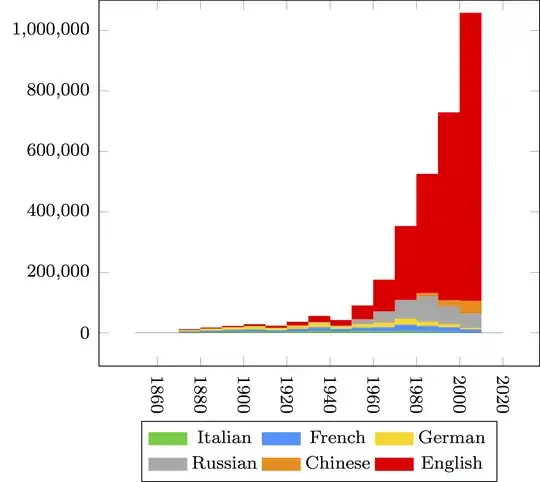
  • English's dominance for mathematical papers is not done overnight in 1940s, but has been steadily increasing until this date. After 1930s, German quickly faded as Jew and others big mathematicians left. So was French. But Russian gained significantly (less than English, however) as Soviet Union became a world power second only to US after WWII. English's dominance is largely due to fact that US became the most dominant power in the world after WWII. This trend continues in 1990s after collapse of Soviet union. These are all correctly reflected in the chart below. – Eugene Zhang Sep 25 '18 at 23:37
  • Soviet mathematicians (scientists) began publishing in Russian only after 1936's case against Luzin. Before 1936, Soviet mathematicians published most important works in German and French. Examples I know are Kolmogorov published his famous work in probability in German, and Luzin, Suslin, Alexandroff published their works in French. – Eugene Zhang Sep 25 '18 at 23:38
  • The only doubt in the chart below is that Chinese produces 3rd most math papers after English and Russian since 2000s. I find this fact hard to believe because first, Chinese is not a world power in mathematics. Second most Chinese mathematicians publish their work in English I believe. Maybe the chart includes many low level papers and papers in other non math fields. – Eugene Zhang Sep 25 '18 at 23:43

1 Answers1

3

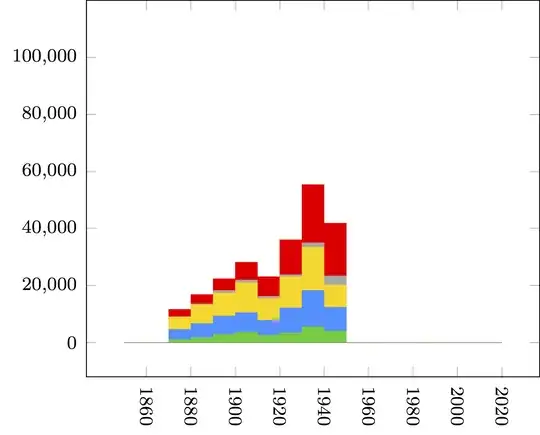
Here are plots using Jahrbuch for 1870–1940 and Zentralblatt after that. A glance at their detailed output suggests some unreliability (e.g. Zentralblatt counts a paper twice when both reviewed it), but hopefully not too much overall. Papers and books in other languages (Danish, Dutch, Hungarian, Japanese, Latin, Norwegian, Polish, Portuguese, Spanish, Swedish,...) are left out as only after 1980 does their sum total (slightly) surpass Italian.

1870-2009

Zoom on the requested pre-1950 period:

1870-1949


Added: Similar picture from Ammon (2012, p. 338):

1880-2005

Francois Ziegler
  • 7,684
  • 28
  • 41