44

As I was reading some papers written by Schrödinger and Heisenberg back in 1920s, I noticed that the symbols they use such as the integral or summation sign or calligraphic letters are as if printed out of a LaTeX document. I don't think that they had characters such as these in a typewriter. I was wondering how they could have achieved writing so flawlessly.

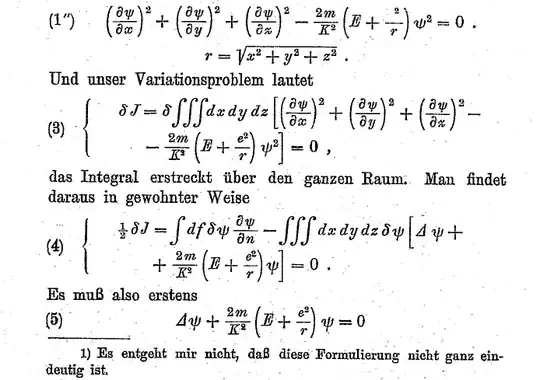
Edit: What I am talking about is something like this:enter image description here

Notice that this is from „Quantisierung als Eigenwertproblem“ by Erwin Schrödinger, which was written in 1926.

Danu
  • 3,852
  • 2
  • 29
  • 53
Gonenc
  • 785
  • 5
  • 14
  • 1
    I think people used to make them by hand until not so long ago. – hjhjhj57 May 06 '15 at 21:05
  • It cannot be because they are almost identical. – Gonenc May 06 '15 at 21:06
  • can you provide the source? – hjhjhj57 May 06 '15 at 21:06
  • Look at the article of Erwin Schrödinger quantisierung als eigenwertproblem. You can easily find it online. – Gonenc May 06 '15 at 21:09
  • I see, let's see if someone can answer. All symbols look perfectly printed. Also, you should add the source or an image to the OP. – hjhjhj57 May 06 '15 at 21:11
  • 42
    A little ironic, isn't it, to ask how mathematics typeset in the early 20th century can possibly look as good as the output of TeX, considering that Knuth created TeX precisely to restore mathematical typesetting to the high standard set in the early 20th century? (Source.) – dodgethesteamroller May 07 '15 at 01:33
  • 3
    Related topic: http://mathoverflow.net/questions/19930/writing-papers-in-pre-latex-era – KCd May 07 '15 at 03:07
  • 1
    Is this why some more recent books have handwritten formulas in them? I'm either thinking about Spivak's or Sternberg's differential geometry book, may be wrong about both of them. – hjhjhj57 May 07 '15 at 03:50
  • 6
    @Javier there was an intermediate period (say 1970/80s) were some cheaper production processes were used that operated from documents often produced by the authors (typewritten plus handwritten) themselves and then essentially photocopied. – quid May 07 '15 at 11:02
  • @quid Thanks for replying. For a moment I thought I was imagining it! – hjhjhj57 May 08 '15 at 00:26
  • 1
  • 1
    I began publishing mathematical papers just as TeX was starting to be used in academia (around 1980). I remember one paper on X-ray physics -- it was loaded with big integrals. It went back and forth between us and the journal six or seven times, and the final publication still had errors in the formulas. Typesetters of the day were very skilled, but they weren't mathematicians. I miss the romance of lead type. But the accuracy of digital typesetting certainly has something to be said for it as well. –  Sep 09 '16 at 00:28
  • Slightly off-topic: which fonts in TeX would give me a similar look? – Michael Bächtold Dec 18 '20 at 07:27

5 Answers5

44

Documents like the one you linked to were not typed on a typewriter.

When writing on typewriters, it was common to leave some space in the document in which the formulas could be inserted by hand. For professional publications, this was then given to a printer (the person, not the machine on your desk ;-)) who hot metal typeset the document.

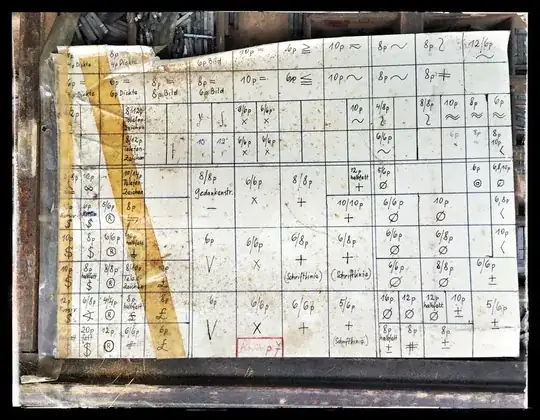
Printers had special boxes for all kinds of types:

Box of types for mathematical formulas

Source of the picture

For example, in the contents sheet of this box, you can see the integral sign and many more types for mathematical formulas.

Chris
  • 556
  • 5
  • 4
  • 4
    quibble: the case diagram you show was for hand-set type, not hot metal. the only really effective "all hot metal" composition system for math that i know of was the monotype "4-line system". although monotype came into existence very late in the 19th century, i haven't seen any reference to the 4-line system until the 1950s; this may not have been developed until after the second world war. thus, before that, printed math with anything more elaborate than one level of sub- and superscripts would have been hand set; the text it was embedded in could have been machine set (hot metal). – barbara beeton May 12 '15 at 15:01
39

It is really funny to read that in the beginning of 21-st century, some young people may think that journals and books printing had something to do with typewriters:-)

If you look attentively at the page you scanned you will easily see that this is not a TeX font and not a typewriter. It is more beautiful.

Before the middle 1990s we lived in the "Gutenberg Universe". In the universe where everything was PRINTED using lead fonts. This was the case from XVI century to th 1990s. The authors (Heisenberg, for example) would submit their paper to the journal, HANDWRITTEN, or text typed on a typewriter, and formulas inserted by hands. Until the beginning of 1990-th mathematicians inserted formulas by handwriting in a typed manuscript. Typewriters which could type Greek and Latin letters, and some formulas were common only in the US, and even there I am not sure how common.

This handwritten manuscript would go to a typography. There professional typesetters would make "pages" composed of lead letters (they had thousands of fonts in good typographies). Typesetters in the beginning of the 20-th century took these letters (made of lead) from boxes, and connected them together into lines and into pages (called "matrices"). These lead blocks called "matrices" contained mirror images of pages, one of each page. They would be used for printing, then the output was sent to the author for correction, then corrected and sent for correction again, several times.

In 1960s I visited such a print shop. Printing the local newspaper. The labor condition were terrible: enormous noise, lead dust everywhere... This was a very hard work. And take into account that the typesetter had to compose lines right-to-left. Some mechanization was introduced later, like the machine called linotype, (see "Linotype machine" in Wikipedia) which was something like a typewriter but enormous. And only professionals worked on them, not the authors, not Heisenberg:-)

As Gerald Edger commented, typesetting mathematics was a very expensive task which required most experienced typesetters. Printing anything was very expensive, especially math.

So it is really strange that the prices of mathematical books and journals skyrocketed AFTER the journals switched to TeX. Nowadays the publisher has practically nothing to do: the major expense of typesetting has been eliminated.

Added remark: whatever the publishers do nowadays, before 1990s they did the same AND typesetting in addition to this. And now compare the prices, just out of curiosity. At least in 1980s many good universities were able to afford subscription to all or almost all math journals.
Alexandre Eremenko
  • 48,930
  • 3
  • 80
  • 177
  • 3
    Before mid-1990s? Maybe you mean before the 1990s. I graduated from college in 1992, and by then LaTeX was available. – KCd May 07 '15 at 03:07
  • 4
    ... and getting mathematical text typeset correctly was very expensive. Typesetters called it "penalty copy" and charged more for doing it, compared to mere text. – Gerald Edgar May 07 '15 at 16:01
  • @KCd: Latex was available, but many journals processed the manuscripts in the old way. If I remember correctly, most of them switched in the mid 90-th. – Alexandre Eremenko May 07 '15 at 16:37
  • @Gerald Edgar: but look how beautiful some old mathematical books and journals are, and how very different. Nowadays you only see these TeX fonts almost everywhere:-( – Alexandre Eremenko May 07 '15 at 16:41
  • 1
    "publisher has nothing to do"?? I think you are really wrong. But anyone who thinks so can (nowadays) publish their own books. – Gerald Edgar May 07 '15 at 20:16
  • 7
    @Gerald Edgar: then please explain me what they do. We submit papers in TeX, we referee them for free, we serve as journal editors for free, what does the publisher do? Collects money. What else? – Alexandre Eremenko May 07 '15 at 21:55
  • 2
    Note that decades (and years) in English are not ordinal numbers like in Russian: the 1990s or the 90s, rather than 1990th. – KCd May 07 '15 at 23:46
  • @AlexandreEremenko: such discussion would be off-topic here. – Gerald Edgar May 07 '15 at 23:57
  • @AlexandreEremenko -- a good publisher will proofread and copyedit the files submitted by an author, correcting grammar and punctuation, checking for consistency of notation, balanced delimiters, and (insofar as possible) making sure that the math expressions are complete and reasonable. this is considerable value added. of course, someone self-publishing a math book would be well advised to have it read carefully by at least one knowledgeable other person. – barbara beeton May 12 '15 at 15:09
  • 8
    @barbara beeton: yes, indeed this is what SOME good publishers do (very few of them). And more of them did it in the past. This little work (in comparison with what authors and editors do) does not justify the prices that we see today. – Alexandre Eremenko May 13 '15 at 19:17
  • 1
    Please don't confuse Gutenberg and Guttenberg! (I guess it's just a typo, but I've seen it too often since Guttenberg's doctorate was revoked...) – Ben Sep 09 '16 at 15:35
  • 1
    How was the cancer rate among people operating these presses? – JHZ Sep 19 '16 at 14:29
  • I don't have the statistics. I would worry more about lead poisoning rather than cancer. But it was known in general that the work of a typesetter hard hard and dangerous for health. – Alexandre Eremenko Sep 19 '16 at 20:43
16

I don't think that they had characters such as these in a typewriter.

First off, that wasn't typewritten. Look at the "i"s in $\text{Variationsproblem}$ or the "fl" ligature in $\it\text{Kugelflächenfunction}$ (on the next page of the article). Typewriters use monospaced fonts, and they don't do ligatures. That article was typeset, printed in the venerable journal Annalen der Physik. Publishers have had the ability to create perfectly typeset mathematics for a long time. Newton's Principia had typeset mathematics.

Secondly, typewriters did have characters such as those. The IBM Selectric had changeable print balls. Every organization that submitted technical articles to conferences, journals, and books had secretaries who knew how to use those beasts. Before that, numerous typewriter manufacturers sold typewriters with switchable heads. The demand was apparently strong enough that Sears sold "Change-A-Type" kits for mathematics, engineering, and Greek symbols.

David Hammen
  • 1,737
  • 11
  • 16
  • 3
    "Typewriters use monospaced fonts, and they don't do ligatures." The first part of this is true for many common typewriters, but there have been typewriters with proportional typefaces for a very long time. E.g., "After 1944, each model (of the the IBM Electric Typewriter) came in both Standard and Executive versions, the latter featuring proportional spacing." Some typewriters probably had at least some ligatures, too. – Joshua Taylor May 07 '15 at 16:53
  • 2
    thanks for the reference to "change-a-type". google doesn't turn up very much on the subject of "changeable type". have you any idea when this feature first appeared? it seems to have been available for some smith-corona models, both manual and electric. – barbara beeton May 12 '15 at 15:21
10

I was one of those secretaries that knew how to use those beasts. In fact, I used a manual typewriter (not a Selectric) to type these formulas for the 30 chemists I worked for at General Tire in the U.S. Our typewriters were outfitted with a holder. I had boxes of individual keys for each of those Greek letters, etc. To create the formula, I picked out the key I needed, inserted it into the holder, struck the X key. I typed reports of hundreds of these formulas, on a manual, in draft, and then in final on multilith paper to be run off on a machine. They didn't pay me enough or appreciate the work. It really was a piece of art when we finished.

Karen
  • 101
  • 1
  • 2
3

i was a scientific tyypist in the 70s and we used an IBM selectric II that had a bracket into which "typits" were inserted to produce scientific symbols, it also had a lever to make spaces 1/2 size and you rolled the bar up and down for super and subscripts - nothing in the sample equation would have been problematic. There were times when a symbol had to be hand drawn but that was rare. Many papers had to be camera ready for publisher. Took a while to become proficient but eventually you could count through an equation (left to right and up and down) to insert the symbols in the correct place without changing them and the ball in and out constantly.