21

I read in an old High School-level History book* that during the reign of Nekau (or Necho II), during the Saita Period, someone called "Hamon" circumnavigated Africa in three years. However the book did not give any source or more details about this voyage or Hamon. Searching for "Hamon" and "Egypt" in Google did not bring any relevant results, except as an alternative spelling of the god Amun.

So, is this claim true? What are the details of this voyage, if it happened?

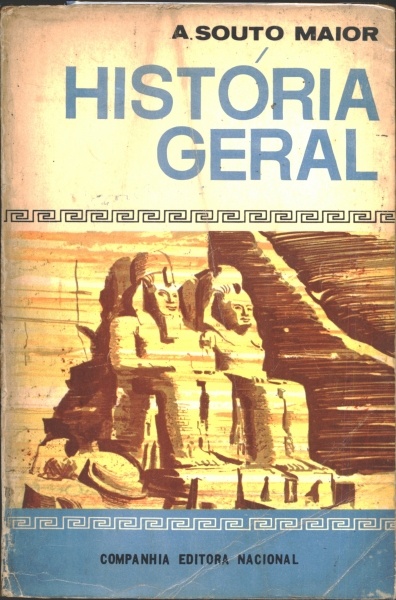
*The book in question is História Geral by A. Souto Maior, in Portuguese, and published in Brazil (7th edition, 1968).

Malady
  • 1,369
  • 13
  • 21
Brian Hellekin
  • 621
  • 5
  • 11
  • Very old? What would 1868 be, then? 968? 1968BC? – Martin Argerami Jan 01 '18 at 07:08
  • 1
    @MartinArgerami, indeed, a non-historian as me is not used to really very old books. I'll fix this little detail – Brian Hellekin Jan 02 '18 at 02:31
  • 1
    My family has an astronomy book dating to about 1850. Many of its ideas seem really quaint and old fashioned. – MAGolding Jan 02 '18 at 03:58
  • 1
    Brian Hellekin - I have read the diary of a relative from 1871. One of my favorite books as a child was Ellis, the Story of the Greatest Nations, 1914. I have sometimes done research on royal genealogies in the 1740 edition of James Anderson's Royal Genealogies. I have read in a rare book room a book listing all the Roman emperors - up to the one reigning when it was published! My idea of an old book may be somewhat older than yours. – MAGolding Jan 02 '18 at 04:10

3 Answers3

31

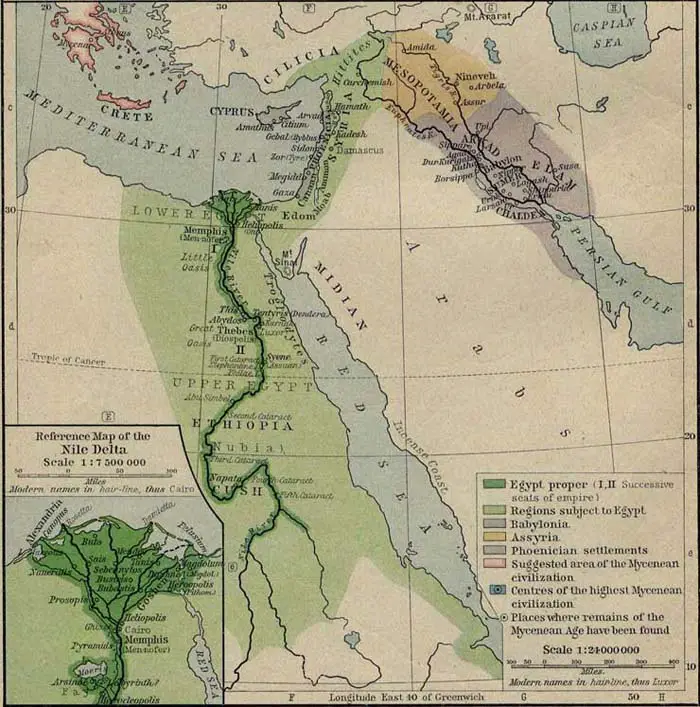
While researching for this question, I found more details about what could be this (possible) adventure. Necho II hired a fleet of Phoenicians, who supposedly sailed from the Red Sea around Africa back to the mouth of the Nile in in three years.

The voyage was related by Herodotus as a complete circumnavigation of Africa in his History:

According to Herodotus, Necho II ordered a Phoenician-crewed fleet to leave Egypt from the east by way of the Gulf of Suez and to return via the Straits of Gibraltar at the Mediterranean's western mouth. Hence, he expected this expedition to navigate around Africa counterclockwise [sic, actually this was clockwise]. This would be a long journey, in which the crew would help support themselves by establishing temporary settlements on land where they would cultivate crops during the voyage.

According to the story, after two full years the fleet eventually rounded the Pillars of Hercules (the Straits of Gilbraltar), and returned to Egypt during the course of the third year.

Besides Herodotus story, there is no evidence if this travel. According to Egyptologist Alan B. Lloyd, the voyage was quite unlikely, since:

Given the context of Egyptian thought, economic life, and military interests, it is impossible for one to imagine what stimulus could have motivated Necho in such a scheme and if we cannot provide a reason which is sound within Egyptian terms of reference, then we have good reason to doubt the historicity of the entire episode.

This site has a possible reconstruction of the voyage. Another discussion is this reddit thread, where the answerer mention Ciaran Branigan as a supporter of the actual existence of this travel, while being skeptical about the voyage due to the same reasons Alan Lloyd did, and the fact "Ptolemy's account of the world which contained all of the Western knowledge of geography from c. 150 AD, considered Africa as an endless Southern land mass", impossible to circumnavigate, in contradiction with this supposed journey.

However, these sources did not mention where comes the name "Hamon". But they mention a Carthaginian navigator, Hanno, who did another travel to Africa, now starting from the West, sailing to Gibraltar. According to Pliny the Elder, Hanno actually managed to circumnavigate Africa, but modern accounts consider they only got to the West African coast, in some point between Senegal or Gabon; the supposed primary source for this journey (a tablet which was later translated to Greek) ended with "For we did not sail any further, because our provisions were running short". It should be noted that the tablet was deposited in the temple of Baal Hammon, also know as Hamon, the chief god of Carthage. So, it's possible that the book confounded these two travels (since this last one was not related with the Egyptians).

Brian Hellekin
  • 621
  • 5
  • 11
  • 2
    The quote about navigating "around Africa counterclockwise" seems at odds with the description of returning through the straits of Gibraltar to the mouth of the Nile, which would be a clockwise voyage. – PhillS Dec 30 '17 at 12:09
  • @PhillS. Yes, "counterclockwise" is a mistake. – fdb Dec 30 '17 at 12:20
  • Yes, reading it again you are write. I extracted the quote from a site. Should I fix it, changing the similarity with the original version of the quote, or should I simply rewrite it? – Brian Hellekin Dec 30 '17 at 15:31
  • 3
    I think standard practice when quoting material that contains a mistake is to quote what it actually days, put [sic] next to the mistake (square brackets to indicate insertion by the editor, 'sic' is Latin for 'thus'). This indicates you are aware of the mistake and are quoting someone else's error knowingly. And add some explanation before or after the quote. – PhillS Dec 30 '17 at 19:21
  • 1
    @PhillS maybe ancient Egyptian clocks went another way :) – IMil Dec 31 '17 at 11:22
  • 1
    Neither Egyptions nor Greeks and what we call clock dials. Sundials in the northern hemisphere indeed have the shadow tip moving opposite to what we call clockwise. So if "counterclockwise" in the translation means "opposite to the direction of the shadow tip in a sundial", then it is correct--but that is opposite to what we mean by the term today. – Colin McLarty Jan 01 '18 at 11:46
13

This story depends entirely on Herodotus 4,42. The passage in question reads:

I wonder, then, at those who have mapped out and divided the world into Libya, Asia, and Europe; for the difference between them is great, seeing that in length Europe stretches along both the others together, and it appears to me to be wider beyond all comparison.[2] For Libya shows clearly that it is bounded by the sea, except where it borders on Asia. Necos king of Egypt first discovered this and made it known. When he had abandoned digging the canal which leads from the Nile to the Arabian Gulf, he sent Phoenicians in ships, instructing them to sail on their return voyage past the Pillars of Heracles until they came into the northern sea and so to Egypt. [3] So the Phoenicians set out from the Red Sea and sailed the southern sea; whenever autumn came they would put in and plant the land in whatever part of Libya they had reached, and there await the harvest; [4] then, having gathered the crop, they sailed on, so that after two years had passed, it was in the third that they rounded the pillars of Heracles and came to Egypt. There they said (what some may believe, though I do not) that in sailing around Libya they had the sun on their right hand.

As you can see, the Father of History was himself not certain about the truthfulness of the story.

fdb
  • 9,782
  • 2
  • 24
  • 41
  • Nor were scientists at the time and for centuries later. And then someone actually did it in the Age of Exploration, and it occurred to scientists a few centuries later that, yeah, they'd only have ever seen what happens in the sky if they had indeed circumnavigated Africa (Alex's response). Doubt in their days, yes; doubt nowadays, none. – Denis de Bernardy Dec 30 '17 at 18:24
  • @DenisdeBernardy - If there’s no doubt these days, why does the top answer seem so…doubtful? ;) – Obie 2.0 Dec 30 '17 at 21:55
  • 1
    @Obie2.0: Speaking as one that upvoted the latter, because it gives some of the backstory. – Denis de Bernardy Dec 30 '17 at 21:57
11

The strongest evidence that this voyage really happened is the sentence in Herodotes:

For my part I do not believe them, but perhaps others may-that in sailing round Lybia they HAD THE SUN UPON THEIR RIGHT HAND.

If the story is invented why anyone would invent such a weird detail? As we see, this was weird for an educated Greek in 5th century. Only later it became clear that when traveling around Africa (East to West) one will indeed see the Sun on the North (that is on ones right hand).

Alex
  • 38,884
  • 2
  • 83
  • 159
  • That is a good observation. What makes me suspicious is that H's story implies that there were no people in Africa (the Phoenicians had to disembark to grow their own food). – fdb Dec 30 '17 at 16:22
  • PS. I have replaced the translation by a more correct one. – fdb Dec 30 '17 at 16:23
  • 6
    No, it's NOT a weird detail. It is only necessary to realize that the Earth is a sphere, and travel as far south as Yemen (South of the Tropic of Cancer) in summer time, to have the Sun to your north. It is then immediately obvious that upon passing the Equator the ordinary north-south pattern will reverse. The Egyptian kingdom extended much further south than that, though clearly Herodotus' travels did not. – Pieter Geerkens Dec 30 '17 at 17:24
  • 1
    Eratosthenes of Alexandria, living only a few centuries after Herodotus, was aware that the Earth is spherical, and famously employed reasoning about how the motion of the sun looks from different points on the sphere to estimate the size of the Earth. He would certainly be able to predict that someone traveling sufficiently far south would see the sun in the north. There doesn't seem to be a good reason to assume this reasoning couldn't have been made in Herodotus's time -- so the detail could quite well be made up for realism, if not by Herodotus himself then by his sources. – hmakholm left over Monica Dec 30 '17 at 20:37
  • 1
    "only a few centuries":-) – Alex Dec 30 '17 at 22:59
  • @HenningMakholm. That the earth is a sphere was known long before the time of Herodotus. – fdb Dec 31 '17 at 09:50
  • 1
    @fdb: known to whom? Before Internet, the scientific theories did not spread so fast as they do not. – Alex Dec 31 '17 at 13:25
  • @HenningMakholm that the Earth is a sphere had to be discovered at some point: Man certainly didn't evolve knowing it... – RonJohn Dec 31 '17 at 17:19
  • @RonJohn: The Babylonians knew (prior to Herodotus) enough practical astronomy to develop the idea of the Sun being seen at a particular place among the fixed stars even though those stars are not actually visible at the same time the sun is. That implies the existence of observation techniques that would fully suffice for a seafaring people to notice that a plumb line at different places points to different points on the firmanent at the same time, and so the earth is at least not flat. From there, it is a rather small speculative leap to assume it is round, if not exactly spherical. – hmakholm left over Monica Dec 31 '17 at 18:09
  • ... And simply speculation the the earth may be round is sufficient to develop the hypothesis that at some places far enough south you will see the sun in the north -- which is all we need to conclude that Herodotus's detail can well have been thought up without anyone actually going there to experience it. – hmakholm left over Monica Dec 31 '17 at 18:12
  • @HenningMakholm "that would fully suffice for a seafaring people to notice..." yes, but did they notice? (More specifically, do we have evidence that they noticed?) – RonJohn Dec 31 '17 at 18:21
  • @RonJohn: The passage in Herodotus is positive evidence that someone either knew or suspected that the sun may appear in the north if you travel far enough south. This can either be because they speculated it is so, or because they went there to find out. You're trying to elevate absence of evidence for the former to evidence of absence, and therefore the latter must be true. That is not logically cogent, without any argument that it is unlikely that anyone may have speculated so at that time. – hmakholm left over Monica Dec 31 '17 at 18:36
  • Furthermore, there are references to navigating by the stars in the Odyssey. They're not particularly detailed, but they show that the idea of looking at the stars to find your way at sea must have existed at the time the Homeric epics were composed. This would not have been the case unless at least a rudimentarily working implementation of it was available, and the only way for that to work is to have a practical theory of the relation between local zenith/horizon and the celestial sphere being different in different places. – hmakholm left over Monica Dec 31 '17 at 18:49
  • @HenningMakholm "You're trying to elevate absence of evidence..." No. That's why I asked if we have any evidence, instead of saying, "we don't know it, therefore it didn't happen." – RonJohn Dec 31 '17 at 19:11
  • @RonJohn: It is still fundamentally misguided to require evidence for not finding a particular argument convincing. The burden of evidence is on the party who champions a positive claim (in this case the assertion that the journey described by Herodotus must have taken place because it was impossible for anyone to make it up). – hmakholm left over Monica Dec 31 '17 at 19:38
  • @HenningMakholm "The burden of evidence is on the party who champions a positive claim" Yes, like fdb's claim "That the earth is a sphere was known long before the time of Herodotus." – RonJohn Dec 31 '17 at 20:05