This is just about understanding Paul's theology -- which became the foundational theology of Christianity, which is the theology of the cross. If you understand the theology, you will understand what Paul did and did not do.
Summary of Paul's view on circumcision and observances
Galatians 2:16–3:3
Knowing that a man is not justified by the works of the law, but by
the faith of Jesus Christ, even we have believed in Jesus Christ, that
we might be justified by the faith of Christ, and not by the works of
the law: for by the works of the law shall no flesh be justified.
But if, while we seek to be justified by Christ, we ourselves also
are found sinners, is therefore Christ the minister of sin? God
forbid.
For if I build again the things which I destroyed, I make
myself a transgressor. For I through the law am dead to the law,
that I might live unto God.
I am crucified with Christ:
nevertheless I live; yet not I, but Christ liveth in me: and the life
which I now live in the flesh I live by the faith of the Son of God,
who loved me, and gave himself for me.
I do not frustrate the grace
of God: for if righteousness come by the law, then Christ is dead in
vain.
O foolish Galatians, who hath bewitched you, that ye should
not obey the truth, before whose eyes Jesus Christ hath been evidently
set forth, crucified among you?
This only would I learn of you,
Received ye the Spirit by the works of the law, or by the hearing of
faith?
Are ye so foolish? having begun in the Spirit, are ye now
made perfect by the flesh?
(KJV)
In this theology, you are dead - you are crucified with Christ -- and the life that was yours is now Christ's life. Your identity, your righteousness, your standing with God -- all come from Christ. The only observances or works that we need to do is to be crucified with Christ - to give up our earthly life by reckoning ourselves dead, to take up our cross and despise the flesh, so that Christ lives through us as eternal treasure in corruptible jars of clay.
Colossians 3:2–4
2 Set your affection on things above, not on things on the earth.
3 For ye are dead, and your life is hid with Christ in God. 4 When
Christ, who is our life, shall appear, then shall ye also appear with
him in glory.
In particular, all the requirements of the law from performing animal sacrifices to being circumcised or observing the sabbath are fulfilled by Christ living in you. It is not just the even numbered commandments or half the observances, but all the requirements are already satisfied. Note that Paul is not saying that circumcision is not an ordinance of God. But that Christ is the one who meets the requirement.
In that case, anything you do to try to fulfill the law with your own efforts is evidence that you despise the cross, because you believe that in this one area, you are not dead and still have some work of the flesh yet to do. That there is some hole or gap in Christ's sacrifice that requires you to resurrect yourself, climb down from the cross, and run around to accomplish some work in the flesh. And if you think about it, it really is quite insulting for someone to say, yes, that's great that God gave his son, but what will put me over the top is not eating a ham sandwich. That is the one thing Christ didn't fulfill.
Note that Paul's theology is much more involved, I gave the 101 version. Paul argues that the law itself kills us, as none of us can keep it. Once we are killed, the law does not apply to a dead man. Here Paul is pointing out that the purpose of the law is to teach us, and once the lesson is learned, we are left with the clear knowledge of our own death and inability to keep the law. In that point of utter hopelessness -- the "horror of Great Darkness" -- that is when Christ's mercy is seen. This was a theme of Luther's. Then Christ comes along to revive us by giving us his life (not resurrecting our own life, but receiving his life). This is what it means to be on the cross, as we see ourselves dead, Christ lives in us. All of this is "seen" through faith. Thus we are dead by the law, but made alive by Christ.
Answer to the question
Back to the question, Paul was very clear that observance of the law is not only useless, but can be a hindrance to the faith.
Galatians 5:2–3
2 Behold, I Paul say unto you, that if ye be circumcised, Christ shall
profit you nothing. 3 For I testify again to every man that is
circumcised, that he is a debtor to do the whole law.
But at the same time, he (and Timothy) made those token observances required in order to gain entrance to synagogues where he could teach and preach the gospel. But after his conversion, these observances weren't made to fulfill the law, but to gain entrance.
Galatians 5:6
6 For in Jesus Christ neither circumcision availeth any thing, nor
uncircumcision; but faith which worketh by love.
So this is a distinction about motivations. If he needed to chop off a finger to preach the cross, he'd do it, so a little foreskin was a a small price to pay. If a Nazirite needed a donation so that people would listen to him, he'd throw some coins at the Nazarite.
But just because he was willing to jump through some hoops doesn't mean he tolerated those that taught circumcision was still required by God of believers, either jews or greeks. Paul had enormous words of condemnation and ridicule for them e.g. he said "Let them be accursed" (Gal 1.8) and elsewhere, "I wish they'd cut the whole thing off!" (Gal 5.12)
Appendix on Synagogues and the role of Pharisees in Paul's day
If Paul is only doing some token observances to gain entrance to synagogues, this would not work if the synagogue was controlled by strict Pharisees that required full observance. Therefore for the above argument to make sense, we need to believe that there were synagogues that would accept token observances (and for that matter, that would accept Christians meeting in them). So let's dig into what is known about first century synagogues.
Originally synagogues weren't buildings, but groups of people:
The origin of the synagogue is shrouded in mystery, though most scholars would place its beginning in exilic times [...]
During Second Temple times the term “synagogue” referred both to a
group of people and/or a building or institution. Although these
notions are not mutually exclusive, it is quite probable that at its
inception the synagogue did not refer to an actual building but to a
group or community of individuals who met together for worship and
religious purposes
Despite the fact that the oldest synagogue inscriptions come from Egypt, we have no archaeological documentation of what they might have been like.[..]
it would seem, it was about a hundred years after the destruction of the Temple that the synagogue as building began to emerge as a central feature of Jewish communal life(1)
And specifically in Palestine, there is data to support the notion that most Synagogues were local governing bodies first and houses of worship second:
Richard A. Horsley argues that the synagogue, according to the gospels
and early rabbinic literature, denoted a village or town assembly.
This assembly met regularly and served primarily as the local
governing body. Thus worship was secondary, and the notion of a
building to house this assembly was decidedly tertiary. Since the
Pharisees did not belong to these assemblies, Jesus’ anti-Pharisaic
rhetoric shows him siding with local villages against outside,
Pharisaic influence.(4)
Thus the first synagogues were just local groups of jews meeting together - no more, no less. They would be controlled by the pharisees only to the degree that the Pharisees controlled the local jewish community. That is, only a minority of such diaspora synagogues would be so controlled during the period of Acts in question, which is what allowed Paul to preach in and convert many jews in synagogues as part of his ministry, whereas it would be unlikely that Paul could do this if that synagogue was controlled by Pharisees. See, e.g. Acts 13:
Acts 13:14-16, 42–44
14 But when they departed from Perga, they came to Antioch in Pisidia,
and went into the synagogue on the sabbath day, and sat down. 15 And
after the reading of the law and the prophets the rulers of the
synagogue sent unto them, saying, Ye men and brethren, if ye have any
word of exhortation for the people, say on. 16 Then Paul stood up, and
beckoning with his hand said, Men of Israel, and ye that fear God,
give audience. [...]
42 And when the Jews were gone out of the synagogue, the Gentiles
besought that these words might be preached to them the next sabbath.
43 Now when the congregation was broken up, many of the Jews and
religious proselytes followed Paul and Barnabas: who, speaking to
them, persuaded them to continue in the grace of God. 44 And the next
sabbath day came almost the whole city together to hear the word of
God.
Notice that it says "the rulers of the Synagogue" suggesting that this was a meeting of local jewish community leaders. It does not say "the rabbi".
But that's just one example, can we determine whether Synagogues were controlled by pharisees from other sources? Yes, for example looking at the architecture of synagogues that were discovered, we see examples of images and sculptures that were rabbinically forbidden, and thus would not be allowed in a Synagogue run by pharisees. This evidence is summed up by Levine(2):
The sages[Pharisees] were undoubtedly a factor in synagogue life that
probably tended to increase in the course of late antiquity.
Nevertheless, they certainly were not in control of the affairs of
that institution, neither in its administrative-political realm nor in
its religious-liturgical dimension. To put it very simply, on the
basis of rabbinic sources alone there is no way we could have imagined
the synagogues as archaeology has uncovered them.
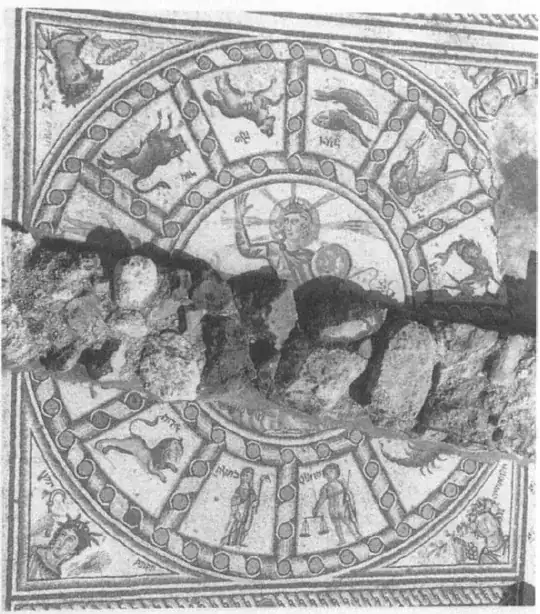
Moreover some Synagogues were discovered with pictures of Greek gods - e.g. the god Helios in this fourth century Synagogue in Tiberius, consistent with the view of the synagogue as a local meeting place of jewry rather than an institution of orthodox rabbinical practice:
What about pre AD 70? Given the dearth of synagogues, we look for other architectural features, again searching to see whether the building is in line with Pharisaic regulations. In his study on ritual baths, Benjamin Wright concludes(3):
One initial and very critical problem is the extent to which rabbinic
literature, primarily the Mishnah, can be used as evidence for pre-70
CE Jewish practice. Although it is almost obligatory to note the
difficulties connected with using the Mishnah as a witness to pre-70 [...] recent discussions have suggested that
even in their own periods the sages were (a) probably not very
numerous and (b) probably not able to compel significant numbers
outside of their own circles to comply with their interpretations of
Jewish Law. For the pre-70 period the legal regulations of the
Pharisees pose a similar problem, and there is much disagreement over
their particular interpretations, their influence among other groups
of Jews, and their continuity with the rabbinic sages. But even if
one could securely date certain rabbinic regulations to the pre-70
period, it is not likely that they would have been any more
influential at that time than during the flourishing of the rabbinic
sages who compiled them. Nevertheless, in some quarters these rabbinic
rules seem to be given a sort of interpretive hegemony over the
physical remains.
And also we can examine contemporary textual references:
Cohen’s contribution to this volume analyzes the evidence from the New
Testament and other early Christian writings. He finds that none of
these texts contain any unambiguous evidence indicating that the
Pharisees or the Rabbis were considered the leaders of synagogue
worship.(4)
I could give many other scholarly examples (5, 6), but the bottom line is that Rabbinic judaism as understood in the Talmud is a much later development than what happened during the ministry of Paul. Christianity, in general, is a much older religion that rabbinic judaism. During Paul's time, the pharisees were one sect among many sects and among hellenized jews, all living together, with many Christians meeting in local synagogues, especially in the diaspora but also in Palestine.
You will get an incorrect picture of the state of jewish life if you read the Talmud or mishna and assumed it described binding regulations that were practiced by a majority of the jewish population at the time. It was not until much later that that the descendants of the pharisees would seize control of jewish diaspora life, and even then, many of the rules and practices developed in the Talmud would be a surprise to the pharisees of Jesus' day, who at best would be described as a proto-rabbinical sect rather than as what we understand to be rabbis in the middle ages when the Talmud was completed and its dominant interpretations finalized.
Rabbinic judaism for the most part dates to the medieval era and was never given the opportunity to try to fulfill the law, nor can we backproject the talmud to the era of first century Christianity and use it to understand contemporary jewish objections to Paul's ministry: the primary reason why Christians were expelled from many synagogues was that local jewish leaders felt their power threatened, rather than any love for or adherence to, pharisaic interpretation of the law. We must avoid what Wright calls the "interpretive hegemony" of assuming that there were large numbers of pharisees following the mishna in Paul's day and enforcing those requirements on the population or on those who attended the Synagogues.
David Noel Freedman, ed., “Synagogue,” The Anchor Yale Bible Dictionary (New York: Doubleday, 1992), 251.
Lee I. Levine, “The Revolutionary Effects of Archaeology on the Study of Jewish History: The Case of the Ancient Synagogue,” in The Archaeology of Israel: Constructing the Past, Interpreting the Present, ed. Neil Asher Silberman and David Small, vol. 237, Journal for the Study of the Old Testament Supplement Series (Sheffield: Sheffield Academic Press, 1997), 185.
Benjamin G. Wright III, “Jewish Ritual Baths—Interpreting the Digs and the Texts: Some Issues in the Social History of Second Temple Judaism,” in The Archaeology of Israel: Constructing the Past, Interpreting the Present, ed. Neil Asher Silberman and David Small, vol. 237, Journal for the Study of the Old Testament Supplement Series (Sheffield: Sheffield Academic Press, 1997), 192.
Paul V. M. Flesher, “Review of Evolution of the Synagogue: Problems and Progress Edited by Kee, Howard Clark, and Lynn H. Cohick,” Journal of Hebrew Scriptures: Volume 3 (2000–2001).
Lee I. Levine, “The Nature and Origin of the Palestinian Synagogue Reconsidered,” Journal of Biblical Literature 115 (1996): 436.
Eric M. Meyers and Mark A. Chancey, Alexander to Constantine: Archaeology of the Land of the Bible, ed. John J. Collins, vol. 3, The Anchor Yale Bible Reference Library (New Haven; London: Yale University Press, 2012), 165.


