The Greek word παράδοσις (paradosis) means “tradition,” literally “the content of instruction that has been handed down” (BDAG). I’ve been told that certain translations of the New Testament only translate this word as “tradition” when it is used in a negative sense but as “teaching” or another word when it is used in a positive sense. I want to test this claim. Is that true?
Asked
Active
Viewed 458 times
1 Answers
11
No, it is not true. However, the NIV (2011) and NLT do translate παράδοσις (paradosis) as something other than "tradition" in 2 out of 3 positive uses, indicating there may be some bias here against using "tradition" in a positive sense (but not entirely).
Method
First I identified every use of παράδοσις (paradosis) in the New Testament (regardless of morphology). I found that it is used 13 times in 13 verses. Next I listed each verse in separate columns in the order in which they appear in a standard English Bible. I then determined whether each use was positive or negative. As this is subjective, I classified two verses (Mark 7:3 and Galatians 1:14) as “neutral,” i.e. not necessarily positive or negative. I personally think they can both be counted as negative usages based on their immediate contexts, but I classified them as neutral since these two verses in isolation could be considered positive. Positive uses have a green background, negative red, and neutral gray. I then listed 9 popular English translations in rows for comparison and wrote the word used to translate παράδοσις (paradosis) in each cell. The lemma is given without morphology in each instance. Instances that deviate from the standard translation (“tradition”) are accentuated in the table.
Results
The chart is shown below:
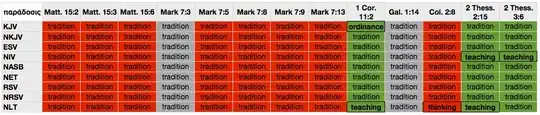
I know it is small and hard to see on this site. Since every instance before 1 Corinthians 11:2 uses the English word 'tradition' in the translations compared, here is an enlarged view of just those thereafter:
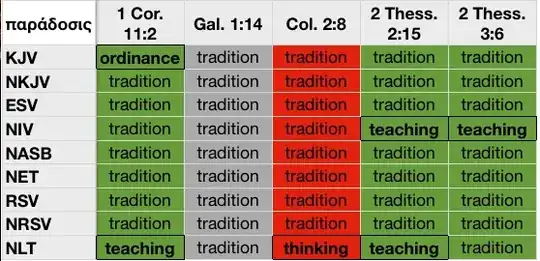
As can be seen, only three of the translations compared deviate from the conventional translation in any verse: the King James Version (KJV), the New International Version (NIV 2011 edition), and the New Living Translation (NLT). In every deviation, the word is used in a positive sense. However, no translation used in this comparison consistently translated the word as something other than “tradition” for every positive use (as was claimed).

Dan
- 8,925
- 6
- 58
- 115