In Gen. 4:26, it is written,
וּלְשֵׁת גַּם־הוּא יֻלַּד־בֵּן וַיִּקְרָא אֶת־שְׁמוֹ אֱנוֹשׁ אָז הוּחַל לִקְרֹא בְּשֵׁם יַהְוֶה
And a son was also born to Set, and he called his name, Enosh. Then ______ (הוּחַל) to call on the name of Yahveh.
Many Jewish commentators asserted that the phrase הוּחַל לִקְרֹא בְּשֵׁם יַהְוֶה means that men began to call their idols by the name Yahveh. Rashi wrote that the word הוחל was an expression of profanation (לשון חולין) and interpreted it as, "They began to call the names of men and the names of herbs in the name of the Holy One, blessed be He, in order to make themselves idols and call them 'gods.'"1 Rashi understood הוחל as being related to profanation (חולין) since the root ח-ל-ל, from which the verb הוּחַל is conjugated,2 means "to profane" when conjugated in binyan Pi’el.3
However, the meaning of a verb in a particular binyan does not necessarily transfer to other binyanim. Therefore, while חִלֵּל (chillel) - conjugated in binyan Pi’el - means "to profane," הֵחֵל (hechel) - conjugated in binyan Hif’il - means "to begin."4 Generally speaking, the meaning of a verb in binyan Huf’al - which is the binyan of the verb הוּחַל in Gen. 4:26 - can be determined by simply converting the meaning of the verb in binyan Hif’il to a passive voice.5 Thus, instead of "to begin" in binyan Hif’il, the meaning would be "to be begun" in binyan Huf’al.
However, contrary to Rashi, Avraham ibn Ezra wrote, והטעם שהחלו להתפלל, that is, "And the meaning is that they began to pray." He also notes, ואלו היה מחילול, היה השם סמוך אל המלה, that is, "And if it was from profanation, the noun [שם] would have been next to the particle [את]."6 Indeed, many examples from the Tanakh can be provided to support ibn Ezra's assertion.
In Lev. 18:21, we find the phrase וְלֹא תְחַלֵּל אֶת־שֵׁם אֱלֹהֶיךָ, meaning "and you shall not profane the name of your God." Here, we see the verb תְחַלֵּל ("profane"), followed by the particle אֶת which is joined to the noun, שֵׁם ("name"). This is the typical grammatical construction used in contexts which describe the name of God being profaned.7
On the other hand, in Gen. 4:26, we have the following construction:
הוּחַל לִקְרֹא בְּשֵׁם יַהְוֶה
- The verb הוּחַל (huchal) is conjugated in binyan Huf’al, 3rd person, masculine gender, singular number, perfect tense. Most translations (e.g., KJV) translate this with the subject "men," as in "men began to call," however the verb is not conjugated according to a plural, but rather a singular subject.
- The word לִקְרֹא (likro) is the infinitive conjugation of the root ק-ר-א conjugated in binyan Pa’al. It means "to call."
- The phrase בְּשֵׁם יַהְוֶה (beshem Yahveh) consists of the preposition בְּ (be-), meaning "in" or "on," prefixed to the noun שֵׁם (shem), meaning "name," and the Tetragrammaton יַהְוֶה. It is translated as "on the name of Yahveh."
Wilhelm Gesenius wrote this concerning the phrase קָרָא in his lexicon:
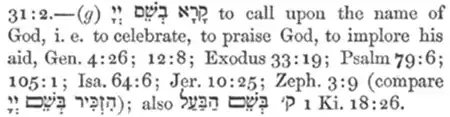
As Gesenius notes, phrases containing a conjugation of the verb קָרָא followed by בְּשֵׁם יַהְוֶה occur in numerous verses. For example, it is written that Avraham built an altar to Yahveh in the land between Beit-El and Hai, and then "he called on the name of Yahveh."8 He built an altar in the plain of Moreh, and then "he called on the name of Yahveh."9 He also planted a tamarisk tree in Be’er Shava and then "he called on the name of Yahveh."10 Yitzchak also built an altar in Be’er Shava, and then "he called on the name of Yahveh."11 As these examples are also in the Book of Genesis, there can be no doubt that they share the same meaning as the phrase in Gen. 4:26. Avraham ibn Ezra interprets the phrase in Gen. 12:8 as תפילה או קריאת בני אדם לעבוד השם, that is, "He praised [Yahveh], or [it was] a declaration of men to worship Yahveh."12
Similarly, 1 Chr. 16:8 states, "Give thanks to Yahveh; call upon His name; make His deeds known among the people."13 In Psa. 116:3, the psalmist "called upon the name of Yahveh" and said, "Please Yahveh, save my soul!" Thus, calling upon the name of Yahveh did not only involve giving thanks14 and worshipping Him15, but also making an appeal to and beseeching Him.16 Indeed, the prophet Yo'el prophesied,17
"And it shall come to pass, all who call upon the name of Yahveh shall be delivered, for in Mount Tzion and in Yerushalaim shall be deliverance, and in the remnant whom Yahveh calls," as Yahveh said.
וְהָיָה כֹּל אֲשֶׁר־יִקְרָא בְּשֵׁם יַהְוֶה יִמָּלֵט כִּי בְּהַר־צִיּוֹן וּבִירוּשָׁלִַם תִּֽהְיֶה פְלֵיטָה כַּֽאֲשֶׁר אָמַר יַהְוֶה וּבַשְּׂרִידִים אֲשֶׁר יַהְוֶה קֹרֵא
As most know, this prophecy was repeated by both the apostle Petros18 and the apostle Paulos19 to declare that men could be saved from their sins by calling on the name of the Lord Yeshu’a the Messiah. In the New Testament, the Hebrew phrase קָרָא בְּ- ("call upon") is translated into Greek by the verb ἐπικαλέω. We may then further deduce the various meanings of the Hebrew phrase by examining the usage of its Greek equivalent in the New Testament.
Upon his martyrdom, Stephen "calls on" Yeshu’a and says, "Lord, receive my spirit!"20 Before his conversion, the apostle Paulos persecuted Christians, those who "called on" the Lord Yeshu’a.21 Those being baptized would call on the name of the Lord Yeshu’a.22 The verb is also used to describe the apostle Paulos "calling on" ("appealing to") the Roman emperors.23
As for the verb הוּחַל, it should be translated as "had begun." But, what is the subject of the verb? It is certainly not "men," for such is nowhere stated in the Hebrew text, nor does the conjugation of the verb הוּחַל according to a singular subject permit it. Rather, the subject seems to be the infinitive itself, לִקְרֹא, "to call" or "calling."
Therefore, Gen. 4:26 should be translated as,
And a son was also born to Set, and he called his name, Enosh. Then, calling on the name of Yahveh had begun.
Footnotes
1 Commentary on Gen. 4:26. This view is also shared by the Targum of Yonatan ben Uzziel on Gen. 4:26.
2 הוחל is conjugated in binyan Huf’al, 3rd person, singular number, masculine gender, perfect tense.
3 cp. Lev. 21:12
4 cp. 1 Sam. 3:12
5 Gesenius notes that "the meaning of Hoph’al (also known as Huf’al) is (a) primarily that of a passive of Hiph’il (also known as Hif’il)... (b) sometimes equivalent to a passive of Qal (also known as Pa’al)..."; p. 146, §53h.
6 Commentary on Gen. 4:26.
7 cp. Lev. 19:12, 20:3, 21:6, 22:2, 22:32; Amos 2:7
8 Gen. 12:8
9 Gen. 13:4 cp. Gen. 12:7
10 Gen. 21:33
11 Gen. 26:25
12 Commentary on Gen. 12:8.
13 cp. Isa. 12:4
14 cp. Psa. 116:17
15 cp. Zep. 3:9
16 cp. Lam. 3:55; Zec. 13:9
17 Joel 2:32
18 Acts 2:21
19 Rom. 10:12-14
20 Acts 7:59
21 Acts 9:14, 9:21; cp. 1 Cor. 1:2; 2 Tim. 2:22
22 Acts 22:16
23 Acts 25:11-12, 25:25, 26:32, 28:19
References
Avraham ibn Ezra (אברהם אבן עזרא). The Commentary of ibn Ezra on the Torah (פירוש אבן עזרא על התורה).
Gesenius, Wilhelm; Robinson, Edward; Tregelles, Samuel Prideaux. A Hebrew and English Lexicon of the Old Testament including the Biblical Chaldee. London: Samuel Bagster and Sons, 1857.
Rashi (רש"י). The Commentary of Rashi on the Torah (פירוש רש"י על התורה).


