8

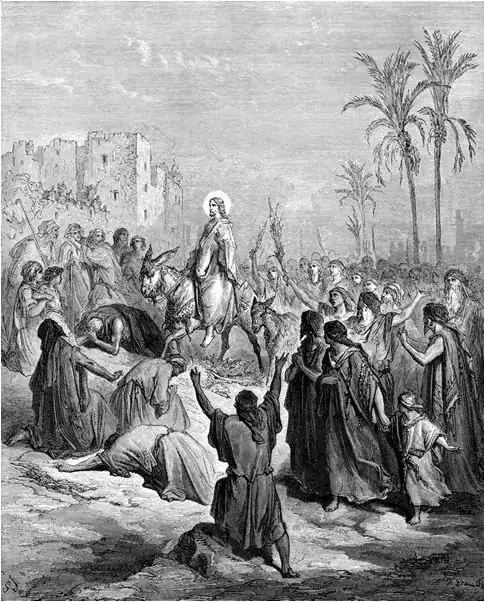
Jesus Enters Jerusalem - Gustave Doré 1832-1883

Jesus Enters Jerusalem - Gustave Doré 1832-1883

Triumphal Entry of the Messiah in Jerusalem

This is Zachariah’s famous vision/prophecy:

Rejoice greatly, daughter of Zion! Shout, daughter of Jerusalem! Look! Your king is coming to you: he is righteous and bringing salvation, humble and riding on a donkey, on a young donkey, the foal of a female donkey. (Zechariah 9:9 NET)

And this is Zachariah’s prophecy as quoted by Matthew:

"Tell the daughter of Zion, ‘Look, your king is coming to you, Lowly, and [kai] sitting on a donkey, and [kai] on a colt, the foal of a donkey.' " (Matthew 21:5 - NET)

Apparently, in his zeal, Matthew has misinterpreted the original Hebrew and/or the Greek translation. And this is the disconcerting result:

6 So the disciples went and did as Jesus had instructed them. 7 They brought the donkey and the colt and placed their cloaks on them, and he sat on them. (Matthew 21:6-7 NET - emphasis by MdS)

Either a physical impossibility, or something absurd and silly.

This, much more than the discrepancy with Mark, Luke and John, all speaking only of one donkey (Mark 11:7; Luke 19:35; John 12:14-15), is the real problem.


Can we reconcile Matthew's quotation of Zechariah with ... Zechariah?

Does Zechariah’s vision include one or two donkeys?

Miguel de Servet
  • 1,012
  • 7
  • 15

6 Answers6

4

Zechariah’s vision: one or two donkeys?

Answer: There were two donkeys, and for good reason.

First, we might recognize that all four Gospels refer to this event, that of Christ's Triumphal Entry into Jerusalem. Three of the gospels agree that Jesus rode on the colt. So, why does the Gospel of Matthew mention two?:

Matthew 21:5: “Say to the daughter of Zion, ‘Behold your King is coming to you, Gentle, and mounted on a donkey, Even on a colt, the foal of a beast of burden.’” (This passage actually appears as all caps — a quote from the Old Testament Books of Isaiah (62:11) and Zechariah (9:9).

There are those who will claim this is a biblical contradiction, but this ignores the proper meaning of Matthew while at the same time dismissing his complete thought as written. When Matthew states "a donkey" and then "on a colt, the foal of a donkey" may be quoting the text of Zechariah using parallelistic language as he repeats the same thought in a different form.

It should be clear that there is only one animal to be ridden, thus Matthew is demonstrating that Jesus rode only on a colt, which agrees with the other Gospels. However, Matthew 21:7 does state that the disciples "brought the donkey and the colt." So, why the two?

Well, as an immature animal, the colt was probably still heavily reliant on its mother, one too young to be separated from her. Note that the colt "had never been ridden" (Lk. 19:30). It, therefore, seems most plausible that the mother donkey was led along the path while the foal would naturally follow her — even though no man had ever sat on him.

Nor is it likely that this young colt had been trained to walk along a road alone.

The other Gospels fail to complete the full picture: Matthew's account paints a more thorough tapestry, perhaps as the only eye witness to the event. (We may never know that for certain.)

Xeno
  • 9,218
  • 3
  • 27
  • 82
  • This is how John 12:14-15 reads: Jesus found a young donkey and sat on it, just as it is written, “Do not be afraid, people of Zion; look, your king is coming, seated on a donkey’s colt!”. What does it mean, “The one missing reference to two animals appears in John 12:14-15”? – Miguel de Servet May 30 '21 at 02:43
  • “We may never know that for certain.” What reasonable explanation can be given, other than Matthew was “the only eye witness to the event”, among the evangelists? – Miguel de Servet May 30 '21 at 02:49
  • @MigueldeServet Basically, if we suggest Scripture contains errors "here and there," then it is not inspired. I could then find no reason to believe it. What I tried to say was this: "an immature animal, the colt was probably still heavily reliant on its mother, one too young to be separated from her. Note that the colt 'had never been ridden' (Lk. 19:30). It, therefore, seems most plausible that the mother donkey was led along the path while the foal would naturally follow her." The fact that we have trouble discerning God's Word is not His fault, it's our misinterpretation of the texts. – Xeno May 30 '21 at 03:14
  • Interesting point about the colt needing its mother--that seems quite plausible. Good use of parallelism, upvoted +1 – Hold To The Rod May 30 '21 at 03:27
  • Xeno, you have used many words, but have not answered my question in my comment: what does this sentence mean: “The one missing reference to two animals appears in John 12:14-15.”? – Miguel de Servet May 30 '21 at 06:39
  • @MigueldeServet Allow me to try this: Matthew 21:7: "[And] brought the [mother] donkey and the colt, and laid their coats on them; and He sat on the coats" (NASB). It is unnecessary for Zechariah to explain the mother donkey when Christ sits on the colt. Yet, he (Zech.) does mention Christ riding on a donkey the foal of a female donkey". Why add "female donkey" when all animals are the offspring of their mothers? Perhaps I'm just missing something more in your question? – Xeno May 30 '21 at 14:17
  • Xeno, if for some reason you can't/won't answer my question, say so. Otherwise, my question is still waiting for a credible answer: what does this sentence mean, “The one missing reference to two animals appears in John 12:14-15.”? – Miguel de Servet May 30 '21 at 21:26
  • Xeno As for why Zechariah specifies that the male donkey (ḥămōwr) is, in fact a colt (‘ayir), the foal of a she-ass (ben’ăṯōnōwṯ), certainly not what one would call a "beast of burden", my educated guess is that Zechariah is expressiong his surprise at his own prophetic vision. – Miguel de Servet May 30 '21 at 21:27
  • 1
    @Miguel I only just now read your comments. Matthew is intensely interested in prophecy (Zech. 9:9 here) being fulfilled. He states that the animals were a donkey (mother) and a foal (baby) that Jesus rode. Yes, the other Gospels relate only one donkey. Often, each Gospel writer gives us their unique perspective. Matthew was present at the T/Entry and saw two donkeys: Mark and Luke were not. Only he and John mention the donkey(s) as O/T fulfillment. If you're concerned about discrepancies, spend a night reading resolutions to such "conflicts" and you will quickly discover there are none. – Xeno May 31 '21 at 01:55
  • By the way, I've restated my response to accommodate your concern. I'm not sure why that hadn't occurred to me sooner. – Xeno May 31 '21 at 02:00
  • Xeno, now that you have, at last, removed that sentence from your Answer (“The one missing reference to two animals appears in John 12:14-15.”), I have no objections: Zechariah, and Matthew with, him talk of two donkeys (the colt and its mother), but only the colt is ridden by Jesus. – Miguel de Servet May 31 '21 at 03:54
2

It's interesting how much depends upon a single conjunction.

In both the Hebrew & Greek texts of Zechariah, "donkey" (or a generic beast of burden) is mentioned twice. What is less clear is whether the conjunction implies an extra donkey.

The Hebrew gives us: a donkey "wə-‘al-" a colt...

The Greek: a beast of burdern "kai" a colt...

What do these conjunctions mean? They can and sometimes are used to mean "and".


"wə-‘al-" (וְעַל־) can be used to mean "upon" or it can mean "in addition to" (and other things less relevant to our analysis, see Hebrew source cited above). That leaves both of these options open:

  • Zechariah speaks of both a mother and a foal donkey
  • Zechariah speaks of just one donkey, first identifying it as a donkey and then further clarifying that it's a foal

"kai" is used to mean "and" all the time, but some translators have suggested a better rendering here is "even" (see Greek source cited above), once again leaving both of these options open:

  • Zechariah speaks of both a mother and a foal animal
  • Zechariah speaks of just one animal, first identifying it as a beast of burden and then further clarifying that it's a foal

The text of Zechariah is just malleable enough that one or two donkeys are both plausible-It is entirely possible that modern translators have been influenced by the New Testament in how they render these words of Zechariah. In fairness to the Septuagint, though, "kai" as "and" is very straightforward, and I suggest it is to be preferred.

How did a first century Jew understand the passage?

Perhaps the most helpful data point on how this passage was understood is how Matthew himself took it--Matthew clearly understood that the reference was to two donkeys. Matthew 21:5 preserves the "kai", which is most clearly rendered as "and", especially considering that in verse 2 Matthew has explicitly told us there are two donkeys.

Authorial intent

Matthew wrote to Jews to show them that Jesus was the Messiah, and so it comes as little surprise that he quotes the OT (and points out fulfilment of its prophecies) more often than do the other Gospels (Mark & Luke wrote to Gentiles, and John apparently wrote to seasoned Christians of all backgrounds).

Since the other Gospel authors were less focused on tying events to OT prophecy, I see no difficulty believing that there were two donkeys, but Mark, Luke, and John don't bother to mention the second one, since Jesus didn't actually ride upon it. Matthew only mentions the second one because the Zechariah connection is so important to him and his audience.

Therefore, I propose that Matthew's interpretation of the OT is most likely to be precise, and the two donkey interpretation is to be preferred.

Conclusion

How many donkeys were in Zechariah's vision? Probably two.

How many donkeys were present at the triumphal entry? Probably two.

Hold To The Rod
  • 17,456
  • 2
  • 30
  • 92
  • 1
    I propose that Matthew's interpretation of the OT is most likely to be precise, and the two donkey interpretation is to be preferred. +1 – Miguel de Servet Jun 04 '21 at 07:35
1

When I tried the title of my question, I must have missed two questions (with relative answers) that were quite close to mine:

I am not sure whether @RevelationLad got it right, or simply overdid it, seeing a connection between Zechariah' vision, Matthew's account of Jesus' Triumphal Entry at Matt 21:1-10 and Genesis 49:11.

Anyway, for what it is worth, I will provide my analysis of Zechariah's text (both Hebrew and LXX Greek) and Matthew's texts. May be there will be reasonable evidence that

  1. Zachariah's vision was a real prophetic vision of future events.
  2. Matthew was a real witness to those events.

A typical "explanation" that we often read, for two donkeys being mentioned, is that Matthew did not translate Zechariah 9:9 from the original Hebrew, but quoted it from the LXX Septuagint, which apparently makes exactly the same “mistake” as Matthew, viz. of mentioning two donkeys (see Zechariah 9:9 HEBREW vs LXXM).

Some may claim that there are differences between Matthew and the Septuagint, but a careful comparison of the texts shows that the differences between Matthew and the Septuagint are not relevant, and they can be explained. Let’s order the two Greek texts (transliterated) by corresponding stich (source Zechariah 9:9 – NET; Matthew 21:5 – NET):

  1. [LXX] Idou o basileus sou erchetai soi (See, your king comes to you)
    [Matt] Idou o basileus sou erchetai soi (See, your king comes to you)
    [NOTE] Identical

  2. [LXX] dikaios kai sozwn autos (righteous and having salvation)
    [Matt] MISSING
    [NOTE] stich entirely missing in Matthew: perhaps a copying error, quite common;

  3. [LXX] praus kai epibebekos epi hypozygion (meek and riding on an ass [lit. “beast of burden”])
    [Matt] praus kai epibebekos epi onon (meek and riding on an ass)
    [NOTE] the “beast of burden” of LXX has been shifted to stich no.4 in Matthew

  4. [LXX] kai pwlon neon (and a young colt)
    [Matt] kai pwlon uion hypozygiou (and a colt, the foal [lit. “son”] of an ass [lit. “beast of burden”])
    [NOTE] see NOTE at stich no.3

It is also possible that both Matthew and the Septuagint translators were working from a different Hebrew original than the one which made its way into the Masoretic text (this would be confirmed by similar parallel findings at Qumran). But the main point remains that LXX and Matthew, to a large extent, mirror each other. This happens only with Matthew, and not with Mark and John, or with Luke (only John, besides Matthew, briefly quotes Zachariah 9:9)

From the above analysis, the similarities between Matthew’s and the Septuagint’s rendering of Zechariah’s 9:9 far outweigh discrepancies:

i. LXX has hypozygion (“beast of burden”) in stich no.3 and Matthew in stich no.4, whereas they both have pwlon (“colt”) exactly in the same position,

ii. Only Matthew uses onon (“ass”, generic, without explicit reference to sex), but this may be Matthew’s choice to specify clearly that it is an “ass”, and not, generically a “beast of burden”. In fact, by using the Greek word for “ass”, rather than the LXX “beast of burden”, Matthew may want to underline that in fact the “beast” upon which Jesus rides, being a “young colt”, is not yet, properly speaking, a “beast of burden”.

iii. Only Matthew uses uion (lit. “son”), but Matthew's pwlon uion hypozygiou is much more accurate, as a direct reference to Zacharia's ‘ayir ben’ăṯōnōwṯ than the LXX's pwlon neon (the Greek neon - “young” - of the LXX has been probably introduced copying from an earlier Greek ms). [Edited June 3, 2021 11:30 CET]

What is unique to LXX and to Matthew, with respect to the Hebrew Zachariah 9:9, is that while Zachariah 9:9 apparently speaks of ONE donkey (“riding on an ass, on a colt, the foal of an ass”), both LXX and Matthew speak of TWO donkeys (“riding on an ass, and on a colt, the foal of an ass” - a physical absurdity-impossibility). This is even more remarkable, bearing in mind that neither Mark, nor John, nor even Luke follow the LXX and Matthew in the same apparent “mistake” or absurdity.

I believe that NOT ONLY my attempt at explaining the Matthean oddity (of “riding on two donkeys”) by recourse to the LXX is perfectly reasonable and satisfactory, BUT ALSO that, if one chooses not to resort to this explanation, one ends up in really deep waters as to why Matthew (and ONLY Matthew, NOT Mark, Luke and John) would have consciously reported this awkward image of the Messiah riding on TWO donkeys.

It would seems reasonable to assume that Matthew drew his Zechariah 9:9 from a Hebrew text with “two steeds” similar (but perhaps not identical) to the one used as a basis for the LXX.

And it is precisely at this point that the visionary nature of Zachariah’s prophecy at Zech 9:9 appears.

Zechariah’s "gradual" Vision

Let’s suppose that the prophet Zechariah had a gradual vision of the Messiah and of two donkeys, an ass and her colt, and of the Messiah riding on the colt, possibly tied to his mother. Let’s examine again the LXX translation of Zechariah 9:9, stich by stich (ST1:ST4)

Let's suppose that Zechariah, in the fuzziness of the vision, first saw the Messiah:

[ST1] “Behold, your king comes to you”

Then, like in a film, closing in on the Messiah, he had a strong impression of his majestic aspect:

[ST2] “righteous and having salvation”

Then the image “expanded” and he saw that the Messiah was humbly riding an ass:

[ST3] “meek and riding on a he-ass” [Hebrew: חֲמוֹר chamowr <H2543>, masculine (“he-ass”)]

We can perceive here that the vision is confused, that the seer “knows” there is more to the vision, and yes, he realizes that, in fact there are two animals, a colt (“young male he-ass”) [Hebrew: עַיִר ’ayir <H5895>] and its mother, a she-ass [Hebrew: אָתוֹן 'athown ]:

[ST4] ”and [on] a colt, the foal [lit. “son”] of a she-ass”.

Note on the Vision

More comments on “Zechariah’s Vision”.

i. The uncertainty and “graduality” of the vision is hinted at by the Hebrew prefix conjunction we (“and”), before רָכַב rakab <H7392> (“riding”), which makes it appear as וְרֹכֵ֣ב (we-rakab) and repeated before the conjunction עַל ’al <H5921> (“on”, “upon”), which makes it appear as וְעַל(we-‘al).

ii. The LXX translates perfectly the Hebrew text of Zechariah 9:9, because the Greek conjunction καί (kai <G2532>), here, bears NOT the meaning of “and” BUT of “even”.

iii. The two English translations that are most faithful to the Hebrew text are NASB and NLT. They are the only ones that NEITHER omit the second vav/we (the one before עַל ’al <H5921> “on”, “upon”, which transforms it into וְעַל- we-‘al), NOR translate it (as the KJV does) with a misleading “and”, BUT correctly express the sense of surprise proper of the vision with “even”.

Matthew's awkward verse 21:7

Now that the quotation of Zehariah's vision is dealt with, Matthew proceeds on his own, and we can safely say that what he writes at verse 7 ...

They brought the donkey and the colt and placed their cloaks on them, and he sat on them. (Matt 21:7 NET)

... is awkwardly phrased

There is no doubt that the Greek phrase ἐπέθηκαν ἐπ’ αὐτῶν τὰ ἱμάτια (“[they] placed their cloaks on them”), which obviously refers to BOTH animals, is already confusing enough, even if not wrong.

But the last part of the sentence, καὶ ἐπεκάθισεν ἐπάνω αὐτῶν is more than just confusing, because:

  1. ἐπικαθίζω (epikathizô <G1940>) is used only once in the whole NT, at Mat 21:7. And we do not fare much better considering Greek literature in general. The most authoritative Liddle-Scott A Greek-English Lexicon records only 6 (six) occurrences for ἐπικαθίζω throughout ancient Greek Texts (approx 5 million words). Besides epikathizô can be both transitive and intransitive, and, because the 3rd person singular is identical to the 3rd plural, ἐπεκάθισεν ἐπάνω can be translated equally as “[they] sat [him] thereon” (KJV) or as “he sat on top them [the cloaks ...]”: they are both equally legitimate, and the grammar does not allow to decide.

  2. ἐπάνω (epano <G1883>) means “above”, “on top” as adverb, but it can be also preposition + GEN. This is certainly the case at Mat 21:7, where αὐτῶν is the GEN. plural of αὐτός (autos <G846>).

  3. αὐτῶν (autos <G846>), being a pronoun, could refer to the immediate noun (which is more grammatically correct), therefore refer to the ἱμάτια (“cloaks”), or refer to more remote nouns (less common and also less correct), τὴν ὄνον καὶ τὸν πῶλον (“the ass and the colt”)

In conclusion, the most probable meaning of καὶ ἐπεκάθισεν ἐπάνω αὐτῶν is ...

“and [Jesus] sat on top of them [the cloaks]”

... BUT Matthew has phrased it so awkwardly that, from a lexical-grammatical POV, it could equally well mean “they sat [him] on top of them [the ass and the colt]”. Which, of course, would be total nonsense, even if ... this is precisely what the KJV does.


May 30, 2021 22:50 CET

Edited to add, after the comments of @RevelationLad.

For completeness' sake and clarity, I have added herebelow the two stichs at the beginning of Zechariah 9:9. Also, I have added, at the beginning of the analysis of each stich of the verse, the transliterated Hebrew text of Zechariah 9:9 and the relative translation.

-1.[HEB] gîlî mə’ōḏ baṯ-ṣîyōwn (Rejoice greatly, daughter of Zion)
[LXX] chaire sphodra, thygater Siōn (Rejoice greatly, daughter of Zion)
[Matt] eipate tē thygatri Siōn (tell the daughter of Zion)
[NOTE] HEB and LXX are identical. Matthew does not have the "Rejoice greatly"

0.[HEB] hārî‘î baṯ yərūšālim, (Shout, daughter of Jerusalem)
[LXX] kērusse thyrater Ierousalēm (Shout, daughter of Jerusalem)
[Matt] MISSING
[NOTE] HEB and LXX are identical. Matthew is missing the entire stich

1.[HEB] hinnêh malkêḵ yāḇōw' lāḵ (See, your king comes to you)
[LXX] Idou o basileus sou erchetai soi (See, your king comes to you)
[Matt] Idou o basileus sou erchetai soi (See, your king comes to you)
[NOTE] Identical

2.[HEB] ṣaddîq wə·nōwōšā‘(righteous and having salvation)
[LXX] dikaios kai sozwn autos (righteous and having salvation)
[Matt] MISSING
[NOTE] HEB and LXX are identical. Matthew is missing the entire stich

3.[HEB] huw' `aniy wə·rōḵêḇ ‘al-ḥămōwr (he [is] lowly and riding on a [he] donkey)
[LXX] praus kai epibebekos epi hypozygion (meek and riding on an ass [lit. “beast of burden”])
[Matt] praus kai epibebekos epi onon (meek and riding on an ass)
[NOTE] the “beast of burden” of LXX has been shifted to stich no.4 in Matthew

4.[HEB] wə·‘al-‘ayir ben’ăṯōnōwṯ (and [=>even] a he-ass, son of she-asses)
[LXX] kai pwlon neon (and [=> even] a young colt)
[Matt] kai pwlon uion hypozygiou (and [=> even] a colt, the foal [lit. “son”] of an ass [lit. “beast of burden”])
[NOTE] see NOTE at stich no.3

In conclusion, the comparison of HEB-LXX-MATT confirms that:

  • The Greek text of the LXX corresponds word for word to the Hebrew text HEB, except that, at stich 3, we have "beast of burden" instead of "he-donkey"; at stich 4 we have "young colt" instead of "he-ass, son of a she-ass", and (specularly to stich 3) the "she donkey" instead of the "beast of burden".

  • Matthew quotation of Zechariah 9:9 is rather "free": in particular, stich -1 has "tell the daughter of Zion" instead of "Rejoice greatly, daughter of Zion"; stichs 0 and 2 are completely missing; stich 3 corresponds perfectly to HEB;
Miguel de Servet
  • 1,012
  • 7
  • 15
  • you say "The LXX translates perfectly the Hebrew text of Zechariah 9:9." However, as far as I can determine, אָתוֹן is rendered as ὑποζυγίων in Judges 5:10 and everywhere else using ὄνος sometimes with θῆλυς. Also if you believe the LXX is a perfect rendering, then the exceptional treatment of אָתוֹן is best explained by identifying two separate animals. 2) Your answer has these phrases: "Let’s suppose that the prophet Zechariah had a gradual vision… Let's suppose that Zechariah, in the fuzziness of the vision, first saw the Messiah… We can perceive here that the vision is confused...".....
  • – Revelation Lad May 30 '21 at 08:30
  • Your exegesis could be improved by sticking to the text and avoiding interpretation requiring such speculation, unless you can offer scholarly or Rabbinic support for this approach. – Revelation Lad May 30 '21 at 08:33
  • @RevelationLad 1) I have introduced in my Answer an "Edit to add" (May 30, 2021 22:50 CET), which confirms that "The LXX translates perfectly the Hebrew text of Zechariah 9:9". The Greek ὑποζυγίων in the LXX for Judges 5:10 is a paraphrase ("beast of burden"), the same one that LXX resorts to in stich 3 and Matthew in stich 4. θῆλυς (Strongs 2338Strongs 2338 simply means "female" and it is a qualifier of the sex of the generic ὄνος . My answer makes it clear that there are Two Donkeys: the colt and its mother. – Miguel de Servet May 30 '21 at 21:02
  • 2) I am not resorting to “speculation”: I am simply taking seriously the notion of prophetic vision: you may examine its merit, and reject it if you find fault with it. To ask me to offer “scholarly or Rabbinic support”, instead, means that you trust authority more than you trust reasonable argument – Miguel de Servet May 30 '21 at 21:03
  • "Only Matthew uses uion (lit. “son”), but that can be easily explained (it is witnessed in Greek codices as a mistaken copy of neon - “young”)." Matthew's πῶλον υἱὸν is a much better translation of the Hebrew than πῶλον νεον. νεον is rarely used with animals. – Revelation Lad Jun 03 '21 at 08:26
  • @RevelationLad After my Edit to add of May 30, 2021 22:50 CET, consequent to your comments, I realized see Matthew's pwlon uion hypozygiou is much more accurate, as a direct reference to Zacharia's ‘ayir ben’ăṯōnōwṯ than the LXX's pwlon neon – Miguel de Servet Jun 03 '21 at 08:55
  • The HEB-LXX-MATT together is very helpful; I had not appreciated just how closely the LXX mirrors the HEB here. Upvoted +1 – Hold To The Rod Jun 06 '21 at 00:30
  • 1
    @HoldToTheRod The key word is, respectively the Hebrew conjunction וְ (), and the correspondent Greek conjunction καὶ (kai) in stich n.4, and whether to translate it as “and” (senseless) or “even” (makes sense). Of course some people prefer to reject the role of witness of Matthew, and claim that he misunderstood Zechariah 9:9 … – Miguel de Servet Jun 06 '21 at 05:23
  • @HoldToTheRod For the full (laborious) account, see this chat :) – Miguel de Servet Jun 06 '21 at 05:41
  • @HoldToTheRod Do you have access to BDAG (2000) p. 900 and what it says on πῶλος? I would like to see how it compares with LSJ and Strong’/Thayer’s. Thank you :) – Miguel de Servet Jun 06 '21 at 05:53
  • @Miguel I appreciate your interest in tying things back the Synoptic Problem, I find this very interesting as well - it can sway assumptions considerably. Unfortunately I don't currently have access to a BDAG 2000; my membership at the local theological library lapsed during the pandemic =( . BDAG is good, but sometimes the lexicons disagree. One dissent I occasionally take from BDAG is the penchant for claiming that a word always means xyz in the NT, even when there are other known usages in ancient literature. I think these types of claims are often not theologically neutral. – Hold To The Rod Jun 07 '21 at 17:43
  • 1
    @HoldToTheRod I think these types of claims are often not theologically neutral. Hear hear ... and thank you :) – Miguel de Servet Jun 07 '21 at 17:58