"In that day," declares the Sovereign Lord, I will make the sun go down at noon and darken the earth in broad daylight. Amos 8:9
What 'day' is Amos referring to?
"In that day," declares the Sovereign Lord, I will make the sun go down at noon and darken the earth in broad daylight. Amos 8:9
What 'day' is Amos referring to?


While I am almost persuaded by the suggestion that the "day" of Amos 8:9 could be 2 August, 2027 -- which I note will be a Bank holiday in Scotland (significant?)1 -- there is a "real" answer to this question:
Thesis : The "day" described in Amos 8:9 is the same "day" as described in Amos 5:18 (so, for the moment, simply setting one single verse along side another). That is, (my suggestion): the "Day of the LORD" in Amos is found both in 5:18 and in 8:9.
This might seem obvious and underwhelming. In fact, in scholarly discussions of the "Day of the LORD", Amos 8:9 is routinely overlooked, and I think there are two reasons:
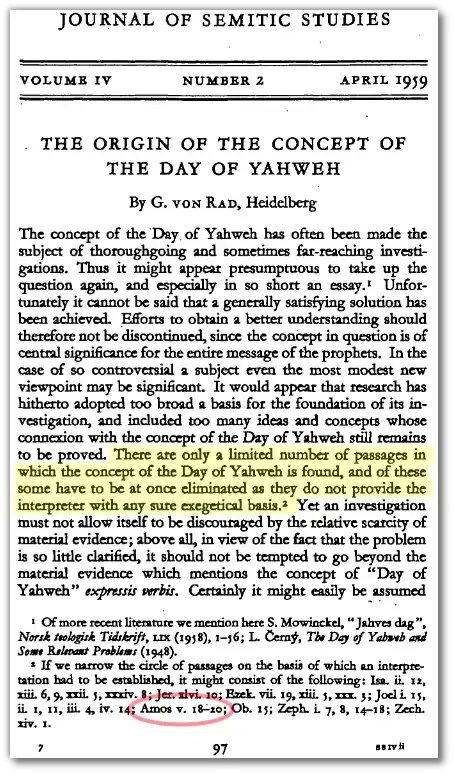
Put these two factors together, and Amos 8:9 has dropped off the radar for thematic thinking about the "Day of the LORD".
Not everyone believed von Rad, and even at his time of writing there was an alternative hypothesis: that the "Day of the LORD" was related to the festival life of Israel (rather than, primarily, to "holy war" traditions as von Rad argued). This suggestion is most closely related to the name of the Norwegian scholar, Sigmund Mowinckel.3
One good place to see this conjunction at work (of the "day" with the "festival of the Lord"), is Hosea 9:5 (see context, too):
What will you do in the day of solemn assembly,
and in the day of the feast of Yahweh?
Add in the (probably later) Joel references to the Day, for example, Joel 1:14-15:
14 Sanctify a fast. Call a solemn assembly.
Gather the elders, and all the inhabitants of the land,
to the house of YHWH, your God, and cry to YHWH.
15 Alas for the day! For the day of Yahweh is at hand,
and it will come as destruction from the Almighty.
The context is clearly the harvest here, with its associated festival (see also the wider context in Joel, and 2:1-2; 3:13-15 for the other Joel "Day" passages -- context important in each case).
Once this set of connections begins to register, the resonances between Amos 5:18 and context, and Amos 8:9 and context take on greater signficance:4
+--------------------------------------------+----------------------------------------------------+
|                Amos 5                      |                     Amos 8                         |
+--------------------------------------------+----------------------------------------------------+
| 18 “Woe to you who desire the day of YHWH! | 9 It will happen in that day,” says the Lord YHWH, |
| Why do you long for the day of Yahweh?     | “that I will cause the sun to go down at noon,     |
| It is darkness, and not light. …           | and I will darken the earth in the clear day.      |
| 21 I hate, I despise your feasts,          | 10 I will turn your feasts into mourning,          |
| and I can’t stand your solemn assemblies.  | and all your songs into lamentation;               |
| 22 Yes, though you offer me your           | and I will make you wear sackcloth on all your     |
| burnt offerings and meal offerings, I will | bodies, and baldness on every head.                |
| not accept them; neither will I regard     | I will make it like the mourning for an only son,  |
| the peace offerings of your fat animals.   | and its end like a bitter day.                     |
+--------------------------------------------+----------------------------------------------------+
Putting all this together, I find the this conjunction of themes compelling, and think that Amos's first use of the "Day" motif in ch. 5 was not his last or only use, but that it was re-employed and developed in ch. 8 as well.
This might not be quite the answer the OP was after (and 2 August 2027 might be closer to the mark!). I happen to believe this is the right answer, though, even if it now leads us to pose another one, digging deeper into the nature of "the Day of the LORD" itself. ... But that's a different question.
NOTES
It is almost too easy of a question. As Amos "sees" the word of the Lord, there is a chronology throughout the vision. The condemnations pronounced are not only directed toward Israel, but also to her enemies.
In all the judgment statements throughout the prophets, we find this statement, "In that day..." over 100 times. The chronology is simple. 1. God announces the end of His patience is here. 2. You heard my message - Time to repent 3. You did not listen to my message 4. Now Israel and her enemies will feel the full impact of My wrath 5. The in that day statements are for both the good news and the bad news. 6. It is a starting point of either finality or new beginning. 7. Once the wrath of the Lord has been poured out in full, He will renew His relation with those who follow His will. 8. Some of these events can be followed in secular historical accounts (Fall of both Samaria and Jerusalem, for example)


