Acts 22:16:
ἀναστὰς βάπτισαι καὶ ἀπόλουσαι τὰς ἁμαρτίας σου, ἐπικαλεσάμενος τὸ ὄνομα αὐτοῦ. (NA28)
Rising, be baptized and wash away your sins, calling on his name. (mine)
We have four verbs:1
- ἀναστὰς = participle from ἀνίστημι (to rise)
- βάπτισαι = imperative from βαπτίζω (to baptize)
- ἀπόλουσαι = imperative from ἀπολούω (to wash)
- ἐπικαλεσάμενος = participle from ἐπικαλέω (to call)
Each participle is grammatically dependent on a finite verb. I think it would be fairly uncontroversial to pair each with its proximate imperative (i.e. 1 depends on 2; 4 depends on 3). As the Accordance syntax module has it (red numbers mine):2
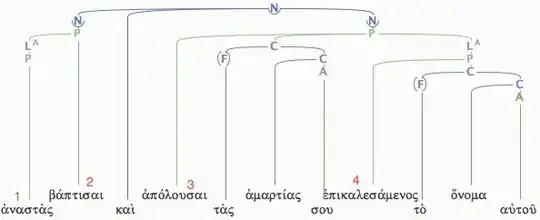
To deal with the pairs sequentially:
- ἀναστὰς βάπτισαι
The first pair is fairly transparent. This use of the ἀναστὰς before a finite verb is idiomatic. In this case the participle
serves an introductory function, doing little more than preparing the reader for the main action.3
Although this usage was known in ancient Greek (the above comment refers to Greek literature), its over-representation in Luke-Acts4 probably reflects Luke's habit of Septuagintalizing, ἀναστὰς being the standard LXX translation of the introductory qûm [lēk]....5 This first pair, then, just means, "get baptized".
- ἀπόλουσαι ἐπικαλεσάμενος
We can be confident that these two verbs "go together" ("wash away, calling..."). However, this doesn't necessarily entail that the calling effects the washing of sins as suggested in the question. A "participle of means" is indeed one common use of the participle and may be the sense here, but a simple temporal sense is also possible ("be baptized as you are calling on his name..."). The grammar does not inform this distinction.
To understand the relationship between removal ("washing away") of sins and calling upon "his name" at the time of baptism, the remainder of the book of Acts can provide some help. On one hand we have Peter's words as reported in 2:38:
μετανοήσατε καὶ βαπτισθήτω ἕκαστος ὑμῶν ἐπὶ τῷ ὀνόματι Ἰησοῦ Χριστοῦ εἰς ἄφεσιν τῶν ἁμαρτιῶν ὑμῶν... (NA28)
"Repent and be baptized each of you in the name of Jesus Christ for the forgiveness of your sins..."(ESV)
Here repentance effects forgiveness (~"wash away"; cf. 3:19), and baptism (apparently following naturally from repentance) is conceived as being "in the name..." (~"calling on the name"). This invocation of "the name of the Lord" during baptism forms a subset of a larger theme of "calling on the name of the Lord" in Acts. This is also a Septuagintism, most directly connected to the Hebrew scriptures via Acts 2:21, quoting Joel 3:5 (EVV 2:32):
wᵉhāyāh kōl ʾᵃšer-yiqrāʾ bᵉšēm yhwh yimmālēṭ (MT)
καὶ ἔσται πᾶς ὃς ἂν ἐπικαλέσηται τὸ ὄνομα κυρίου σωθήσεται· (LXX Rahlfs = Acts NA28)
And it shall come to pass that everyone who calls on the name of the LORD (Gk. Lord) shall be saved. (ESV)
In both Joel and Acts, the sense seems to be that "calling on the name" is effective. It is in consideration of this proclamation that Peter issues to the exhortation to baptism quoted above (2:38), so it's not hard to make the connection between being "saved" and the washing of sins that comes about by means of calling on his name, consistently pictured here as simultaneous with the act of bapstim.
- καὶ
Above we have addressed two clauses. For completeness, the conjunction that joins them ("and") should also be explained. This has a surprisingly wide range of meanings, and the grammar alone can not decide the issue. My own impression is that καὶ here is epexegetical (see BDAG, "καὶ", c.), i.e. (awkwardly), "be baptized, which is to say, wash away...". A result nuance is also possible, particularly in light of 2:38 (above; see BDAG b.ζ.).
Whatever the precise sense of καὶ, it seems to me that a single action is in view both within and between clauses, the profundity of which is apparently best served by four verbs.
1. Both of these are middle imperatives, and the commentaries seem to be mostly interested in teasing out the nuance of the middle voice here, but this is beyond the interests of the OP. It will also be noted that the participles are aorist, as are the imperatives, leaving us with little clue about the aspectual relationship between them (Wallace, Greek Grammar... [Zondervan, 1996], 624-5).
2. Tagged by Marco V. Fabbri. This is by no means authoritative, but it provides a nice illustration and I think there's really no other way to parse this. I don't think you need to understand the abbreviations to see the subordination structure, but if you're curious please comment and I can explain.
3. "ἀνίστημι", in New International Dictionary of New Testament Theology and Exegesis. Ed. Moises Silva (Zondervan, 2014), 1:309-310.
4. See Luke 17:19; 22:46; Acts 9:11; 10:13, 20; 11:7; 22:10, 16, vs. nowhere else in the NT. For a review of Septuagint language in Luke-Acts, see J. Fitzmyer, The Gospel According to Luke I-IX (Doubleday, 1985), 114-125.
5. See, e.g., Gen 13:17, 19:15, 27:19, 27:43, 28:2, 35:1, 43:13, 44:4, et passim.


