Great references @David, but after the exile there appears to be a linguistic aspect to the variations. We can begin by separating the historical phases—pre-exilic, exilic, and post-exilic periods.
Many have puzzled over all the variations of the name, because if derived from it they should somehow “resemble” the full name itself (and only one does this—the poetic form Yāh with stress lengthening). They all do not: beginning yəhô-, yô-, and at end -yā́hû, and -yāh.
Firstly, in the pre-exilic period both the full name YHWH and abbreviations are found, but to understand both Hebrew orthography, Neo-Assyrian transcriptions, and the religious contexts of Yahweh all help. YHWH (not yāhû) appears clearly (but syncretistically) at Kuntilet Ajrud (9th-8th century B.C.E.). The instances of “YHW” are where the final /h/ seems missing and Gogle restores it (Sandra Gogle, A Grammar of Epigraphic Hebrew [Atlanta: Scholars Press, 1998], 414–415). Mesha stele (9th century B.C.E), Arad, and Lachish (8th to 6th century) give clear use of YHWH.
Inscriptions attest to mostly two abbreviated forms of the name Yahweh—in northern Israel only -yw- at beginning and end of names (Samaria ostraca); in Judah mostly -yhw- also at beginning and end (but for a short time also -yw- in eighth century). See Ran Zadok, The Pre-Hellenistic Israelite Anthroponymy and Prosopography (Leuven: Uitgeverij Peeters, 1988), 184. Throughout the earlier to the later periods we always find the initial long yhw- consistently with /w/ visible, not defective (and hence not vocalic), and by the sixth century in Judah only the ubiquitous long -yhw- is found, indicating yahw. The short form then of yw-/-yw (also not defective) found mostly in northern Israel appears derived from it, but with dropping of /h/ (yaw). The /h/ made no difference in sound, only in an indication of the source—Yahweh. Also, Neo-Assyrian (Zadok, Pre-Hellenistic, 302) shows West Semitic consonantal /w/ and vocalic /ū/ both spelled exactly with vowel (and <ú>) (ḫa-za-qi-ia-a-u LÚ ia-ú-da-a-a—Hazaqyahw Yahudaya). Also, it couldn’t represent /h/. Thus, the pre-exilic period attests to only YHWH in both secular and religious uses, with no mystery about use in Judah or “ineffability.”
The same cannot be said in exile. When one peruses the book of Daniel an interesting phenomenon can be discerned—the name Yahweh is never found in the Aramaic portions (Dan 2:18–20), only the terms Elah and Elah of Heaven (like in Ezra and Aramaic-speaking Elephantine Jews). In the Hebrew section of Daniel, however, the name Yahweh is found (Dan 9), which is not a Hellenistic pesher practice. Yet, in Aramaic we never find a Yāhū.
Transcriptions of "Jehoiachin" and "Judah" from Weidner Texts
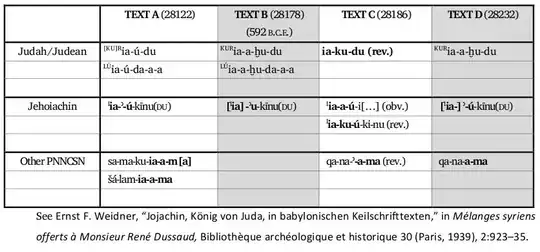
It is at the beginning of the exile we first certainly find the spelling yāhū in the famous Neo-Babylonian cuneiform ration tablets that mention King Jehoiachin. The key is in the strange spelling ia-ku-ú-ki-nu for the king and the name Judah also strangely found as ia-ku-du, with /h/ represented by < k >. This is not the usual way to transcribe either. We saw in Neo-Assyrian above how Hazakyahw and Yahûdāh were transcribed (without /h/ represented). But now, in both these the < k > ensures our only vocalization of the /h/ in the Hebrew name is in a pronunciation /hu/, transforming our abbreviated name yhw (now /w/ = /ū/—as a mater lexionis). Nevertheless, in Neo-Babylonian two differences that help us confirm the correct form of the king’s name are that the Babylonian scribes now use the grapheme <ḫ> to indicate the true aspirated /h/ sound (which didn’t happen in Neo-Assyrian), and they use < ma > to indicate consonantal /w/ (again a new thing). These ensure the vocalizations in the table above, as in Yāhûd (< Yahûdāh) and šalamyahw above. But, by 583 B.C.E. we do find the regular spelling ia(?)-a-ḫu- (/h/ represented by /ḫ/) for the first time applied to personal names as well, continuing the practice of yahu- (like in ia-ku-ú-ki-nu). See Ran Zadok, The Earliest Diaspora: Israelites and Judeans in Pre-Hellenistic Mesopotamia (Tel Aviv, 2002), 28. This is the ubiquitous form then on. But, yāhū is still only found in personal names not yet independently.
One may ask, if Yahweh led to -yahw- (and reflected by ia-ʾ-ú-) where then did yāhū- in names originate? These cuneiform texts give the answer, where we see the strange spelling of < k > for /hu/ in ia-ku-ú-ki-nu and in ia-ku-du for Yāhûd, shortened form of Yahûdāh, seen in Ezra 5:1 (the /a/ typically being left off in Hellenistic period). It was inspired by the spelling of the geographic name spelled in cuneiform sometimes like the abbreviated name as in Text A, [KU]R ia-ú-du, and the king’s name spelled ia-ʾ-ú-kīnu(DU). In other words -yāhû- in names came from Yāhûd. The goal was to protect the form of Yahweh from being accidentally spoken in personal names in foreign tongues (as in a possible ia-a-ú-ia-ki-nu = yahwiakin).
This brings us to the post-Exilic period where the Elephantine Jews did use Yāhû as the name of the deity (but we never find YHWH), because this yāhû in names was assumed to be the Judean deity in Babylonia. But most Judeans, knowing the origin, opted for the other shortened abbreviation of Yahweh, not yahw, but stressed final Yāh (and only final) (a poetic abbreviation of Yahweh–Exo 15:2), which stressed would then sound exactly like yahw (/aw/ in auto not in cow). This is why on a personal name spelled in a cuneiform document as pi-il-ia-a-ma there was the same name spelled in Aramaic on the endorsement on the outside plyh, which shows ia-a-ma = yh. See Matthew Stolper, “A Note on Yahwistic Personal Names in the Murašû Texts,” Bulletin of the American Schools of Oriental Research 222 (1976): 27. But, ia-a-ma actually indicates yahw but only in Hebrew.
Since the Bible was primarily written in Hebrew the name YHWH is intact and we never find independent YHW (yāhû). But our difficulty lies in personal names, where two things happened: a pronunciation shift occurred but later at the end of the fourth century, and a “leveling” occurred of the consonantal distribution, with a similar intent as in the exilic period, protection of the “ineffable” name.



http://en.wikipedia.org/wiki/Mappiq
– Dec 03 '14 at 21:30