12

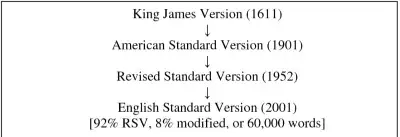
In "The advantages of the ESV" by Wayne Grudem, he states that the 2001 edition of the ESV is "92% RSV, 8% modified, or 60,000 words" (from the RSV):

enter image description here

This sounds like strong confirmation of the well-know lineage of the ESV from the KJV line, but it is hard to be sure of that without some sort of baseline for comparison.

To help get that 92% figure into context, I'd like to know what the figure is for the NIV versus the RSV. At a complete guess I'd put it at 30-60%, but perhaps someone somewhere has made the comparison and come up with a figure, if so, what is it?

Dan
  • 8,925
  • 6
  • 58
  • 115
Jack Douglas
  • 12,366
  • 11
  • 65
  • 122
  • 3
    Its erroneous with respect to the NT to call any of the modern translations other than the NKJV "in the KJV tradition" since all the others abandoned the Textus Receptus for the Nestle-Aland type text. That deviation began before the ASV with the RV of 1881 (using the Wescott&Hort Greek text), of which the ASV is the American revision. – david brainerd Aug 31 '14 at 01:03
  • @davidbrainerd OK, point taken (though I said 'lineage' - 'tradition' was Grudem's rather odd choice of word). That's not an issue I'm personally interested in but I know it's a big topic for some: I'm interested in getting context for the '92% RSV' figure, that's all. And the question of what do you count? – Jack Douglas Aug 31 '14 at 07:29
  • @JackDouglas - ah, hadn't seen the chat discussion. I went ahead an asked another question that hopefully doesn't overlap too much with yours. – Susan Aug 31 '14 at 07:57
  • @Susan it's similar but different enough I think, thanks for asking it. I'm sorely tempted to try and come up with my own methodology - it isn't necessary to compare the entire corpus, a comparatively tiny random sample should suffice... – Jack Douglas Aug 31 '14 at 14:42
  • @JackDouglas - I think it remains to be seen whether any superior methodology exists, so I think you should go for it! The question is more interesting to me when brought to bear on, e.g., the relationship between DSS and MT texts, which it seems likely that people have indeed invested the energy to compare in some organized fashion. Probably it would have to be yet another question (neither of our 2 existing questions on the topic gets into the methodology), but it seems like it should be a related sort of intra-language comparison procedure. – Susan Aug 31 '14 at 15:47
  • 1
    I'm trying to find something about their comparison methodology to no avail. If you use a different methodology than the one used to derive those statistics, you won't be comparing apples to apples. I can't find how they are doing it, though. Do they map English words/clauses to the original language in a specific critical text or do they simply compare English words and phrases? How are differences in word order with essentially the same words taken into account? Etc. I know how to go about answering this kind of question but need to know their methodology to make a good comparison. – Dan Sep 03 '14 at 17:14

1 Answers1

8

I don't know the method that Wayne Grudem used. On possible method is Levenshtein Distance, which measures the number of insertions, deletions, and subsitutions needed to convert one text to another. In order to test the method and compare it with the 92% found in the chart, I ran the first chapter of Genesis (without verse numbers) through an online Levenshtein Distance calculator. Genesis 1 is 4222 characters in the Revised Standard Version, which I used as the denominator:

The only real datapoint we can compare is the RSV to ESV changes and the edit distance method produces a similar number to Dr. Grudem's method. From the mention of "60,000 words" in the chart, I expect that it counts the number of inserted, deleted, and substituted words rather than characters. That certainly would speed up the calculation somewhat. (The recursive algorithm I initially tried needed memoization to return results before I ran out of patience.) It would also, presumably, strip out changes in punctuation style.

Comparing NIV and ESV to the King James itself shows that, at least in the first chapter of the Bible, the NIV translators felt more free to stray from the traditional English translations.
Jon Ericson
  • 30,362
  • 42
  • 156
  • 334