6

(For this question please assume that Paul considered himself a Christian and that he was the author of all 13 canonical Pauline letters.)

My question is: what terms (or phrases) did Paul use most frequently in referring to Christians? I am guessing he didn't call them "Christians."

Some possibilities (to give you an idea of what I mean) might be:

  • brothers

  • elect (of God)

  • believers

I would like the top 3 terms that he uses with some sort of figure indicating how often he used it relative to other terms.

Dɑvïd
  • 24,735
  • 4
  • 74
  • 155
Jas 3.1
  • 12,125
  • 7
  • 76
  • 131
  • Another possibility I just thought of might be "spiritual men" – Jas 3.1 Jul 11 '14 at 02:18
  • 6
    Frequently in his opening greetings, 'saints'. –  Jul 11 '14 at 02:50
  • 1
    In Acts 22:4, he calls them "followers of this way" and uses that as a name for Christians in 24:14 ("However, I admit that I worship the God of our ancestors as a follower of the Way, which they call a sect."). Jesus had identified himself as "the Way" (John 14:6) and the name appears throughout Acts (9:2; 11:26; 19:9, 23; 22:4; 24:14, 22; see 18:25, 26 for the similar terms "the Way of the Lord" and "the way of God"). Luke seems to have liked it. However, Paul does not use that term in the Epistles. – Frank Luke Jul 11 '14 at 13:19
  • I did a search for the word christian and found this “The disciples were called Christians first at Antioch.” — https://www.biblegateway.com/passage/?search=Acts+11:26&version=NIV (I was told that christian appears 3 or 4 times, but I only found this one). Also “followers of the way” disciple means follower. – ctrl-alt-delor Jul 26 '14 at 07:14

1 Answers1

8

OP's interest in quantifying Paul's (or, if you like, the NT's Pauline tradition) most frequently used designations for "Christians" makes for a challenging question, and one that would take a long time to deal with definitively.

Here is my best shot. Methodology: I have tabulated the figures for the thirteen NT letters in the "Pauline tradition", using the designations discussed by Paul Trebilco, Self-designations and Group Identity in the New Testament (Cambridge University Press, 2011). In his introduction (p. 3), he outlines them thus:
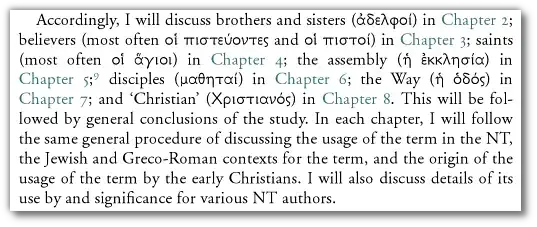
trebilco page 3

Here are the figures:

                  +----+----+----+----+---+---+
                  | A  | B  | C  | D  | E | F |  
+-----------------+----+----+----+----+---+---+
| Romans          | 13 |  5 |  9 |  6 |   | 1 |
| 1 Corinthians   | 27 | 22 |  7 |  3 |   |   |
| 2 Corinthians   |  7 |  9 |  5 |    |   |   |
| Galatians       | 10 |  3 |    |  1 |   |   |
| Ephesians       |  1 |  9 | 11 |  1 | 1 |   |
| Philippians     |  8 |  2 |  2 |    |   |   |
| Colossians      |  2 |  4 |  6 |    | 1 | 1 |
| 1 Thessalonians | 17 |  2 |  1 |  3 |   |   |
| 2 Thessalonians |  7 |  2 |  1 |    |   |   |
| 1 Timothy       |  3 |  3 |  1 |    | 5 |   |
| 2 Timothy       |  2 |    |    |    | 1 | 1 |
| Titus           |    |    |    |    | 1 | 1 |
| Philemon        |    |  1 |  2 |    |   |   |
+-----------------+----+----+----+----+---+---+
| TOTAL           | 97 | 62 | 45 | 14 | 9 | 4 |
+-----------------+----+----+----+----+---+---+

Legend
A - brothers and sisters (ἀδελφοί)
B - assembly (ἐκκλησία)
C - saints (ἅγιοι)
D - believers (πιστεύοντες)
E - believers (πιστοί)
F - elect (ἐκλεκτός) n.b. NOT one of Trebilco's terms
n.b. - blanks = 0

Notes: (obvioulsy) arranged left-to-right in order of decreasing frequency. I have included the 0's (blanks) to make clear the comparison. But I have omitted the following:
   - disciples (μαθηταί);
   - way (ὁδός); and
   - christians (Χριστιανός).
as they are all "zeroes" for these thirteen books. Trebilco (it will be noted) combines the categories I have separated out as "D" and "E", as the distribution seemed interesting here between the Catholic and Pastoral epistles. There is some element of "judgment call" in D/E, so those interested should do the search/concordance work for themselves.

Do consult Trebilco's substantial book for further information. A bit of additional relevant bibliography:

There is, of course, much more, but hopefully this responds adequately to OP's interest.

Dɑvïd
  • 24,735
  • 4
  • 74
  • 155
  • 2
    Great info! Realizing the books vary in length (some normalization based on length would be interesting), it is still intriguing to see the emphasis of ἐκκλησία for the Corinthians (35% in 1 Cor, 50% adding 2 Cor) dealing with issues of their assembly (1 Cor 1:10-17). Additionally, 35% of the uses of ἀδελφοί were in those two books also, as he tried to emphasize unity. Other similar things jump out: 24% of ἅγιοι in Eph, which deals with being and living sanctified, 18% of ἀδελφοί in 1 Thes with a church Paul had to leave quickly (Act 17:1-10, 1 Thes 2:17), showing his attachment and care. – ScottS Oct 15 '14 at 13:54
  • 1
    @ScottS - yes, plenty of interest in there. The thought about "normalizing" crossed my mind, but Q is about overall preference/frequency, and that isn't affected by "weighting". But yes, the distribution has some quite fascinating facets! E.g., One wonders in 1 Thess also whether the ἀδελφοί language is cementing what was still a very freshly forged "familial" relationship. – Dɑvïd Oct 15 '14 at 14:20
  • Only math is perfect, so that was a perfect answer. –  Oct 07 '15 at 01:44