8

Whilst working with OGR, I came across the following field used define a geographic dataset:

COORD_DIMENSION

The spatial dimension (2, 3 or 4 dimensional) of the column.

Whilst I've used 2D and 3D features, are there any examples of datasets in GIS that use the fourth dimension, and do any GIS systems actually handle these?

Update:

The 4d with regards to OGR / PostGIS is likely to be used for M-values (M-Aware in ArcGIS) (though I've yet to find this in a tech doc). However the quesion of (real?!) 4d in GIS remains open.
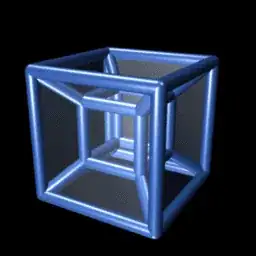
4d

geographika
  • 14,320
  • 4
  • 53
  • 77
  • 12
    This is probably the most psychedelic image in gis.stackexchange.com so far... – amercader Feb 07 '11 at 11:23
  • Does this include principal components analysis of hyperspectral imagery? (Lots of dimensions there.) – Kirk Kuykendall Feb 07 '11 at 17:03
  • @Kirk Good point. But I see that the quotation specifies "spatial" dimension, which presumably means something more than an abstract idea of "space." (On the other hand, any dimension beyond 3 must have some element of abstraction to it.) BTW, you don't need to invoke PCA: hyperspectral images potentially (and probably do, in general) have as many dimensions as there are slices of the spectrum. PCA merely identifies the dimensions in which most of the variation occurs. – whuber Feb 07 '11 at 19:06
  • @whuber It's been a long time since I've done any image analysis, but it seems like if two adjacent pixels are separated by a smaller spectral distance than two pixels that are spatially far apart, then it seems more likely that those two pixels should be classified the same. In other words the boundary between (the concept of) spectral distance and spatial distance is not always sharp. Internally, dealing with spectral dimensions versus spatial dimensions won't be that different will it? – Kirk Kuykendall Feb 07 '11 at 19:17
  • @Kirk There is a formal definition of "dimension" of a set of vector-like objects as being the smallest number of linearly independent elements in that set. This is independent of any applications such as clustering, spectral analysis, or even distance. When "spatial" is used in a GIS context, though, it comes implicitly with understanding that it includes a geometry that is appropriate to describe physical objects and relationships among them. That means we care about things like distance, length, bearing, angle, and area. The latter do make sense for images, but ... – whuber Feb 07 '11 at 19:27
  • (continuation) in a GIS they are handled in a completely different manner. For instance, a GIS will usually not buffer an image (in the sense of the distance you are thinking of), or perform "spatial" queries on images, or create "polygons" of images. This is because although such things make mathematical sense, they rarely, if ever, correspond to stuff people want to do with images. – whuber Feb 07 '11 at 19:29
  • @whuber good explanation. Still, I sometimes wonder if GIS might benefit by evolving the same way that physics did. If Tobler's first law ("Everything is related to everything else, but near things are more related than distant things") can be viewed in terms of Newton's law of gravity, then maybe GIS could take the same step that physics took and view geometry as subset of dimensions. Isn't that what Tensor analysis is all about? This might sound esoteric, but it might benefit day to day workflow, e.g. help hyperspectral imagery analysis, find shortest path in a socio-geometric network. – Kirk Kuykendall Feb 07 '11 at 20:14
  • (Oops: I meant "largest number of linearly independent elements" above.) – whuber Feb 07 '11 at 21:10
  • @Kirk I think you are correct in spirit. The problem with comparisons to Newton's Law (and many comparisons have been made) is that Tobler's Law is not quantitative, so nothing quantitative can be deduced from it directly. Tensor analysis can be described in many ways. One useful to GIS is that it studies sections of vector bundles. The mathematics for exploiting these is differential geometry, but this field still maintains a sharp distinction between the base manifold (the space where things happen) and the fibers over that manifold (what is happening there). – whuber Feb 07 '11 at 21:15
  • @whuber It's been a while, but last time I checked transportation modelling involves a very quantitative step called trip distribution http://en.wikipedia.org/wiki/Trip_distribution If you want to get gov't funding for a highway project, I think you need to do this sort of modeling. It always struck me as prone to self-fulfilling prophecies and discouraging mixed use developments. I wonder when transportation planning will move beyond the gravity model. – Kirk Kuykendall Feb 08 '11 at 02:20
  • @Kirk A transportation "gravity model" is quite different in nature from Newton's law although superficially it looks the same. Those models are just fitting data to fairly arbitrary formulas that have no demonstrable generality. Indeed, the law that inspired them (of Retail Gravitation, proposed by William Reilly in 1929) is based on people's misunderstanding of Reilly's work and on Reilly's flawed analysis of the data he collected (which do not support an inverse square law at all). I admire what Reilly did but lament that almost all subsequent references to him miss his main points. – whuber Feb 08 '11 at 05:58

3 Answers3

7

I think the four dimensions used in GIS are x, y, z (height), m (measure). This measure can be time or something else like the projected distance along a reference line, e.g. a pipeline.

Samuel
  • 606
  • 3
  • 5
  • That would be disappointing..! But likely to be the true 4d value. Is 4d the MAware equivalent in OGR? – geographika Feb 07 '11 at 11:37
  • 2
    Measures, although they require a fourth number, would not ordinarily be thought of as an additional "dimension." A dimension would have to be a coordinate that is independent of the other three. Measures are always functions of the two (or three) spatial locations of points in a feature. They act, mathematically, as analogs of grids: a grid is a mechanism to assign an attribute to every location within a polygon (a 2D object) while a measure assigns an attribute to every location within a polyline (a 1D object). – whuber Feb 07 '11 at 14:04
4

In this case the forth dimension is measure as gissolved mentions, but more commonly the fourth dimension does refer to time. Historically, most GIS systems have been weak at integrating time, but the increase in dynamic modeling over the years has brought time into most current GIS systems. See for example this recent question.

While the software has been slow to formalize concepts of time, there is a good body of GIScience literature which covers the conceptual basis of dealing with time, such as the articles covered in Martin Raubal's 288MR course.

scw
  • 16,391
  • 6
  • 64
  • 101
  • Agree 4D is additional to 3D X,Y,Z +M (Measure/Time) - try 5D http://en.wikipedia.org/wiki/Five-dimensional_space – Mapperz Feb 07 '11 at 14:55
1

i think 4D used to show time with x,y,z, and time for any feature. we used additional dimension to show time when we are getting x,y, and elevation of any feature at any place.

Ryan Garnett
  • 9,479
  • 8
  • 61
  • 106
azm fiaz
  • 11
  • 1