Both versions are correct and mean the same thing, and their spellings have not changed in the wake of the spelling reform. But "eure" is used about 80 to 100 times more often than "euere", and in the last 200 years there never was an era when these words was used with an equal frequency or when "euere" was even used more frequently than "eure."
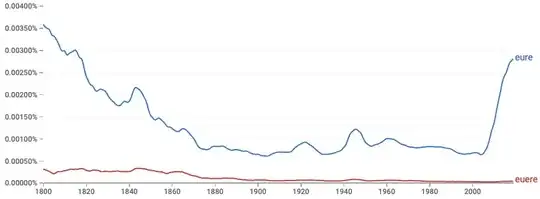
See this Google Ngram:
source
Before 1870 "euere" was printed in books with a frequency of 0.0002 to 0.0003 percent, in 1890 this frequency dropped under 0.0001% and is now at about 0,00003%. But "eure" has now a frequency of 0.0028%.
So, my advice is to delete "euere" from your active vocabulary (do not write or speak this word) but keep it in your passive vocabulary (know what it means when you read or hear it).
The Ngram shown above displays the situation for printed texts (anything that Google can scan). But much more phrases, sentences etc. are not printed but spoken. And for spoken language there are only few evaluations, and most of them evaluate TV series, films and similar material that is broadcasted. But I only know resources about spoken English, not about spoken German. So, for spoken German I only can talk about my personal experience. I am a German native speaker, I'm 56 years old and I lived all these years in a country where people speak German (in Austria), and I do not remember to have heard the word "euere" (3 syllables: eu-e-re) in spoken language in my whole life. People use only "eure" (2 syllables: eu-re) when they speak (or dialect versions of "eure" like "eire" or "eichre", all of them with 2 syllables). So, while in written German the ratio eure:euere might be 80:1, it for sure is greater than 10,000:1 in spoken language.


