11

A teacher, I once had (native German), said there are three translations for English "there is/are":

  • es ist (ein Auto auf der Strasse)
  • es gibt (ein Auto auf der Strasse)
  • es hat (ein Auto auf der Strasse)

I've only heard "es gibt" before. Is this a regional thing? Do people actually say the other two?

Matt Fenwick
  • 2,338
  • 4
  • 24
  • 30

4 Answers4

13

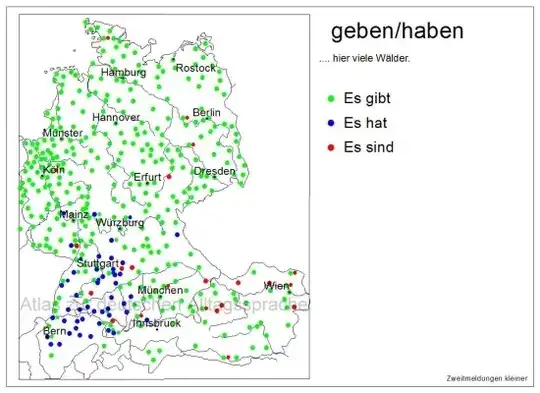
According to the Atlas zur deutschen Alltagssprache, "es hat" is a variant that is mostly heard in the south-west of Germany and the German-speaking parts of Switzerland.


Laut dem Atlas zur deutschen Alltagssprache ist "es hat" eine Variante, die hauptsächlich im Südwesten Deutschlands und der deutschsprachigen Schweiz vorkommt.

enter image description here

Jan
  • 11,406
  • 10
  • 61
  • 86
10
  • "Es ist ein Auto auf der Straße": Some people say it, but to me it sounds like a literal translation of the English version, and it seems there is something missing. For example "Es ist ein Auto auf der Straße unterwegs" would work fine.
  • "Es gibt ein Auto auf der Straße": Is the usual way to say that there is something and is definitely used often.
  • "Es hat ein Auto auf der Straße": I've heard this, but I think it is a regional thing. I think I heard it mostly from Austrians or Southern Germans, but I'm not sure. It's used rarely in Northern Germany.

Note that the examples are somehow constructed. I'd use "Es gibt" e.g. to explain which points of interest are somewhere, like "es gibt an diesem Platz eine Pizzeria, ein Museum und einen Zauberstabladen". You can of course also say "an diesem Platz befinden sich [...]", which may sound a little more sophisticated.

OregonGhost
  • 14,206
  • 1
  • 59
  • 83
  • 2
    +1 for constructed examples. "Es fährt ein Auto auf der Straße." or "Es steht ein Auto auf der Straße." but "Es gibt"? – John Smithers Dec 02 '11 at 14:12
  • Not quite sure what you mean by 'constructed' -- artificial or unnatural? – Matt Fenwick Dec 02 '11 at 14:47
  • @MattFenwick: I meant "konstruiert" ;) I'm not sure what the correct English word is - I think it is artificial because you would not actually say that there is a car on the street in German, and someone just made up these examples. – OregonGhost Dec 02 '11 at 15:12
  • @Matt, OregonGhost means that even the most plausible of your three sentences, while not grammatically wrong, sounds strange. You'd say "Es steht ein Auto auf der Straße" - "A car is standing/parked/waiting in the street". – fzwo Dec 02 '11 at 15:44
  • Cool, that's what I thought. Thanks for the clarification! – Matt Fenwick Dec 02 '11 at 17:20
  • Here, "Es is ein Auto auf der Straße." is the common form, and "Es gibt ein Auto auf der Straße." sounds strange. – sbi Dec 05 '11 at 09:08
  • @sbi: Would you also say "Es ist ein Tierpark in Berlin" and not "Es gibt einen Tierpark in Berlin"? – OregonGhost Dec 05 '11 at 09:27
  • @OregonGhost: No, I would say "Es gibt zwei zoologische Gärten in Berlin:" :) That doesn't mean I'd consider this better for a car on the street, though. And please don't ask me why. There's no logic to language, it's mostly what the people said where/when you grew up. – sbi Dec 05 '11 at 09:35
  • @sbi: There is only one that calls itself Tierpark though :P What I meant is that I already wrote that the example with the car on the street is strange in any of these forms. Good to know that the Berliner Schnauze uses "es gibt" where I would use it too ;) – OregonGhost Dec 05 '11 at 09:40
  • @OregonGhost: I'm a Berliner not by birth, I only moved here 20 years ago, so you'd rather not take what I say as Berliner Schnauze. – sbi Dec 05 '11 at 09:46
  • Re: „I think I heard it mostly from Austrians“: Austrians from eastern regions don't say „Es hat ...“ if 3. Person Singular Indikativ Präsens of „sein“ is meant. They say „Es ist ...“ then. As a Viennese I heard „Es hat ...“ in this context only from Swiss friends/visitors or Austrians living close to Switzerland, especially people from Vorarlberg. – Gerold Broser Nov 16 '20 at 22:32
3

Theoretically speaking:

  • "Es gibt ein Auto auf der Straße" would roughly translate as "A car exists in the street."
  • "Es ist ..." would be the right choice in 99.9% of situations.
  • "Es hat ein Auto auf der Straße" is plainly wrong from a grammar standpoint, although ->

Practically speaking:

  • All (and more) variants are used in everyday language and dialects.

Bottom line:

Stick with "ist" says the native, you can't go wrong there. If you want to sound more "elaborate" use "steht, parkt, fährt" for the respective situations.

hemmer
  • 31
  • 2
  • I'd expect „Es gibt ein Auto auf der Straße.“ in a more abstract context like a poem or a discussion about traffic, for instance. „Es ist ein Auto auf der Straße.“ if there's a real one there. I'm from Vienna/Austria, if that matters. – Gerold Broser Nov 16 '20 at 21:43
3

I was hoping to have some feedback from some of my more learned Yiddish correspondents before weighing here, but in the absence of prompt replies to my inquiries I’m going to answer from my own incomplete personal knowledge. We definitely don’t use “es gibt...”: that would be the surest giveaway of a German-educated person trying to speak Yiddish. If anything it would have to be “es git…” like the Swiss, but even that does not seem to be idomatic with us. The two forms I know for sure are:

“Es gefinnt sich a wâgen af der gasse…”, where the “ge-“ prefix has somehow become a part of our present tense, and

“Es is (dâ) vorhan a wâgen af der gasse…” where the “dâ” is optional.

I notice from a discussion in another thread (which I can’t recall at the moment) that “findet” is also used in German, and with a bit of the reflexive going on as well, although not identical in form to ours. If I get some better information on these usages, I’ll post an update.

Marty Green
  • 2,647
  • 2
  • 16
  • 21
  • +1 for "es findet sich" - not used for cars on streets however – Takkat Dec 04 '11 at 14:48
  • Interesting answer -- so is Yiddish similar to german? – Matt Fenwick Dec 04 '11 at 14:53
  • 1
    @Takkat: "Es befindet sich ein Auto auf der Straße" could be used without a problem. – John Smithers Dec 04 '11 at 15:11
  • 1
    @Matt The term may be politically charged, but I wouldn't hesitate to call it a dialect. For a deeper discussion, you might want to post this as a separate question? – Marty Green Dec 04 '11 at 16:01
  • For what it's worth, this is very Germanized Yiddish---certainly no one pronounces words in this fashion. For instance, "gasse" is said as "gas", "vorhan" is "faran" etc. I imagine the German spellings used here were due to the fact that Yiddish does not use a Latin alphabet. In any case, in north-eastern Yiddish (Lithuania, Latvia, Belorus, North Ukraine and North Poland), one would say "es gefint zich a vogn af der gas" and "es is (do) faran a vogn af der gas." –  Aug 10 '20 at 20:56
  • @Argon But the question here was not how to say it in correct Yiddish but whether these forms exist in German. – Marty Green Aug 11 '20 at 21:27
  • @MartyGreen Sure---but that is not Yiddish (is it some type of German that wasn't mentioned?). It seems to me like it's akin to writing Portuguese with Spanish words. –  Aug 12 '20 at 00:43
  • I prefer to write Yiddish so that it is comprehensible to German speakers. – Marty Green Aug 13 '20 at 02:01
  • @Argon: you wanted to clarify in this answer (via edit) that "the two forms I know for sure are" complies with standard german. I tried to read that from these comments and I failed. Please clarify it a bit more explicit or ask Marty Green to integrate it. Was the point to say "not a german dialect, not swiss, not austrian, just plain standard german"? – Shegit Brahm Aug 13 '20 at 14:22
  • @ShegitBrahm They comply with German orthography (I assume), which do not reflect to Yiddish pronunciations or orthography. For instance, the Yiddish word written in the answer above as "vorhan" (as in German, I assume) is written in Yiddish as פאראן and is pronounced "faran". "Gefinnt sich" is written געפינט זיך and is pronounced "gefint zekh" or the like. "Gasse" is written as גאס pronounced "gas". The transcriptions here are not transliterations, nor translations, but a word-for-word conversion from Germanic Yiddish words to German, which is currently un-noted in the answer. –  Aug 13 '20 at 14:39
  • The passages I quoted are simply Yiddish and readily comprehensible as such to any educated Yiddish speaker. The choice of spelling convention is irrelevant to the discussion at hand. I was merely posting to further add to the list of variations on "there is/are" which are found in German dialects. I was also wondering if these Yiddish forms are used in any other German dialects and I'm not sure I have an answer. – Marty Green Aug 13 '20 at 15:17
  • @MartyGreen It's intelligible, but it's not Yiddish, in the sense that virtually no one writes it this way or pronounces it in the fashion suggested by the transcription (e.g. gasse). I think it's worth at least mentioning that fact in the answer, because the way it is written suggests that this is regular Yiddish. –  Aug 13 '20 at 16:59