10

Which preposition would you use in this sentence?

Ich gehe morgen ins / aufs / zum Rathaus.

I tried googling and I get a lot of results for each one.

Is it regional? Or is there any difference in meaning?

stillenat
  • 1,939
  • 1
  • 19
  • 30

5 Answers5

6

Ich gehe morgen ins Rathaus.

This means you will enter the Rathaus, e.g. for meeting someone.

Ich gehe morgen aufs Rathaus.

This means you will climb up the roof..

(I am not sure about this, but it might be used for "zum Rathaus" in some parts of german-speaking regions - e.g. I think I have heard this in Bavaria..)

Ich gehe morgen zum Rathaus.

This means you will visit the Rathaus. You don't have to enter the Rathaus, but you may do so - the sentence is used for both.

It also means you can say "Ich gehe morgen zum Rathaus, um meinen Ausweis zu beantragen". This sentence implies that you will enter it.

christian.s
  • 1,822
  • 10
  • 17
  • 9
    Man kann durchaus auf ein Amt gehen, ohne gleich auf das Dach zu klettern! – Takkat May 26 '14 at 06:23
  • @Takkat aber nicht im hochdeutschen, oder? Falls doch entschuldige ich mich und editiere es, bis dahin habe ich das nur in Süddeutschland gehört.. – christian.s May 26 '14 at 06:24
  • 3
    Auf das Bürgeramt gehen. Das geht. Aber, "Auf das Rathaus gehen", kann ich nur als 'auf das Gebäude klettern' verstehen. Anders ist es bei: "Ich gehe auf die Dorfschule". Geht auch. – oliholz May 26 '14 at 07:00
  • 1
    @christian.s Hier in Hessen geht man aufs Einwohnermeldeamt, wenn man etwas beantragen will. Man geht ins Einwohnermeldeamt, um sich dort mal umzuschauen. – Thorsten Dittmar May 26 '14 at 07:49
  • It's a regional difference. "Ins Rathaus gehen" means you enter the actual building; you may or may not have official business there. "Aufs Rathaus" gehen means to visit it officially, because you need a permit or whatever. "Zum Rathaus" gehen means to go to the building, without actually entering it. (This is different with people or institutions: "Ich gehe damit zum Bürgermeister" is fine.) All of this is true for Austrian German. Details may vary in other German-speaking regions. – Ingmar May 26 '14 at 07:50
  • @christian.s: Soll das heißen "im Süden" spricht man kein Hochdeutsch? Im österreichischen (Hoch) Deutsch ist "auf ein Amt" gehen gang und gäbe. Wir gehen aber zB auch "in die Schule" wo ihr "zur Schule" geht. – Ingmar May 26 '14 at 07:52
  • @Ingmar nein, das heißt es nicht. Nur da in einer Region wohne, in der fast komplett Hochdeutsch gesprochen wird und mir zudem "Aufs Rathaus gehen" im Sinne von etwas im Rathaus erledigen aufstößt gehe ich davon aus, dass es ein Dialekt ist. Das ist keinesfalls wertend gemeint.. Hast Du Referenzen für "Aufs Rathaus" ? – christian.s May 26 '14 at 07:56
  • @Ingmar/@christian.s auch im Norden ist aufs Rathaus völlig verständlich in gleicher Weise wie aufs Amt (und bei uns gibt es nur den Dialekt Hochdeutsch ;-) – RRZ Europe May 26 '14 at 08:13
  • Es ist kein Dialekt sondern österreichische Standardsprache. Deutsch als plurizentrische Sprache hat bekanntlich nicht nur "ein Hochdeutsch"; in der Schweiz wird "auf" mW genauso verwendet, aber das müssen Berufenere beantworten. – Ingmar May 26 '14 at 08:16
  • 1
    Warum werden hier eigentlich Äpfel mit Birnen verglichen? Ein Rathaus meint das Gebäude ein Amt meint die Institution. Warum sollte man die beiden über den selben Leisten ziehen? – Vogel612 May 26 '14 at 09:10
  • Weil "das Rathaus" durchaus auch stellvertretend für die Behörde verwendet wird. Bei anderen Einrichtungen (zb Schule, oder Ministerium) ist das noch viel deutlicher ausgeprägt: "Legationsrat Dr. Tuzzi betrat das Ministerium wie üblich durch den Hintereingang." und "Das Ministerium (für Inneres) hat eine Gesetzesvorlage ausgearbeitet". – Ingmar May 26 '14 at 10:44
  • 2
    Ganz allgemein finde ich die Unterscheidung Hochdeutsch/Dialekt hier nicht so hilfreich. Gemeint ist wohl eher im gesamten Sprachraum/nur in Teilen des Sprachraums. – Carsten S May 26 '14 at 13:12
  • @CarstenSchultz das ist ein hilfreicher Kommentar, habe es angepasst - danke – christian.s May 26 '14 at 13:42
  • @Vogel612 Was sollte man den bitte sonst vergleichen? Zwei Dinge, die eh schon gleich sind, zu vergleichen ist absolut sinnlos. Da kommt nix bei heraus. Das ist die schwachsinnigste Redewendung die es gibt. Gleich auf mit dem Quantensprung. – bot47 May 27 '14 at 00:42
3

In connection with official buildings, the preposition auf may be used instead of zu or in. However, the use differs from region to region.

The linguistic atlas Atlas zur deutschen Alltagssprache shows the areas of distribution of „zur/auf die Post“ (to the post office) and „auf/in der Post“ (in the post office):

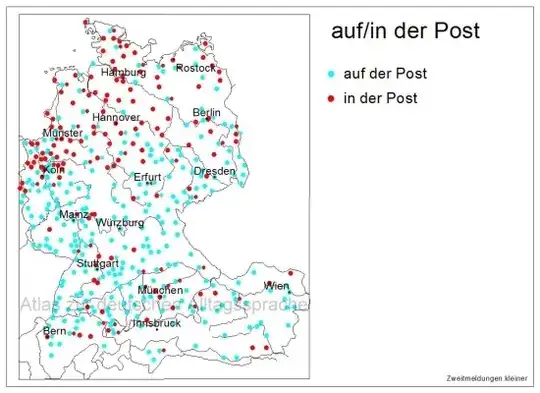
zur/auf die Post

auf/in der Post

1

Statt "gehen zu" sagen die Leute oft im Zusammenhang mit einem Amt "auf", etwa "aufs Rathaus/ aufs Standesamt/Einwohnermeldeamt gehen. Dieser Gebrauch von "auf" ist eine spezielle Nische. Ich glaube, das geht auf mittelalterliche Zeiten zurück, als die Bürger ihre amtlichen Angelegenheiten auf der hochgelegenen Burg des Grafen oder des Vogts erledigen mußten. Leider konnte ich dafür keine Belege finden, aber Grimm müßte sowas eigentlich haben. Natürlich kann man dafür auch "zu/zum" sagen.

DWDS hat unter "auf" verzeichnet: aufs Schloß gegen, auf die Burg.

rogermue
  • 7,852
  • 18
  • 22
0

It is regional.

For example in my region Thuringia we say:

Er ist auf Arbeit. (Auf seinem Arbeitsplatz.)

Ich gehe auf Arbeit.

However I would not say ich gehe auf's Rathhaus. I'd say ich gehe in's or zum Rathaus.

My explanation for the use of auf is like in Chess. You put a piece on a field. So you put a piece on a field which represents the work place or in your example the city hall.

You can also go to the city hall or work place. Or go inside.

In German we say we go into the internet. In America they say they go on the internet. Which sounds strange to me since how can you go on it? However how can you go into the internet?

However if you are on-line then you are on the line. Or on the internet - line.

I hope that helped.

DisplayName
  • 2,783
  • 14
  • 23
-2

You can use all three, they are all equivalent as discussed in the following link:

https://answers.yahoo.com/question/?qid=20110413103257AALnXsA

ThreeFx
  • 423
  • 4
  • 11