6

In transcribing an 1825 Settlement Examination from Mansfield, Nottinghamshire, the following line appears to read: William Brough "then hired at Mansfield Statutes to Mr. Milward of Epperstone for a year which he served."

An online search for "Mansfield Statutes" produced several 'hits' for Nottingham newspapers via British Newspaper Archive at Genes Reunited, but I don't have a membership.

Another 'hit' turned up an 1859 diary entry of David John at welshmormon.byu.edu: "4 Nov Went to Mansfield, "Statutes", and met Brothers Cook and Holmes there. We held a social party until 10 P.M. at Mrs. Warren's."

But then I also saw two similar references following that entry: "7 Nov Cook, Nelson, and myself went to the Eastwood 'Statutes'. We spent the evening in walking through the fair. "15 Nov Brother Cook, Sister Elizabeth Cook, and I went to the Loughborough Statutes, met Elders Nelson, ????, and many of the Saints. Held a party at Brother Thomas Henderson's house in the evening."

PolyGeo
  • 11,170
  • 6
  • 29
  • 57
JeanO
  • 133
  • 5
  • 1
    Welcome to G&FH SE! As a new user be sure to take the 2-minute [Tour] to learn how the site works, although you seem to have already figured that out and asked a very interesting first up question. – PolyGeo Oct 08 '15 at 07:23

1 Answers1

4

I have not come across the term before but found this in the Derbyshire Courier November 15, 1851:
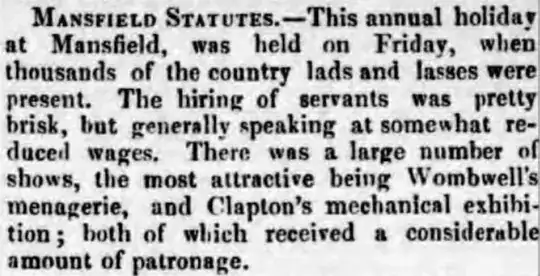
enter image description here

It sounds like an event rather than a place. In many other references to Mansfield Statutes (and other statutes like Bolsover Statutes) that I found there were often mentions of servants being hired so that seems to have been something of a focus for it/them.

I also found this at the GENUKI page for Mansfield:

The Statute Fair for the hiring of servants was held on the first Friday on November.

so it seems like hiring servants was its main purpose.

And from the Merriam-Webster online dictionary:

Definition of STATUTE FAIR

: an annual fair formerly held in English towns and villages for the hiring of servants and farm laborers

There is also some interesting context provided by @alephzero that I think should be captured within this answer:

There was nothing equivalent to modern transport and communication systems, and many of the servants, farm workers, etc being hired would be functionally illiterate. So instead of the modern "continuous recruitment" system, the standard contract for servants was employment for "a year and a day", and job-swapping was done by physically getting everybody in the community together on one day each year, usually after the end of harvesting, when the workload on the farms was low but the weather was still good enough to allow an all-day open-air "recruitment event" to be practical.

Some of these annual fairs have been in existence since the 13th century, and since they involved large scale public meetings, the ruling classes were naturally concerned about the possibility of insurrection, etc. Their dates and locations were therefore officially regulated (in some cases, by Acts of Parliament) - hence the name "statute fair", i.e., a public gathering which would otherwise be illegal, but permitted by a legal statute.

Since all the employers were physically in one place on the same day, it made sense to use the time for other things as well as recruitment - for example trading animals between themselves, as opposed to selling animals to be slaughtered for food which was obviously a regular necessity (e.g. at markets held once or twice each week).

PolyGeo
  • 11,170
  • 6
  • 29
  • 57
  • 1
    Many Statute Fairs (in some places called Mopp Fairs) still take place all over England. Although they have lost their servant hiring purpose. – Chenmunka Oct 08 '15 at 09:58
  • @Chenmunka I'm curious why servant hiring warranted creating a fair around, and why many placements happened at the same time and place. – PolyGeo Oct 08 '15 at 10:02
  • 1
    Those I know of around Somerset & Wiltshire coincided with livestock fairs, so weren't specifically for hiring servants. I too have always wondered why they only seemed to take place once a year - usually in the autumn. – Chenmunka Oct 08 '15 at 10:15
  • 1
    This one still takes place... http://www.visitwiltshire.co.uk/whats-on/marlborough-big-and-little-mop-fair-p498103 – Chenmunka Oct 08 '15 at 10:16
  • Perhaps they didn't want displaced servants wandering around in the winter looking for new positions and was the best way to match supply to demand. – PolyGeo Oct 08 '15 at 10:35
  • 2
    @PolyGeo There was nothing equivalent to modern transport and communication systems, and many of the servants, farm workers, etc being hired would be functionally illiterate. So instead of the modern "continuous recruitment" system, the standard contract for servants was employment for "a year and a day", and job-swapping was done by physically getting everybody in the community together on one day each year, usually after the end of harvesting, when the workload on the farms was low but the weather was still good enough to allow an all-day open-air "recruitment event" to be practical. – alephzero Oct 08 '15 at 14:30
  • 2
    Some of these annual fairs have been in existence since the 13th century, and since they involved large scale public meetings, the ruling classes were naturally concerned about the possibility of insurrection, etc. Their dates and locations were therefore officially regulated (in some cases, by Acts of Parliament) - hence the name "statute fair", i.e., a public gathering which would otherwise be illegal, but permitted by a legal statute. – alephzero Oct 08 '15 at 14:56
  • 1
    @Chenmunka since all the employers were physically in one place on the same day, it made sense to use the time for other things as well as recruitment - for example trading animals between themselves, as opposed to selling animals to be slaughtered for food which was obviously a regular necessity (e.g. at markets held once or twice each week). – alephzero Oct 08 '15 at 15:01
  • 1
    @alephzero I think your three comments could easily be combined into a good answer to this question (basically "What are Statutes like the Mansfield Statutes?") which I think it helps to answer. Thanks for providing such useful context. – PolyGeo Oct 08 '15 at 23:53