I am looking at the 1860 US Census Record of John Surarrer. The transcription of it states that he was born in "Canada E". Here is the image. Does this just mean Canada, or does the E give some kind of a more specific hint?
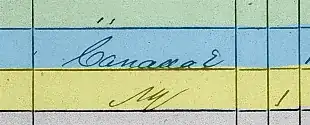
I am looking at the 1860 US Census Record of John Surarrer. The transcription of it states that he was born in "Canada E". Here is the image. Does this just mean Canada, or does the E give some kind of a more specific hint?


To answer this question, it helps to understand some Canadian history, especially basic facts about Canada's creation. A good overview can be found in Yvonne Sorensen's webinar Using Canadian Census Records, which was presented by FamilySearch's US/Canada team on 28 May 2015.
A timeline:
Wikipedia's article says:
Following the Rebellions of 1837, Lord Durham in his Durham Report, recommended that Upper Canada and Lower Canada should be joined to form the Province of Canada and that the new province should have a responsible government. As a result of Durham’s report, the British Parliament passed the Act of Union 1840, and the Province of Canada was formed in 1841. The new province was divided into two parts: Canada West (the former Upper Canada) and Canada East (the former Lower Canada).
The "Upper" and "Lower" designations refer to the provinces' position along the Saint Lawrence River, which flows in a roughly north-easterly direction. See the Historical Atlas of Canada Online Learning Project for maps; the map Territorial Timeline: 1840-1849 shows the provinces as Canada West / Canada East.
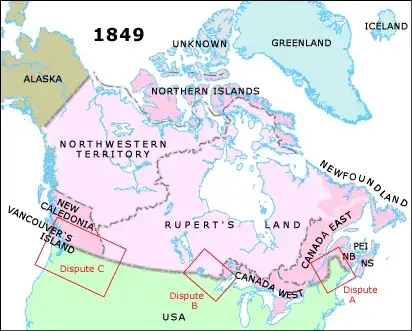
The Enumerators Instructions sometimes give instructions about how different areas of Canada should be designated, but I don't see anything specific for the 1860 Census. So I suspect it is supposed to say Canada East because that was the contemporary name of the province.
You can download the handout for a similar talk by Lisa McBride, AG, from the Family History Library Classes and Webinars page in the FamilySearch Wiki. The recording of the webinar is not available from that page, but you can find it by going to the FamilySearch Help Center and searching for Canadian Census, then looking under Lessons.
A caution:
The instructions on what information on the US Federal Census vary from decade to decade. Always check the instructions, if you can find them, to see what the enumerators were supposed to record -- that isn't a guarantee of what was recorded, but at least you know what was expected.
The instructions for the 1860 Census say:
- Birth Place.-- Under heading 10, you are to insert the place of birth of every individual whose name you record. If born in the State or Territory of their present residence, insert the name, abbreviation, or initials of such State or Territory. If born out of the United States, insert the name of the country of birth. To insert simply Germany would not be deemed a sufficiently specific localization of birth place, unless no better can be had. The particular German State should be given-- as Baden, Bavaria, Hanover. Where the birth place cannot be ascertained, write "unknown" in the proper column; but it must be of rare occurrence that the place of birth may not be understood. You should ascertain the exact birth place of children as well as of parents, and not infer because parents were born in Baden that so also were the children.
while the instructions for the 1900 Census say:
- If the birthplace reported is Canada or Newfoundland, ask whether the person is of English or French descent. Write Canada English or Canada French, according to the answer.
A cross-check of other pages in the same census might reveal if the enumerator for that district (or in other districts) recorded others as being from "Canada W". Findmypast offers the US Census records for free (the content that was formerly offered by Mocavo), so that makes it easier to look at the census images.