2

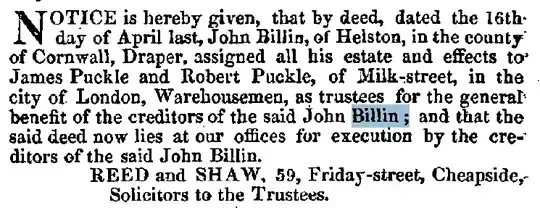
In an earlier question (Interpreting "From what County selected" column for Billin family on 1849 "Eliza" Passenger List (Plymouth, England - Port Adelaide, South Australia)?) I included the bankruptcy/debt notice from 1845 below which relates to my 3rd great grandfather John Billin.

enter image description here

Does anyone know whether the deed mentioned is a document that is likely to have survived to this day? i.e. would Reed and Shaw's records, that might include John Billin's address at the time, be accessible anywhere?

Hopefully, this can act as a worked example of "how to locate legal records from 19th century London?"

PolyGeo
  • 11,170
  • 6
  • 29
  • 57
  • I think it is worth a look. Some records of this nature did survive and are in archives. For examples see: http://www.nationalarchives.gov.uk/accessions/2002/02digests/legal.htm or http://apps.nationalarchives.gov.uk/search/search_results.aspx?Page=1&QueryText=solicitors&SelectedDatabases=BOOKSHOP|RESEARCHGUIDES|WEBSITE and the guide at http://www.nationalarchives.gov.uk/records/research-guides/bankrupts-insolvent-1710-1869.htm – Jan Murphy Nov 14 '14 at 04:27
  • 2
    The Blitz could have had a a major effect on the survival (or lack of survival) of records: http://www.bbc.co.uk/history/ww2peopleswar/stories/05/a5386205.shtml –  Nov 14 '14 at 09:45
  • @ColeValleyGirl "In 1940 during the period of the blitz my father who had a clothing warehouse in a street off Cheapside, called Friday St, went to work one morning to find not only had the building been destroyed but the whole of the street." certainly sounds ominous :-( – PolyGeo Nov 14 '14 at 09:53

1 Answers1

4

The Reed in "Reed and Shaw" was Frederic/k John Reed who was admitted to the Law Society in 1840. His partner was George Ledger Shaw (d 1869). The exact address was 2 Friday Street.

Their partnership (Reed and Shaw) was dissolved on 23 Sep 1845 (London Gazette, 28 Nov 1845) at the address of 59 Friday Street, with Reed taking on all responsibility for debts due to and from the partnership.

Reed became part of Reed, Langford and Marsden at 59 Friday Street (Commercial Gazette, 16 Oct 1847; Morning Chronicle, 6 March 1855; London Gazette 14 Nov 1856). So we can assume that Reed, Langford and Marsden was the successor firm to Reed and Shaw.

The partnership of Reed, Langford and Marsden was dissolved on 11 Jan 1860 (London Gazette, 13 Jan 1860).

Reed then moved to 3 Gresham Street (London Gazette, 30 Mar 1860) in partnership with Thomas Phelps and Edward Sidgwick. The firm was called Reed, Phelps and Sidgwick. The partnership was dissolved on 8 Sep 1871 (London Gazette, 12 Sep 1871). Reed then retired to Cumberland, where he died in 1888 at the age of 79.

Phelps, Sigwick and Biddle was the successor firm. That partnership was in turn dissolved on 31 May 1905 (London Gazette, 6 Jun 1905).

Biddle, Thorne, Welsford and Sidgwick was the successor firm. That partnership was dissolved on 31 Mar 1965 (London Gazette, 23 Jul 1965).

Biddle and Co was the successor firm. In 2001, Biddle & Co merged with Pinsent Curtis to form Pinsent Curtis Biddle.

This is now known as Pinsent Masons LLP. It is a sizeable international law firm.

You may wish to ask whether Pinsent Masons has any relevant archive material from its predecessor firms or knows if/ where it could be found. Good luck!
user3310902
  • 1,226
  • 7
  • 5
  • That is an amazing answer. Thank you so much for tracing it through using techniques that I was unaware of. I shall certainly write to Pinsent Masons. – PolyGeo Nov 16 '14 at 02:38