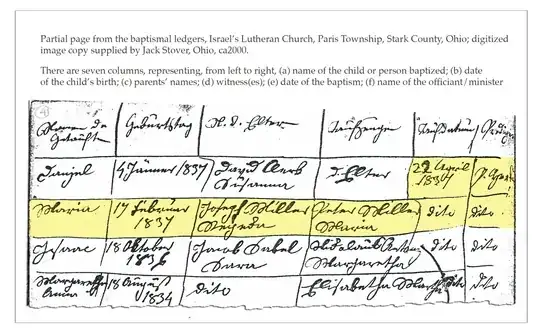
The partial image below is from an 1837 baptismal register of a church located in Paris Township, Stark County, Ohio. It is written in old German script. At least to our knowledge, these ledgers have never been translated/transcribed as a body of work.
One entry (the entry of interest) is highlighted. (See the full page HERE.) We have been able to interpret (translate/transcribe) all but one name in the entry of interest.
Maria, [born] 17 February 1837, [dau. of] Joseph Miller [and wife] ---XXXXXX---, [witnessed by] Peter Miller [and wife] Maria, [baptized] 22 April 1837, by P. Herbr.
The wife's name has been hard to interpret/translate/transcribe. Here is a larger version of her name:
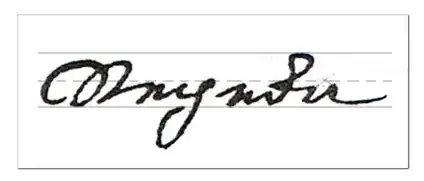
Based on the work of others, the name is thought to begin with the letters Re- and to end with an -a. Although the graphic represents four missing letters (in the middle), we can't be sure of how many letters make up that part of the name.
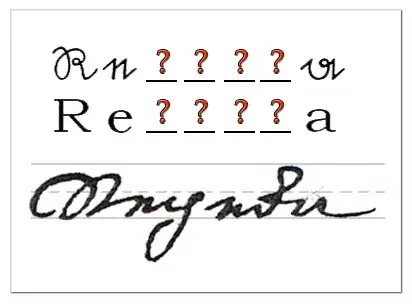
A few of the references I have worked with about German script are below.
- "Wir lernen die Sütterlin - Schrift" and also its index of helpful links and references, "Contents."
- Examples of 17th to 19th century lower case script and upper case script.
- "Sütterlin" in Wikipedia.
Updated/Extended Information:
I descend of Peter Miller (ca1779-1845), whose second wife was Mary Stewart (ca1786-1855). They settled at Paris Township, Stark County, Ohio. Separately, Peter Miller was a member of the church at Paris, and he and Mary are both buried in the church cemetery. Their first born was a Joseph Miller (b. 1814).
Although we don't know of any other Peter and Mary Miller contemporaries of Paris, there were many Joseph Millers of the day about the township, county and state. Both of "Paris township," one Joseph Miller married at Stark County in 1835 to Rebecka Thoma. (The Thoma farm neighbored Peter Miller's Paris farm.) This Joseph and Rebecka's first child is generally given as William Miller (19 Jan 1839 - 22 Sept 1918).

Rather early, a descendant of this Joseph and Rebecca/Rebecka in Ohio (Jack Stover) worked with the church ledgers. He came away with an interpretation for the wife's name in this entry as "R-e-g-i-n-a."
Jack consulted about the ledger with Dr. Daniel Jay Grimminger, Obl.O.S.B., Ph.D., author of Images of America: Paris and former Israel Lutheran church historian. Dr. Grimminger's insight assisted much with other parts of the entry, but he couldn't improve on the wife's name.
I wasn't able to interpret "R-e-g-i-n-a," or any obvious "whole" name from the record. (The members of Genealogy.SE are doing much better.)
Albeit probably biased by other logic applied to prove or disprove that Joseph Miller (m. Rebecca Thoma) was one and the same, Peter Miller's son Joseph, my humble attempt produced "R-e-[_]-e-c-k-a."
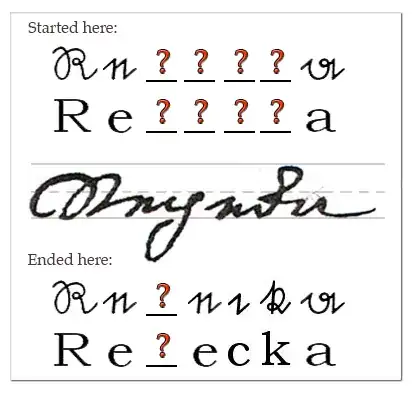


It looks clear that the three-and-a-halfth character is "y" unless "g" is a translation… in which case why not take the Question to a language-specific site?
Before that the two-and-a-halfth character looks like "n".
How is it clear that the first scribble is a single character, not two?
How is it clear any part of that is "R" or "r"?
– Robbie Goodwin May 25 '20 at 18:32