12

The long s(ſ) is often confused with the lower case f.

Because the use of the long s died out in the early 19th century, few are familiar with it.

It leads to many confusions. Now, in printed text, they are easy to tell apart-- the long s has no nub. In handwritten texts (such as early birth records), the two seem indistinguishable to me.

Is there any way to tell the two apart in handwritten texts?

Luke_0
  • 2,477
  • 1
  • 23
  • 41
  • 1
    Interesting possible overlap here between us and english.stackexchange.com –  Nov 21 '12 at 20:04
  • Yes, but this also could apply to any language using a Latin Alphabet (including English). However, this question is focusing on the handwritten forms, whereas ELU SE does not. – Luke_0 Nov 21 '12 at 20:11
  • Was just struck by the fact that the confusions you referred to were both on another stackexchange site (and both refer to printed documents) –  Nov 21 '12 at 20:13
  • While linking to Wikipedia was a good idea, I do think it would have been nice to see some interesting graphic examples be provided as part of this question. – GeneJ Nov 21 '12 at 22:12
  • Well, take the last letter of the first numbered line here for example. http://genealogy.stackexchange.com/q/2077/56 Bgwiehle calls it an "s", but it could be "Lauf". Funny (no pun intended). – Luke_0 Nov 21 '12 at 22:23

4 Answers4

8

According to The National Archives:

Don't get long s and f mixed up. The 'f' will have a cross stroke, even if it's hardly noticeable, and the context will make it clear whether it is a long 's' or an 'f'. Writers would often use both long and short 's', sometimes even in the same word.

  • 2
    The long s sometimes has a nub at the middle, and so it can appear even more like an elaborate lower case "f." (Even more difficult when talking about script.) See Wikipedia's entry. http://en.wikipedia.org/wiki/Long_s – GeneJ Nov 21 '12 at 22:09
  • 1
    @GeneJ, I thought the long s only has a nub in the middle in typeface not in handwriting. –  Nov 22 '12 at 09:36
5
  1. If the sample is large enough, you can identify all the occurrences of f and long s, thereby distinguishing the writers hand.

  2. If f and long s are almost identical, usually the word in question can be defined through trial and error. People and place names are most difficult.

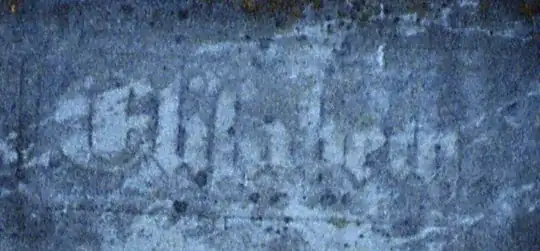
  3. German-Americans continued using long s into the early 20th century. An ancestor of mine, named Elisabetha, was recorded in a book of tombstone inscriptions as "Chalberna". I didn't learn her true name until I visited the grave, and saw the readers had misinterpreted the gothic script and long s.

enter image description here

Rusty Erpenbeck
  • 3,614
  • 12
  • 20
5

The U.S.A. Bill of Rights is a good example for study. We know exactly in what time frame and context it was written. At the top, we have the long S in

Congreſs of the United States

and the title is boldface italics (so to speak). This long-S does have a cross stroke, but it's not clear from the image whether that's a background line or actually is a cross stroke.

If you scan down through the document, you'll see many examples of double f, and near by examples of long-S-short-s. For example,

be subject for the same offence (Article 7 line 2)

is directly above

without due proceſs of law. (Article 7 line 3)

In this specific document, there is a difference between the two letters. Look at the direction of the lower part of the letter (clockwise vs. counter-clockwise). For a single isolated lower-case F, the descender is always formed counter-clockwise. For a long S, the descender is always formed clockwise. However, in the case of double-F, the first F's descender is clockwise, and the second F's descender is counter-clockwise.

I have never seen that distinction "officially" explained, but I have noticed it in other early 19th century American (USA) handwriting.

I think I have only seen the long-S as the first letter of a double-S combination. But I've only looked at USA handwriting, 1680-1880. Hopefully these minor distinctions will help you recognize the difference more easily!

Luke_0
  • 2,477
  • 1
  • 23
  • 41
Edward Barnard
  • 308
  • 1
  • 8
2

This hypothesis is based on a very limited dataset (one Welsh parish register circa 1800) but may be worth further testing.

It appears that a "long s" was not used when it would be the last letter of the word. If you could be certain that any such letters were f, then you have a good basis for comparison of individual writing styles.

Fortiter
  • 13,336
  • 1
  • 20
  • 69