17

I have recently had my diploma stating that I have Bachelor degree in maths translated into French. (for those, who speak Russian диплом бакалавра по математике). I have got this diploma in Ukraine. The translating agency that made the translation wrote “bachelier”.

As “bachelier” corresponds to secondary education in France, I think I'll have problems with such a translation, when trying to get a grant from the French government. Am I right?

There are other possibilities to translate my diploma in French:

  • License

  • Baccalauréat

  • Diplôme de Bachelor

  • Diplôme de Bakalavre

Which of them is the most appropriate and corresponds to the standards of translation Ukrainian (Russian) diplomas in French?


P.S. As I have got an answer, but it isn't what I need, I think I must clarify the question a bit.

There is equivalence and translation, and these are two absolutely different things.

We can speak about the equivalence only if there is a convention between two countries about diploma recognition. Translators do not have the right to translate according to the equivalence. So my diploma can't be translated as “diplôme de master” or “diplôme de maîtrise”.

Translation doesn't require any recognition. It is supposed to make clear to a speaker of a l2 the conception expressed in a l1.

I have contacted another translating agency and they propose to translate my diploma as “diplôme de bakalavre”.

My final question for the moment is: Which is less confusing for a French speaker “diplôme de bachelier” or “diplôme de bakalavre”?


P.P.S. If it is easier to answer in French, please do, I understand French.

Stéphane Gimenez
  • 30,422
  • 13
  • 71
  • 152
May
  • 275
  • 1
  • 2
  • 7
  • 3
    "diplôme de bachelier" is confusing for a french audience. "diplôme de bakalavre" is probably a less confusing translation, but you'll probably have to explain it (with the equivalence) to most of french speaker ;) – Cédric Julien Mar 08 '13 at 09:40
  • If you are translating and not aiming for an equivalent, as you claim, then I would think that the only reasonable thing to do would be to leave the degree title untranslated. Anything else would be misleading, I think. Certainly translating using faux amis (e.g. maîtrise <--> masters) is not legitimate. An expression such as diplôme de bachelier is meaningless, and diplôme de bakalavre is all the more so. – Drew May 29 '16 at 02:00
  • You might want to give more context about your degree in the American education system to help people find a French equivalent among DUT informatique, BTS informatique, Bac STG, or Bac pro SEN... – GAM PUB Feb 01 '17 at 07:23
  • You failed to provide basic information: If this is a university-level degree, how many years did you study? Three or four? Is it a four-year degree? Also, what is the degree you get at the END of secondary school called in your country (translated)? Until you answer my questions, I cannot help you. :) – Lambie Feb 01 '17 at 19:23
  • A U. S. Bachelor's Degree (four years of study), receive a DEUG, as an equivalence; Canada's Bachelor Degree may be a License, I don't know. – Lambie Feb 01 '17 at 19:25
  • Fyi, translating a diploma is one thing; getting an equivalence is a very different thing. Using foreign words for a diploma is a no no, unless in parenthesis. – Lambie Feb 01 '17 at 20:47
  • (1 of 2) @Lambie I for one totally agree with you (that USBA=Bac+2) and my wife’s reverse experience bears that out. Granted, diploma inflation/deflation over the years (in both countries) might also be at play, but my wife’s 1976 Bac was awarded 60 credit hours and her “+2” an additional 60, which gave her the required 120 she needed for a USBA, which seemingly mirrors your experience. ….(to be continued) – Papa Poule Feb 01 '17 at 21:42
  • Yes, a French BAC would give a person the equivalence the other way of two years of college. Pretty good. – Lambie Feb 01 '17 at 21:43
  • (2/2) @Lambie The biggest fallacy contained in some of the answers below is that “a French Bac = a US HS diploma,” for that formula ignores that a French Bac (at least one from 1976) is the equivalent of 2 years/60 credits of the “General College Requirements” that most US universities require & that the content studied in the “+2” of French studies equals the additional 2 years of studying a “major” required for a USBA. (Even using the “Fr Bac+3=4-yr USBA” formula requires one to recognize, using simple algebra, that “Bac=1” & therefore it’s absurd to say, as some are doing, that “Bac=USHS.”) – Papa Poule Feb 01 '17 at 21:43
  • 1
    @Papa Poule Yes, that's right. And I get so tired having to fight that fallacy. It's very simple: Un Bac te donne deux ans de fac aux Etats Unis, et un BA américaine te donne deux ans d'équivalence et te mettrais en année de License en France. – Lambie Feb 01 '17 at 21:48
  • "Bac + 4" is very unambiguous. Otherwise, the French education system is too different to provide an equivalent. What you need to do in practical terms is: a) have your diploma translated by a translator certified in France (there are plenty of those when it comes to Russian and Ukrainian). B) approach local immigration authorities (OFII etc.) regarding the procedures for converting your diploma, driving license, etc. - it is all possible. – Roger V. Jun 01 '22 at 21:22

9 Answers9

13

According to the wikipedia page about Bachelor, the russian bachelor would be (for France) an equivalent of the master degree (5 years at university).

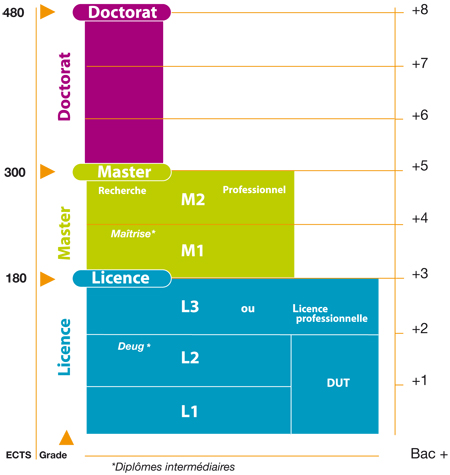
Here are the list of french degrees (levels could be different in other countries) :

  • You gain the ability to study at university level when you obtain the baccalauréat, you become a bachelier
  • After 3 years of study at university level, you will gain a License
  • After 4 years of study at university level, you will gain a Maitrise
  • After 5 years of study at university level, you will gain a Master
  • After >7 years of study at university level (and a thesis), you will gain a Doctorat
Cédric Julien
  • 6,739
  • 6
  • 35
  • 63
  • Thank you for the answer. I got my degree after 4 years of study. But translators do not have the right to translate according to the equivalence, because for some specialities there is a loss of a year, when entering a French University. – May Mar 05 '13 at 10:01
  • 5
    While I'm sure this is accurate for France and thus what the OP wanted, it might be worth mentioning that things do differ country to country and this would not be applicable, say, in French Canada, where a baccalauréat is a university degree. – Kareen Mar 05 '13 at 15:06
  • @Kareen : right, I added some precisions about that... France only :) – Cédric Julien Mar 05 '13 at 16:05
  • 2
    @Kareen actually, the french baccalauréat is the first university degree :-) – Benoît Mar 06 '13 at 06:31
  • @Benoît That's not how I'm understanding this answer. If you "gain the ability to study at university level when you obtain the baccalauréat", then you did not obtain your degree from a university. – Kareen Mar 06 '13 at 15:03
  • 2
    @Benoît In any case, what I basically mean is that a Canadian baccalauréat is actually a Bachelor's degree and is obtained after 3 or 4 years of university. – Kareen Mar 06 '13 at 15:10
  • @kareen Benoît is right, the baccalauréat is officially the first university degree. http://www.education.gouv.fr/cid143/le-baccalaureat-premier-grade-universitaire.html – jlliagre May 29 '16 at 00:23
  • @jlliagre "Le baccalauréat sanctionne la fin des études secondaires et ouvre l'accès à l'enseignement supérieur." Unless university is secondary school in France, a French baccalauréat is not equivalent to an American/Canadian bachelor's degree. How that translates to the Russian/Ukrainian degree, I can't say. All I've been trying to say this whole time is that: baccalauréat in France is not equivalent schooling as a baccalauréat in Québec or a bachelor's degree in the United States or the rest of Canada. – Kareen May 29 '16 at 05:17
  • @Kareen The French baccalauréat is by law a university degree. Décret n° 2006-583 du 23 mai 2006 / D. 334-2 Le baccalauréat général est délivré au vu des résultats à un examen qui sanctionne les enseignements dispensés dans les classes de première et terminales préparant à ce diplôme. La réussite à l'examen détermine la collation par l'Etat du grade universitaire* de bachelier.* D. 334-21 Les jurys sont présidés par un professeur des universités ou un maître de conférences nommé par le recteur sur proposition des présidents d'université. – jlliagre May 29 '16 at 19:39
  • @Kareen Of course, I do not question the fact the French baccalauréat is not the same as the US or Canadian bachelor's degrees (or Belgian Baccalauréat for that matter). – jlliagre May 29 '16 at 19:42
  • @jlliagre I see. The fact that it is called a university degree because it is presided over by university professors and not because the students have been studying at the university level is very confusing (to me anyway), but now I understand. Thanks. – Kareen May 29 '16 at 19:58
  • En ce qui a trait au Québec, on a le baccalauréat qui est un diplôme universitaire de premier cycle correspondant à la licence. –  Feb 01 '17 at 07:38
9

Diplôme de bakalavre will not be understood by any French speaker unless they also happen to speak Ukrainian or they have encountered Ukrainian diploma before. This is not a translation, it's a transliterated but untranslated foreign word. Use this word if you want to be precise and you don't care that the reader understands what is meant. This is necessary when translating the diploma itself, because this is a legal document where being precise is more important than being understood, but you should provide an explanation in a separate document.

Translation is not always exact. If two countries have different educational systems, the only way to fully convey the meaning of a foreign diploma is to explain the other country's educational system in detail. Failing that, you will need to resort to an approximation.

If an equivalence exists, it would be the best translation in this context. However the equivalence is likely to be dependent on the university you're applying to (and they may be somewhat flexible as their policies can't possibly cover all cases), so you probably can't use that.

(This paragraph applies to France specifically, other French-speaking countries may use different terms and Québec in particular is very different.) In your CV, write bakalavre and provide a short explanation. Counting the number of years of post-secondary education is common in France. France itself has some complex educational subsystems that are not well-known, so it's not uncommon to have to explain a French diploma to a French person (this is slowly changing as France is moving towards a 3/5/8 Bachelor/Master/PhD system). The idiom for this is « Bac +N », for example a license is a « diplôme bac+3 », a maîtrise (discontinued) is a « diplôme bac+4 », a master is a « diplôme bac+5 ». Since you have 4 years of post-secondary study, you should probably write « bakalavre (bac+4) ».

Do not use bachelier at all in that context in France. Everyone will think that you haven't been to university yet.

Gilles 'SO nous est hostile'
  • 56,258
  • 8
  • 109
  • 229
  • Thank you for the answer. I think I'll send the variation with bakalavre to the embassy. The idea of bac+n sounds reasonable, but as far as I know, for some specialties (like economic or philology) there is a loss of a year, so it's also tricky. – May Mar 10 '13 at 09:21
6

The Baccalauréat in France (or Bac) is an exam you take before going to university (at the end of 12th grade). You shouldn't use that.

The terminology depends on how many years you've studied, starting when you join your university. Licence is three years, Master is 5 years and Doctorat is 8 years. (See here)

From what I've understood, a bachelor's degree can take different amounts of time depending on your school, but I guess if you had a master's degree you would have said so, so I recommend you use "Licence en informatique".

But studies are never completely equivalent, so that's just to give an idea of what your diploma is to a French. Only see this as an approximation. I would add the original name of the degree, like this:

Diplome : Licence en Informatique (Bachelor's degree in Computer Science) - School XXX, Year.

Teleporting Goat
  • 12,085
  • 20
  • 46
3

Hmmm - I do not think that "Baccalauréat Informatique" exists (I could be wrong).

In any case, a US Bachelor's degree would correspond more to a French Licence (en/d'informatique), if we go by the number of years of study after high-school: the French Licence takes three years after graduating from high-school. I would go with Licence d'Informatique as a close equivalent of "Bachelor's degree in computer science". If you studied for four years after high-school, then the French equivalent would be a "Maîtrise". Five years would be a "Mastère".

Note that the French "Baccalauréat" is awarded upon graduation from high-school, so it is not equivalent to a US "Bachelor's degree" at all, although the root for these two words in Latin is the same.

A copy of an official document from the French Consulate in Boston with current (2017) information on that topic:

enter image description here

This site also has official, current information: CIEP.

Frank
  • 9,199
  • 1
  • 20
  • 39
  • "Licence en informatique" rather than "Licence d'informatique" – sapienz Feb 01 '17 at 08:35
  • @sapienz - check out this link: https://books.google.com/ngrams/graph?content=licence+en%2C+licence+de&year_start=1800&year_end=2000&corpus=7&smoothing=3&share=&direct_url=t1%3B%2Clicence%20en%3B%2Cc0%3B.t1%3B%2Clicence%20de%3B%2Cc0 - both are found? – Frank Feb 01 '17 at 15:20
  • A BA is usually given a DEUG as an equivalence, they won't give you a License. How do I know? I got one for a four-year BA. Then, I got a French License, one more year, in France. – Lambie Feb 01 '17 at 19:27
  • From the French Consulate in Boston: http://www.consulfrance-boston.org/Higher-Education-in-France-and-the-United-States – Frank Feb 01 '17 at 21:06
  • Lambie - the DEUG doesn't exist anymore since the LMD reform: "En France, le diplôme d'études universitaires générales (DEUG) est un diplôme national de l’enseignement supérieur. Il est délivré entre 1973 et la réforme LMD (2003 à 2006). Il correspond aux deux premières années de l’université, après le baccalauréat et avant la licence. En tant que diplôme du premier cycle, il est accessible à tous les titulaires du baccalauréat." – Frank Feb 01 '17 at 21:15
  • Whatever, but they will only give you two years so it really does not matter. They will not give you a license for BA in ANY CASE. Where it says BAC or équivalent, that's RIGHT. You need two years of US university or college before you can go to a French university. A French BAC is equal to two years of US college (university). That is what the diagram does not say. – Lambie Feb 01 '17 at 21:46
  • 1
    @sapienz No, “licence d'informatique” is a lot more common, it wouldn't come to my mind to say “licence en informatique”. I'd never realized that some subjects use en and I wonder why. – Gilles 'SO nous est hostile' Feb 01 '17 at 21:59
  • @Gilles - check out the actual stats here at the ngrams link above though. – Frank Feb 01 '17 at 22:00
  • @Lambie Formal equivalences often give you less than the corresponding degree. Frank, although the DEUG no longer exists, it's still important to recruiters, as there are more people in the workforce who have one than people who studied after the LMD reform. P.S. your Ngrams include a lot of parasite hits, check my question for some more precise ones. – Gilles 'SO nous est hostile' Feb 01 '17 at 22:00
  • @Gilles - pointer to your question? I tried with "licence d'informatique, licence en informatique" rather than "licence de, licence en", but that didn't seem to work. – Frank Feb 01 '17 at 22:31
  • In fact, we don't use "de" nor "en" anymore! I checked a few universities, and found e.g. "licence histoire", "master économie" ... So no point arguing about whether "de" or "en" is correct :-) – Frank Feb 01 '17 at 23:34
1

French native here,

"Diplome du baccalauréat" is a diploma you pass at the end of your high school years, in France it is worth mentioning what was your speciality (S (science), L (literature), ES (economic and social))

A bachelor degree, is equivalent to a "License, bac +3" bac +3 stand for the 3 years you studied to get your degree.

Hope this can help you or someone else in need.

  • First of all, one doesn't pass a diploma in English and secondly, a bac is not equivalent to a high school diploma. – Lambie Jun 01 '22 at 16:42
0

There aren't equivalence between Franch diploma and American diploma. A Bachelor Degree in Maths it's approximately a "Lincence Mathématiques" in France (after 3 years in university). So, if you need to study in France after a Bachelor Degree, maybe you will be in Maîtrise (Master 1).

aleck
  • 1
0

You cannot base the equivalence on the number of years at the University, because in France the lycée usually lasts until you are 18 years old whereas College in NA ends at your 19. By the way, that extra year prevents you from joining NA Universities right after the french baccalauréat.

A bachelor degree is usually recognized as something between a License and a Master. It depends of your field of study and if the entity that delivers the diploma in your country has some sort of deal with the same French entity.

As an example, I am preparing a Bachelor Degree in Electrical Engineering at Montréal, Québec, CANADA, in a school allowed to deliver an "engineering diploma" by the Ordre des Ingénieurs du Québec (OIQ).

In France, the same entity is the Commission des Titres d'Ingénieur (CTI) and it delivers a Diplôme d'Ingénieur.

The OIQ and the CTI made some sort of deal to make sure both country recognize the diploma delivered by the other.

Thus, my Bachelor Degree in Electrical Engineering would be the equivalent of a French Diplôme d'Ingénieur, which is slightly higher than a Master (here again, a Master in France and a Diplôme d'Ingénieur are both 5 years at the University but the former is above the latter).

You could try to find information about your country on this website.

DRz
  • 285
  • 1
  • 7
0

En France, les différents diplômes courants et utiles sont les suivants :

  • Bac (en fin de lycée avec des spécialisations)
  • DUT ou BTS (Bac +2, ce sont des diplômes particuliers centrés sur les aspects métiers et moins sur la théorie. Il sont enseignés dans des établissements dédiés. De nombreuses personnes ont ces diplômes mais une réforme vas les faire disparaitre. Le DEUG n'est déjà plus utilisé.)
  • Licence (Bac +3, Licence professionnelle si elles sont plus centré sur les aspects métiers et moins sur la théorie.)
  • Master (Bac +5, Il existe également des écoles d'ingénieurs qui donnent un diplôme d'ingénieur qui est souvent mieux reconnu en France. C'est un vieil héritage qui date de l'époque napoléonienne et qui n'a pas vraiment de sens)
  • Doctorat (Bac +8, accompagné d'une thèse)

Je ne connais malheureusement pas le système de diplômes ukrainiens, mais si tu dois retenir des niveaux d'études qui seront bien compris, utilise bac si tu n'as pas fait d'études après ton équivalent du bac, Bac +2, Licence, Master et Doctorat.

Pour tous les intermédiaires juste Bac + le nombre d'années après le bac.

Toto
  • 14,992
  • 8
  • 37
  • 62
Elthel
  • 1
  • 1
-1

Diplome du baccalauréat, at least how it is in Quebec, I think it's the same in France.

EDIT: Now at home I checked Évaluation comparative des études effectuées hors du Quebec: É*tudes universitaires de premier cycle complétées (programme de quarte années de baccalauréat).* I graduated University in Russia (5 years). So, they gave me bac, not master.

Alexan
  • 211
  • 1
  • 4
  • 9