2

Is it possible to say Ils visiteront chez lui to convey the meaning They will visit his house?

If it is wrong to use chez lui that way,

  1. is this counted as a grammatical mistake?

  2. would a French person understand what I mean?


Edit: Here is the link that made me ask this question.

Xfce4
  • 503
  • 2
  • 7
  • That is a famous artist. They will visit his house. C'est un artiste très connu. Ils visiteront sa maison. In that sense, OK. – Lambie Oct 05 '21 at 19:46
  • It is extremely difficult to answer questions about what a person hears another say in a language that is not their native language. I know tons of people who get by in everyday life with really ratty English (for a number of reasons) but they could do with some help to make their English more idiomatic. It's hard enough sometimes to understand native speakers.... – Lambie Oct 05 '21 at 20:05
  • 2
    Related: https://french.stackexchange.com/questions/8447 & https://french.stackexchange.com/questions/14142 – jlliagre Oct 05 '21 at 20:18
  • @jlliagre Neither of those provide a broad picture. – Lambie Oct 05 '21 at 21:22
  • 4
    @Lambie Did I suggest they do? Related – jlliagre Oct 05 '21 at 21:34
  • @jlliagre It just does not matter what I say or how I say, you create issues for me. The OP is not even an English speaker so I wonder what they mean by: They will visit his house. How do I know? Because of their use of the word shun. You reject an answer, you don't shun it. So, what is the question here really? They will visit his house? To see it to buy it. Or: They will visit his home, as they are guests. There is no way to tell. Ergo, the translation is not really possible. – Lambie Oct 05 '21 at 23:17
  • 4
    @Lambie I don't reject your answer. I didn't downvoted it. I wrote it is mostly true. I quote you in my reply saying you were right saying museums are visités in French, not houses. Who cares about shun, this is FSE. The question is about a queen and a king visiting someone's house and you talk about a realtor, seriously? I provided useful links to questions related to the usage of visiter in French. You replied with a rude and inappropriate comment. Am I the one creating issues? – jlliagre Oct 05 '21 at 23:30

4 Answers4

2

The other answers don't mention the most important points. You cannot use it alone or at least not outside of colloquial speech. The reason "ils visiteront chez lui" is not used alone is because "chez" is a special preposition, which has the particularity of meaning "at or in [his home]" depending where it's used. This means that the action of "visiter" is made at his house, but you don't know what is visited. This would be equivalent to "They will visit at his house". The effect is the same in French (it might stand out a bit less due to the confusing nature of "chez").


Disclaimer: This part might be only applicable to Quebec and Africa according to Larousse: "En Afrique et au Québec, rendre visite à quelqu'un, aller le voir : Elle est allée visiter sa grand-mère." But I have a feeling this isn't exclusive to us considering the answer of @LPH showing many examples where visiting someone is acceptable.

According to my explanation, you would expect the same construction in French: "Ils visiteront sa maison". Note here that visiting a place, like a house, imply that you will visit as in some sort of tour. If you want to visit people, you will specify it. I expect the same kind of logic in English.

If you add an object, the form is now possible. "They will visit Bob at his house". This would translate to "Ils visiteront Bob chez lui". You can also use a pronoun in this case: "Ils le visiteront chez lui". Notice how a simple "le" can change a lot.


The answer to both of your questions is yes. It is ungrammatical but people will easily understand what you mean. Even some French people might use it because technically, this preposition is special and confusing since it implies "home" in the mix.

Simon
  • 538
  • 2
  • 9
  • Very well put. Thank you. Bear in mind though in English: They will visit his house. sounds like a real estate agent taking people to see it or that the house is a museum. The verbs may have the same meaning but rendre visite à in English is just visit, not pay a visit. That is my only difference of opinion here. – Lambie Oct 06 '21 at 17:49
  • @Lambie "Je vais rendre visite à Marie" and "I will pay a visit to Marie" is the exact same thing. "Ils vont visiter sa maison" and "They will visit his house" is the exact same thing. This is why I'm saying that it's irrelevant to the question. The question is about "visiter chez lui" vs. "visit his house". The fact that you're confused is why I think the other answers are misleading. – Simon Oct 06 '21 at 17:59
  • Je vais rendre visite à Marie can just be: I will visit Marie. It is a false equivalence to say that rendre visit must be pay a visit. It doesn't. – Lambie Oct 06 '21 at 18:01
  • @Lambie "Je vais rendre visite à Marie" actually can be "Je vais visiter Marie" just like in English... Now the real question is, can "visit his house" in English be used as "visit him"? According to your first comment, it can't and it sounds like a house tour, which would confirm my first statement, that they're equivalent. – Simon Oct 06 '21 at 21:20
  • No, "visit his house"" cannot mean "visit him". That is precisely my entire point. – Lambie Oct 06 '21 at 22:46
  • @Lambie It's the same thing in French... "Visiter une maison" cannot mean "visiter une personne". The main answer seem to have wrongly assumed that this was the case in English. I'm telling you, the meanings of both expressions are equivalent. – Simon Oct 06 '21 at 23:12
  • @Simon Tu fais référence à ma phrase On ne sait pas trop si le sens n'est pas plutôt, « ils vont nous rendre visite dans notre maison et ensuite, nous irons visiter leur château » ? – jlliagre Oct 07 '21 at 09:29
  • @jlliagre non, ta réponse n'est plus la même qu'au début et précise bien maintenant, donc ma déclaration n'est plus valide. – Simon Oct 07 '21 at 11:07
  • Oui, je l'ai modifiée après avoir lu et répondu à ton commentaire. J'ai compris en me relisant l'ambiguïté qu'on pouvait y trouver, merci ! – jlliagre Oct 07 '21 at 11:54
1

Is it possible to say "Ils visiteront chez lui" to convey the meaning "They will visit his house"?

Suivant le sens qu'on donne à they will visit his house, ça peut être possible mais c'est très peu idiomatique.

Si on parle du roi et de la reine comme dans la phrase de Duolinguo (The king and the queen will visit our house, and we will visit their castle), la traduction « ils visiteront sa maison » proposée par duolinguo est bien plus naturelle que « ils visiterons chez lui ». Il n'en reste pas moins que la phrase est curieuse car comme l'a justement écrit Lambie, ce sont les musées ou les châteaux qui se visitent, pas une maison ordinaire. On ne sait pas trop si le sens attendu n'est pas plutôt, « ils vont nous rendre visite dans notre maison et ensuite, nous irons visiter leur château » même si ni visit our house ni « visiter sa maison » n'impliquent la présence de ceux qui y résident.

« Visiter » peut avoir certains sens qui peuvent rendre moins improbable cette expression en français, mais encore plus éloignés de la vie de tous les jours d'un couple royal.

B. - 2. a) Examiner à fond et méthodiquement un lieu, un objet (appareil, document, installation, bagage à la douane, etc.) Synonyme contrôler, inspecter, vérifier.

qui permet (source) :

Alors je m'explique, la police m'a rendu visite alerté par un de mes voisin qui m'aurai balancé. Bref, ils ont visité chez moi (un studio de 30m² à Paris) on en a vite fait le tour...

Un autre sens:

B. - 2. c) Familier Examiner, fouiller ce qui est susceptible de contenir de l'argent, des objets de valeur; pénétrer dans un lieu par effraction pour y dérober quelque chose. Visiter un appartement, un coffre-fort, un sac à main, un vêtement.

Qui pourrait permettre :

Il y a des cambrioleurs qui circulent dans le quartier. J'ai fait installer un système d'alarme très dissuasif qui empêche de rentrer dans mon jardin parce que je suis sûr que sinon, pendant mes vacances, ils visiteront chez moi.

Il n'en reste pas moins que la phrase « ils visiterons ma maison » reste plus naturelle dans ce cas-là aussi.

jlliagre
  • 148,505
  • 9
  • 106
  • 237
  • I really wonder why someone downvoted this answer. – Xfce4 Oct 05 '21 at 21:51
  • 1
    @Xfce4 I have my idea ;-) – jlliagre Oct 05 '21 at 21:52
  • Exceptions can be found to everything. However, they will visit his house and your police example are based on a fallacy. In French, the cops can "visiter" une maison but that is not the translation of "The cops will visit his house". It is the translation of: The cops will come to his house. Because we don't use visit to mean come by, show up or come to. Hier. nous avons visiter le Musée d'Orsay. Yesterday, we went to the Orsay Museum. Not visit. – Lambie Oct 05 '21 at 23:06
  • 3
    @Lambie You clearly misunderstood my reply. – jlliagre Oct 05 '21 at 23:33
  • Alors je m'explique, la police m'a rendu visite alerté par un de mes voisin qui m'aurai balancé. Bref, ils ont visité chez moi (un studio de 30m² à Paris) on en a vite fait le tour.. = NOT They will visit my house. in English/ – Lambie Oct 06 '21 at 00:02
  • 1
    @Lambie Est-ce que j'ai écrit quelque part que c'était une traduction de they will visit their house ? J'explique les rares cas où la phrase de l'OP Ils visiteront chez lui pourrait avoir un sens. Tout le monde est conscient, y compris l'OP, que ça ne traduit pas la phrase They will visit my house dans un contexte où un roi et une reine rendent visite à quelqu'un. En plus, comme tu l'as écrit, ce n'est probablement pas un anglophone donc l'anglais, on s'en fiche un peu ici, c'est le sens de visiter en français qui peut intéresser les lecteurs d'un site consacré à la langue française. – jlliagre Oct 06 '21 at 00:21
  • Ils visiteront chez moi est du langage familier. "Ils me visiteront chez moi" est la formulation correcte (ou ils visiteront ma maison, dépendamment du sens). – Simon Oct 06 '21 at 23:25
  • @Simon C'est vrai, mais attention à ne pas rejeter le langage familier ou a confondre familier et incorrect. La langue familière est celle qui est largement la plus utilisée pour la plupart des gens, hors familles royales peut-être... – jlliagre Oct 06 '21 at 23:50
  • @Simon In the last quote, the person says he is going to be on vacation. By the context, it is understood that he will be far from his home and wants to protect the house. How can the correct usage /complete sentece be Ils me* visiteront chez moi*? – Xfce4 Oct 07 '21 at 01:41
  • 1
    @Xfce4 You're totally right, as specified in my brackets, the correct use would be ma maison in this use case. If you were at your home, the previous sentence would be the correct one. Note that in the familiar language, it's fine to use it, as jlliagre mentioned. – Simon Oct 07 '21 at 01:47
  • @Simon Would it be okay to say Ils me* visiteront chez moi* for burglars when I am home and their intent is to steal? – Xfce4 Oct 07 '21 at 03:14
  • No, that would be very odd, or an anglicism. Places are visited, not people. – jlliagre Oct 07 '21 at 07:29
  • and even in the few cases where visit people is possible in French (eg. by a doctor), il me visite wouldn't be used. – jlliagre Oct 07 '21 at 09:21
1

Yes, this is possible, but only when you want to make precise that the people you are visiting are being visited in a particular place, which can even be their own place. However, there must be an object, as in the ssentences shown below. Otherwise this is meaningless: it does not convey the meaning of "they will make an inspection of the house", which is said as follows: "il feront une visite chez lui", "il feront une visite de son habitation", ….

The following examples are issued from this Google page, on which you'll find plenty more.

  • de pauvres hères qui assiègent nos dispensaires , nos hôpitaux , que d'admirables Françaises visitent chez eux ..

  • profitant de leur sortie de chaque dimanche , visitent chez elles des familles pauvres du quartier Mouffetard et leur distribuent des bons de pain .

  • elles se partagent les enfants , les visitent chez leurs parents , chez leurs maitresses et chez les seurs , et présentent au Conseil un rapport sur la

  • Vendredi 25 juillet 2008 Nous avons décidé de consacrer ce vendredi à la réception d'amis qui nous visitent chez Christine.

Normally, the specification is not included and you use simply the following verbal expressions which have the same meaning.

  • visiter, rendre visite à, faire une visite à

Examples

  • (ref. 2021) Parfois, je la visite juste pour la saluer et m'assurer qu'elle est bien. Nous allons aussi visiter l'entrepôt de Daniel qui est dans le domaine de la ...

  • (ref. 2014) A l'époque où j'accomplissais mon service militaire, ma mère, qui s'était remariée, avait suivi son second mari en Espagne, où je la visite chaque été.

  • (ref. 2001) Je le visite pour lui présenter des condoléances pour la mort du fonctionnaire du troisième rang [ Fujiwara no ] Michimoto

  • (ref. 2007) Il n'en parle pas, pourtant il a visité ses parents. Il est tellement plein de ses préoccupations religieuses et missionnaires qu'elles seules font le sujet .

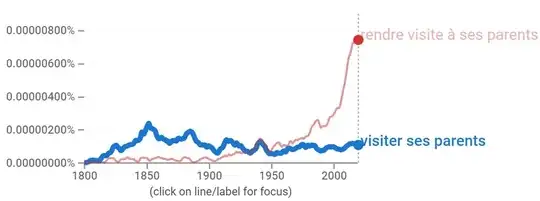
You can see from the following ngram that "visit" is used much less than "rendre visite" ; however, both forms are fully idiomatic, and you can use whichever you want.
enter image description here


Addition prompted by a comment from user Xfce4

Le roi et la reine visiteront notre maison et nous visiterons leur château.

As modern French, this phrasing is puzzling on account of the likely breach from reality that can be read into it or on account of the particular use of "visit". A king and queen might visit a great house (in the sense of visiting a museum), and it would have to be quite an impressive house, but excepting this possibility of greatness, what remains is only the eventuality of paying a visit to somebody, which is conceivable in the context of sovereigns feeling honour bound to show a certain consideration to some of their subjects (meritorious ones, for instance), but then the verb is wrong. So the sentence is acceptable in the "museum" context; otherwise, I would rephrase it as shown below.

  • Le roi et la reine nous visiteront chez nous et nous les visiterons dans leur château. ("chez nous" rather than "dans notre maison" or "à la maison" because of a felt greater idiomaticity, hard to define and possibly a mere personal impression; nevertheless, the other choices are acceptable, I think.)
LPH
  • 1
  • 3
  • 17
  • 56
  • We don't "make precise". préciser is to specify or be specific. Specification is not the right word here. Specifying is not included. You simply use (not "use simply:" which has a different meaning). Rendre visite and visiter are not the same thing exactly the same thing and their usage is specific. – Lambie Oct 05 '21 at 23:12
  • @Lambie ex.: Trying to make precise that which is merely implied and indeterminate runs the hazard that the result (https://www.google.com/search?q=%22make%20precise%20that%22&tbm=bks&lr=lang_en). I agree that "be specific about" is fine and possibly more elegant, but "make precise" is correct. // I don't believe either that "specification" is incorrect; here is the SOED definition: 1c A specified item, a detail, etc.. What else if not a detail is this fact that the visit occurs in a given place? // (1/3) – LPH Oct 06 '21 at 13:18
  • @Lambie Your use of "simply" is perhaps an option. However, here are examples from the books, and you can check them: You could also use simply lab plus x for laboratory instead of labo.Now , those officers have been trained up to use simply a certain type of weaponmany researchers and some writers about effect sizes have come to use simply d to denote Cohen's variance-poolingLeonard and Mokhtari use simply the upwind value 5Φ =ΦUnix/ Linux systems, and Windows in text mode, use simply "\n". (2/3) – LPH Oct 06 '21 at 13:18
  • @Lambie • (course) _ you can use simply powdered sugar // Your last remark is also wrong: those two verbal forms are synonymous. Check this: "rendre visite (v. trans.) (transitif indirect : à) aller voir, passer, venir voir, rendre une visite (V+à+qqn), visiter (V+qqn)". (http://dictionnaire.sensagent.leparisien.fr/rendre%20visite/fr-fr/) // One more time, all your suppositions have not been verified and they are all wrong.( 3/3) – LPH Oct 06 '21 at 13:20
  • It doesn't matter how many cubic meters of text you post to flood out my idea, my remarks are accurate. Sorry. "to do something simply" is not "to simply do something". – Lambie Oct 06 '21 at 16:07
  • @Lambie I do not post cubic meters and what I post are referenced refutations; if you think you are too good for consulting references, what can I do? I am certainly not going to modify my writing, at least not until you come up with sensible proofs of what you say; however, as most discussions with you result in a lot of assertions for which you refuse to give references while on top of that you refuse to consider the referencess that are shown to you, there is little chance of that happening. You are now showing yourself consitently as dishonest. – LPH Oct 06 '21 at 16:43
  • You should run some of your texts past an English language editor, like Jason on ELL or ELU. In, say, 300 words of your texts, there are so many non-English variants, that it is impossible to do here. And your refutations are always "rivers of text". – Lambie Oct 06 '21 at 16:46
  • @Lambie There are references in it and you clearly ignore them because they prove you wrong (two of them the last comments, the Oxford dictionary and the Parisian; you say nothing about that). – LPH Oct 06 '21 at 17:01
  • @LPH Thank you. This was a quite nice answer. What do you say about the usage on Duolingo? Is Le roi et la reine visiteront notre maison a valid sentence? Is there a better alternative to convey the meaning? – Xfce4 Oct 07 '21 at 01:11
  • 1
    @Xfce4 My reply to your comment is in my answer, as an addition I just made. – LPH Oct 07 '21 at 05:28
0

rendre visite à quelqu'un: to vist someone

rendre visite à quelqu'un chez lui/elle, etc.

rendre visite [à quelqu'un] à la maison [pas au bureau, donc]

maison is for house, chez lui is more like at home.

"visiter sa maison" as in a museum-type of thing can be, yes: visiter sa maison.

rendre visite

Visiter means to visit a place, such as a city or monument.

[...]

Easy enough, right? The problem is that visiter can only be used for inanimate nouns.

When visiting people, the French expression is rendre visite à.

[Bolding mine]

Lambie
  • 1
  • 11
  • 23
  • Thank you but why do you introduce a new word, i.e rendre? I would like to know what Ils visiteront chez lui means exactly. – Xfce4 Oct 05 '21 at 19:27
  • 1
    @Xfce4 If you visit a person, the French is rendre visite à. Languages don't have word-for-word equivalences. You have to work with the meaning, not the individual words. – Lambie Oct 05 '21 at 19:33
  • Here is the original case https://forum.duolingo.com/comment/32832064. This is why I shun rendre. – Xfce4 Oct 05 '21 at 19:37
  • @Xfce4 I do not want to enter into an entire discussion here. I have given you what they say in France for visit people and cannot do better. I also gave you the difference between at home, at the house and at the office. The only French person in that link says the same thing as I just did. Ils visiteront chez lui sounds like an American or other English speaker trying to speak French and getting it wrong. Cheers. – Lambie Oct 05 '21 at 19:45
  • Thank you. I shared the link to show you that the meaning is not about visiting someone, but their house. – Xfce4 Oct 05 '21 at 19:48
  • @Xfce4 Now you can say it "all". House only in the sense of an actual house. – Lambie Oct 05 '21 at 19:49
  • Do you mean I can say Ils visiteront chez lui to mean They will visit his house ? – Xfce4 Oct 05 '21 at 19:51
  • 1
    @Xfce4 No, of course not. That is not idiomatic in French for any of this. Please just use my answer as a guide.... – Lambie Oct 05 '21 at 19:55
  • @Lambie FWIW I didn't downvote your answer. Most of your reply is correct but you might want to temper the statement visiter can only be used for inanimate nouns because there are well known and documented exceptions. – jlliagre Oct 05 '21 at 22:09
  • @jlliagre I don't think that beginners and intermediate learners need well-documented exceptions especially when they still haven't got a grasp on the basics. You can find an exceptions to just about any "rule". If you think "Ils visiterons chez lui" as in the cops coming to the house is in English, "They will visit his house", you haven't understood the English. Cops come to houses, they don't visit them. And I did say: visit his house as in visiter la maision {d'un artiste). – Lambie Oct 05 '21 at 23:02
  • @Lambie I don't think that beginners and intermediate learners need to be fed with incorrect statements. It doesn't cost a lot to replace can only be by is almost only in a sentence. Le médecin visite ses malades is an extremely common expression, nothing exotic. Please don't gaslight me, there is nowhere a mention of "cops visiting a house" (in English) in my reply. I'm answering to the OP question #2 and explain what might be understood if that sentence is heard. – jlliagre Oct 05 '21 at 23:18
  • @jlliagre "Alors je m'explique, la police m'a rendu visite alerté par un de mes voisin qui m'aurai balancé. Bref, ils ont visité chez moi (un studio de 30m² à Paris) on en a vite fait le tour..." [sic] – Lambie Oct 06 '21 at 16:05
  • Il semble que tu n'as pas vu que j'avais précisé *in English*. – jlliagre Oct 06 '21 at 20:35