6

Recently, I've been learning French language and I've noticed that many words in English have similar words in French, for example the word “example” in English and the word “exemple” in French. If I want to use this rule to guess the meaning of some French words by comparing to their English brothers, I have to be careful about the counterexamples, the words that are spelled similarly in French and in English, but have very different meaning in each language. For example, the word “comment” in English and in French.

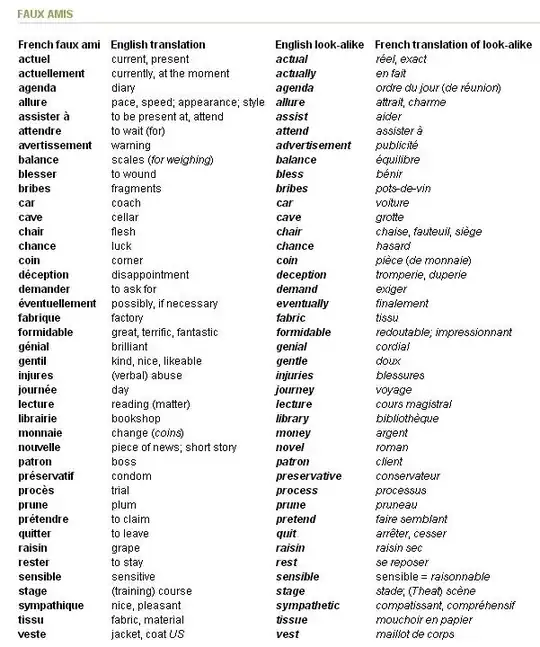
Therefore I'd like to know: Is there any (preferably online) list of such (counterexample) words in French & English?

Of course, I don't need an exhaustive list of all counterexamples of the above rule. A short list of very commonplace words would be more useful.

Édouard
  • 7,545
  • 1
  • 28
  • 49
  • 4
    The term you are looking for is "faux-amis" ("false friends" in English). From the Wikipedia article, you could have found this list for example. – Alexis Pigeon Jul 22 '14 at 07:49
  • 1
    Two of the most comprehensive lists of French false cognates (faux-amis in French) : perso.numericable.fr/jeuxdelettres/HTML/faux_amis/faux_amis.htm and fr.wiktionary.org/wiki/Annexe:Faux-amis_anglais-fran%C3%A7ais – None Jul 22 '14 at 08:13
  • 1
    Are you looking for a list of false cognate (words which are close in orthographe but have different meanings, such as “comment”) or a list of words with the same meaning, but different orthographe (such as “example/exemple”? These are two different things. – Édouard Jul 22 '14 at 09:31
  • Good luck with gallicisms (this is the exact word for "false-friends" coming from the French language)! (Gallicisme en français) – Sifu Jul 22 '14 at 12:31
  • @Édouard: I am looking for a "short" list of common false cognates. –  Jul 22 '14 at 12:34
  • 1
    @Sifu IIRC, gallicisms are to english what anglicismes are to french: word, expressions or figure of speech borrowed from one language to the other. – Édouard Jul 22 '14 at 12:55
  • @VahidShirbisheh In that case, I would remove all references to “examples” as they make your question unclear. – Édouard Jul 22 '14 at 12:56
  • This thread ended up with quite a long list, although realistically many of these so-called "false friends" wouldn't be confused in actual usage. http://www.forum.french-linguistics.co.uk/forum/topics/faux-amis – Neil Coffey Jul 22 '14 at 17:18

1 Answers1

9

First 7 results on google :

French English False Cognates - Faux Amis (formerly on French.about.com)

http://www.oxfordlanguagedictionaries.com/Public/PublicResources.html?direction=b-fr-en&sp=S/oldo/resources/fr/Difficulties-in-French-fr.html

I think this last one (oxfordlanguage) offers a good small list :

oxfordlanguage List of gallicism

http://www.frenchcrazy.com/2011/08/french-english-false-cognates.html

Most Common False Cognates in French: A List of Students

http://www.macmillandictionaries.com/MED-Magazine/July2003/09-french-english-false-friends.htm

http://french.answers.com/language/common-false-french-to-english-cognates

False cognate on Wikipedia.

Does that help you?

Tsundoku
  • 539
  • 2
  • 7
  • 26
Sifu
  • 1,159
  • 1
  • 7
  • 18
  • Thanks @Sifu, the things that I didn't know these words are called false friends or false cognates. –  Jul 22 '14 at 12:48
  • You will find more references with "False friends" or "False cognates". But the exact and proper term for those are Gallicism. – Sifu Jul 22 '14 at 13:00