10

Is there a French equivalent to the English phrase "Cloud Cuckoo Land"? This noun phrase is used to describe an imaginary place that a person is in when they the speaker believes that they're hoping for that which is unattainable, or practising wishful thinking. An example would be:

I've invented a great new product!
You're living in Cloud Cuckoo Land if you think that is going to save the company from bankruptcy.

Evpok
  • 20,004
  • 7
  • 70
  • 137
Jez
  • 10,273
  • 19
  • 60
  • 109

6 Answers6

18

Officiellement, Coucouville-les-nuées est la traduction de l'original Νεφελοκοκκυγία d'Aristophane.

Mais je doute fort que grand-monde la comprenne. Opte pour les bisounours, ou éventuellement l'expression sur un petit nuage ou sur son petit nuage ou peut-être même dans les nuages.

Ou encore, peut-être plus habituel, se faire des (douces) illusions :

J'ai inventé un produit génial!
Tu te fais des douces illusions si tu crois que ça va empêcher la faillite de l'entreprise.

Et dans ce cas, à vrai dire, l'expression n'est même pas nécessaire pour peu qu'on ajoute un peu d'emphase :

Si tu crois que ça va empêcher la faillite de l'entreprise !

Il y a encore le classique tu te fourres le doigt dans l'œil, et notons aussi qu'on peut proposer à quelqu'un qui se trouverait sur son nuage de redescendre sur terre :

J'ai inventé un produit génial!
Redescends sur terre, ce n'est pas ça qui va empêcher la faillite de l'entreprise.

Joubarc
  • 14,653
  • 6
  • 53
  • 103
17

In a non official context, you can translate it with

le pays des Bisounours

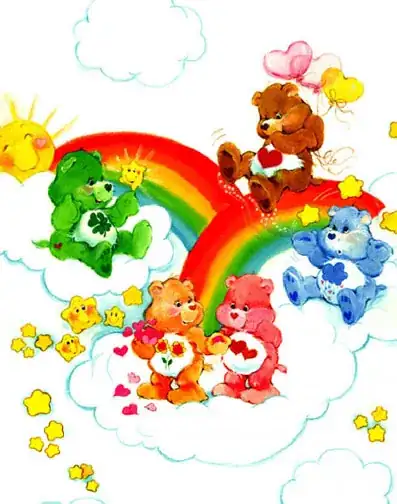
where “Bisounours” (apparently known in the US as Care Bears) were popular characters of a children TV program where everybody were nice and everything had happy endings.

Bisounours

If you seek a little more “sarcastic” reference, you can use a title of a Jean Yanne movie:

Tout le monde il est beau, tout le monde il est gentil.

Stéphane Gimenez
  • 30,422
  • 13
  • 71
  • 152
Cédric Julien
  • 6,739
  • 6
  • 35
  • 63
  • Cédric, you scooped me by 27 seconds, so I merged my answer with yours above (well, the Wikipedia link and the image, basically). I hope you don't mind… – F'x Sep 09 '11 at 12:41
  • @F'x no problem, I was just looking for an english version ;) – Cédric Julien Sep 09 '11 at 12:43
  • I'd think using "bisonours" really depends of the context. Not everyone will grasp what you mean. – Nikko Sep 09 '11 at 14:05
9

In French, something that will be understood by everyone and don't depend on your cultural background:

— Descends de ton nuage.

(climb off your cloud)

with some variants:

— Tu vis sur un nuage.

— Tu vis dans un monde imaginaire.

Nikko
  • 815
  • 5
  • 11
6

I've also heard (and I'm using) other possibilities like:

  • C'est [pas] le monde de Oui-Oui (french version of Noddy)
  • C'est [pas] Disneyland (no reference needed for this one I think)

I particularly like the last one and when I hear it, the (excellent) movie Le goût des autres comes to my mind with the following quote:

- Mais non, il est pas moche le monde, Madame Castella... Il est comme il est, faut faire avec...
- Non ! Moi j'ai pas envie de faire avec ! C'est trop dégoûtant, c'est trop horrible, ça m'intéresse pas.
- Ben faut vivre à Disneyland...

Le monde des Bisounours works quite fine also.

LudoMC
  • 2,478
  • 2
  • 23
  • 25
2

Tu vis dans la Lune marche aussi depuis Cyrano de Bergerac au moins :D

Kheldar
  • 129
  • 3
0

For the particular expression as given in the question you could possibly translate by "Si tu crois que X va sauver la société t'as vraiment perdu la boule".
I like that "perdre la boule" expression, and apparently it comes from "losing a sense of direction", but it doesn't use the English expression's notion of "nonsense land", "Noddy land" or, even less, Aristophanes' Νεφελοκοκκυγία.
I wonder whether this is the only example where demotic English has assimilated a classical allusion where French simply hasn't got any equivalent assimilation?

mike rodent
  • 312
  • 2
  • 9