Its possible inheritance isn't the solution, but it depends on the end goal.
In a case where B is A, A would not generally be deployed, but as you've seen, B would acquire all of its state variables and functions. This is a way to modularize and compartmentalize code and you can use well-solved base contracts without cluttering up your app's main contract. Consider:
contract MainMapp is Owned, Pausible, Managed, Factory {}
Those four base contracts would be useless on their own, but the MainApp can acquire a lot of functionality without getting unwieldy.
There is a different pattern you might find more appropriate for your use-case: Separate but related contracts that form a larger system. For example, you might have a Storage contract and then have separate "client" contracts that rely on it for object persistence. This wouldn't be inheritance.
There's a lot wrong with this example, but I kept it as close as I could to yours while still showing the other approach.
pragma solidity ^0.4.11;

contract BaseLookup {

  struct Lookup {
    uint id;
    bytes32 name;
  }

  mapping(uint => Lookup) lookupById;

  function setLookupById(uint id, bytes32 name) public returns(bool success) {
    Lookup memory lookup;
    lookup.id = id;
    lookup.name = name;
    lookupById[id] = lookup;
    return true;
  }

  function getLookupById(uint _id) public constant returns (uint, bytes32) {
    return (lookupById[_id].id, lookupById[_id].name);
  }
}

contract ClientLookup {

  BaseLookup b;

  function DerivedLookup(address baseLookupAddress) public {
    b = BaseLookup(baseLookupAddress);
  }

  struct Lookup {
    uint id;
    string name;
  }

  function set(uint id, bytes32 name) public returns(bool success) {
    return b.setLookupById(id, name);
  }

  function get(uint id) public view returns(uint  theId, bytes32 name) {
    (theId, name) = b.getLookupById(id);
    return (theId, name);
  }
}
To use it, first deploy a BaseLookup contract and copy the address, then deploy a ClientLookup and pass Base's address into the constructor.
Here it is in Remix to show it working:
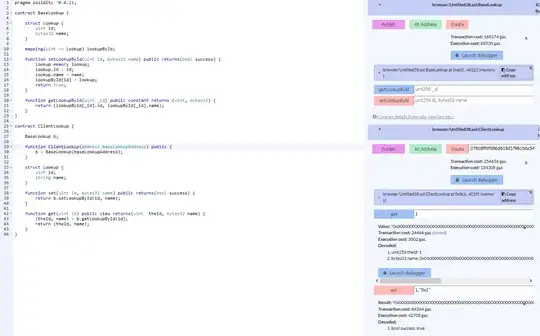
You can avoid storing duplicate information by removing the id from the struct. Have a look over here for examples of how to organize state storage: Are there well-solved and simple storage patterns for Solidity?
Hope it helps.


