I've got something that will help you press on.
The modifier
modifier onlyUser {
    if (msg.sender != userAddr) throw;
    _;
}
prevented all efforts to set a product, because userAddr was never set (==0x0). Added a constructor to look after it and now I can add a product.
After that, getUserProduct() started working. I added "public" to some state vars and some logs to help see what's going on. Watch for other small changes I may have slipped in while debugging.
Worked once. No Warranty. :-)
pragma solidity ^0.4.6;

library DataSet {

  struct IndexValue { uint keyIndex; uint256 value;}
  struct KeyFlag { uint key; bool deleted; }
  struct KeyValue { uint key; uint value; }


  struct Data {
      mapping(uint => IndexValue) data;
      KeyFlag[] keys;
      //KeyValue[] kvpairs;
      uint size;
  }

  function stringToBytes32(string memory source) returns (bytes32 result) {
      assembly {
          result := mload(add(source, 32))
      }
  }


  function getCurrent(Data storage self) returns(uint index){
      return self.size - 1;
  }

}

contract Controlled {
    address public userAddr;

    struct User {
      address a;
      string name;
      string email;
      uint phone;
    }

    mapping (address => User) public Users;

    event LogNewUser(address user, string name, string email, uint phone);

    function Controlled() {
        userAddr = msg.sender;
    }

    function registerUser(string _name, string _email, uint _phone) returns (bool success) {
      Users[msg.sender].a = msg.sender;
      Users[msg.sender].name = _name;
      Users[msg.sender].email = _email;
      Users[msg.sender].phone = _phone;
      LogNewUser(msg.sender, _name, _email, _phone);
      return true;
    }

    modifier onlyUser {
        if (msg.sender != userAddr) throw;
        _;
    }

}

contract Main is Controlled {

  using DataSet for *;
  DataSet.Data d;

  struct userProduct {
    address user_address;
    uint id;
    string desc;
    uint price;
  }

  userProduct[] public products;

  event LogNewUserProduct(address user, uint index, string description, uint price);

  function newUserProduct  (
    address u,
    uint i,
    string d,
    uint p) onlyUser returns (bool added) {

    userProduct memory newProduct;
    newProduct.user_address = msg.sender;
    newProduct.id = i;
    newProduct.desc= d;
    newProduct.price = p;
    products.push(newProduct);
    LogNewUserProduct(msg.sender, i, d, p);
    return true;
  }

  function getUserInfo (uint g) constant returns (address ,bytes32, uint ) {
      for (uint i = 0; i <= products.length; i++) {
          if (products[i].id == g) {
             return(products[i].user_address, DataSet.stringToBytes32(products[i].desc), products[i].price);
          }
      }
  }
}
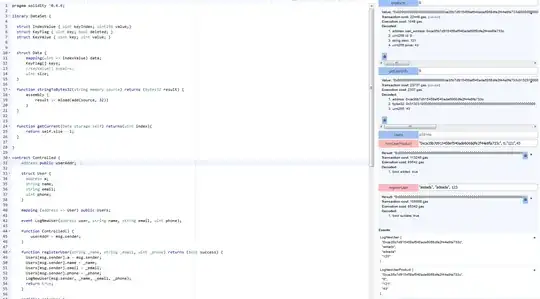
Here it is in Remix to show it working.
Side tip
It's hard to discern the data structure you're aiming for. If you can clarify that for me I might send back a simplified version of this for you.
There are example patterns over here that might help: Are there well-solved and simple storage patterns for Solidity?
Admittedly, it gets a little tricky applying the patterns to joins and there's no generalized example of that in the post.
Hope it helps.
Update
I'm a little confused by who's supposed to do what.
onlyAdmin must be able to create/update attributes/delete the product
from the struct array. onlyManager must be able to update
attributes/delete the product and onlyTester must be able to update
the product attributes
As a caution item, in general, I try to externalize access control concerns. "owner" can be a contract designed to reflect access control concerns.
This scaffold might give you some ideas about how to proceed.
pragma solidity ^0.4.6;

contract Store {

    address public owner;

    enum UserType {owner, admin, tester}

    struct User {
        bytes32 name;
        bytes32 email;
        bytes32 phone;
        UserType userType;
        uint userIndex;
    }

    mapping(address => User) public userStructs;
    address[] public userList;

    struct Product {
        uint price;
        bytes32 description;
        uint productIndex;
    }

    mapping(bytes32 => Product) public productStructs;
    bytes32[] public productList;

    modifier onlyOwner {
        if(msg.sender != owner) throw;
        _;
    }

    modifier onlyAdmin {
        if(!isUser(msg.sender)) throw;
        if(userStructs[msg.sender].userType != UserType.admin) throw;
        _;
    }

    modifier onlyTester {
       if(!isUser(msg.sender)) throw;
       if(userStructs[msg.sender].userType != UserType.tester) throw;
        _;
    }

    // constructor

    function Store() {
        owner = msg.sender;
    }

    // simple counts

    function getUserCount() public constant returns(uint userCount) { return userList.length; }
    function getProductCount() public constant returns(uint productCount) { return productList.length; }

    // Id checks

    function isUser(address user)
        public
        constant
        returns(bool isIndeed)
    {
        if(userList.length == 0) return false;
        return userList[userStructs[user].userIndex] == user;
    }

    function isProduct(bytes32 productId)
        public
        constant
        returns(bool isIndeed)
    {
        if(productList.length == 0) return false;
        return productList[productStructs[productId].productIndex] == productId;
    }

    // inserts

    function createAdmin(address userAddress, bytes32 userName, bytes32 userEmail)
        onlyOwner
        returns(bool success)
    {
        if(isUser(userAddress)) throw;
        userStructs[userAddress].name = userName;
        userStructs[userAddress].email = userEmail;
        userStructs[userAddress].userType = UserType.admin;
        userStructs[userAddress].userIndex = userList.push(userAddress) - 1;
        return true;
    }

    function createTester(address userAddress, bytes32 userName, bytes32 userEmail)
        onlyOwner
        returns(bool success)
    {
        if(isUser(userAddress)) throw;
        userStructs[userAddress].name = userName;
        userStructs[userAddress].email = userEmail;
        userStructs[userAddress].userType = UserType.tester;
        userStructs[userAddress].userIndex = userList.push(userAddress) - 1;
        return true;
    }

    function createProduct(bytes32 productId, uint productPrice, bytes32 productDescription)
        onlyAdmin
        returns(bool success)
    {
        if(isProduct(productId)) throw;
        productStructs[productId].price = productPrice;
        productStructs[productId].description = productDescription;
        productStructs[productId].productIndex = productList.push(productId);
        return true;
    }

    function updateProduct(bytes32 productId, uint productPrice, bytes32 productDescription)
        onlyTester
        returns(bool success)
    {
        if(!isProduct(productId)) throw;
        if(isProduct(productId)) throw;
        productStructs[productId].price = productPrice;
        productStructs[productId].description = productDescription;
        productStructs[productId].productIndex = productList.push(productId);
        return true;
    }

}


