2

For many Ethereum addresses Etherscan shows this:

Then when you click on the "b" link you see something like this:
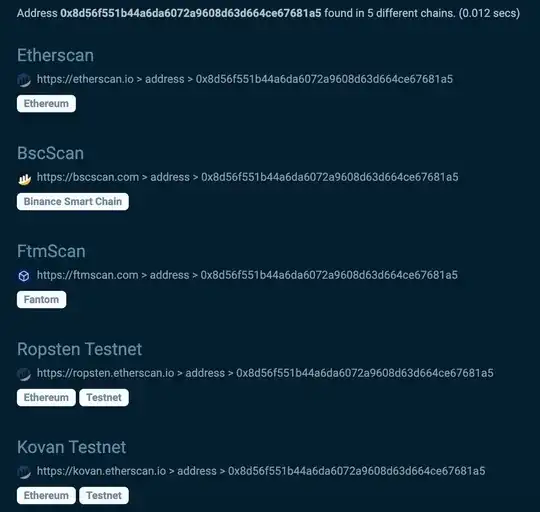
So, this can be just a coincidence, right? Somehow the same public address was generated in all five blockchains but that doesn't mean it's the same person or entity behind each one of them - is that correct?

Reading this answer I got the sense that if you use the same private key in all these blockchains then you'll necessarily end up with the same public address in all of them. Is that right?

Now, if that's all correct then why does something like Blockscan exist? I'm guessing that if something like Blockscan exists that's because it's not just a coincidence that the same 42-character string is a valid public address in different blockchains - does that make sense? Maybe in some cases it's a coincidences but usually it's not?

What's the best way to think about this? (I mean, without inspecting transactions to see if the times match, etc.)

Parzival
  • 123
  • 1
  • 4

1 Answers1

2

Short answer : Yes. A single address is be tied to one and only one private key accross all the EVM compatible chains (because they use the same encryption method), so a person in control of an address on 1 chain will also be in control of that address on all the other chains since they have the private key for this address.

Foxxxey
  • 4,307
  • 1
  • 6
  • 22
  • Hii does that mean anyone with same private key can simply transfer my funds???????? – Zartaj Afser Oct 18 '22 at 03:35
  • Yes, but the point is that no one has the same private key. – Foxxxey Oct 18 '22 at 14:27
  • I am confused a little bit. Like if I have an address on ethereum blockchain, and someone has the same address on a different blockchain. does that mean we have the same private key? If yes, then can't he import an account with that private key and control my funds in ethereum blockchain??? – Zartaj Afser Oct 19 '22 at 15:24
  • Indeed, but that situation doesn't happen. – Foxxxey Oct 19 '22 at 20:27
  • It means this possible. But 1 in a billion chance?? Isn't it a matter of security?? – Zartaj Afser Oct 20 '22 at 05:18
  • It's not 1 in a billion, it's 1 in ~10^77. In other words, it doesnt happen. – Foxxxey Oct 20 '22 at 09:36
  • 1
    It's theorically possible, yes. But let's say I pick a random atom somewhere in the universe and you do it too. You have about the same probability of picking "my" atom than generating my private key. – Foxxxey Oct 20 '22 at 09:40
  • Yeah, understandable. Thanks – Zartaj Afser Oct 20 '22 at 13:03
  • What about contract addresses? Those are different across EVM-compatible chains? E.g., a contract address points to different contracts within Polygon PoS and Ethereum. – NTAuthority Jan 09 '23 at 12:50
  • The address of a newly created contract is derived from the deployer's address and the transaction nonce, so if an address wants to deploy 2 contracts on 2 different chains at the same address, they can (uniswap contracts are deployed at the same address on ETH mainnet and on its testnets, for example), but more often than not it isnt the case – Foxxxey Jan 10 '23 at 02:49