2

In the United States I think it's considered politically incorrect or culuturally insensitive to refer to China and other Asian countries as the "Far East". That's because calling it East of anything suggests that Europe is somehow the center of everything.

But did you know in Chinese, the name for China is literally translated as "Central Country" (http://www.shanghaiexpat.com/phpbbforum/why-is-china-called-zhongguo-t81787.html).

Pretty ironic, eh?

  • Welcome to ELU. I regret that to the extent this question can be regarded as a Real Question it will probably also be regarded as Not Constructive. See the FAQ. – StoneyB on hiatus Oct 17 '12 at 04:41
  • The answer necessarily has to come from domains other than language, certainly not English language. Voting to close as off-topic on ELU. – Kris Oct 17 '12 at 05:05
  • 2
    @StoneyB this seems like a constructive question to me. I've seen plenty of "is this offensive" or "is this derogatory" questions on the site, and it's good to know what kind of language to use or not to use. This question is a good example. – rurouniwallace Oct 17 '12 at 05:05
  • 2
    @phoenixheart6 I came down against it because it's not really a question but an assumption leading into an argument. It's "ambiguous, vague, incomplete, overly broad, or rhetorical and cannot be reasonably answered in its current form.". Beyond that, it strikes me as "likely [to] solicit debate, arguments, polling, or extended discussion". – StoneyB on hiatus Oct 17 '12 at 12:54

3 Answers3

6

This will probably get closed pretty quickly as "not a real question", but for what it's worth:

In contexts where people refer to China and Japan as "the East", they also typically refer to Europe as "the West", not "the Center". So I don't see anything inherently chauvinistic about these labels. They just describe the relative geographical locations of the two places.

Yes, the labels are arbitrary in the sense that you can get to China from Europe by travelling west or to Europe from China by travelling east. But that's the historical accident of how people actually first travelled between the two. I presume that if the first contact between Europe and China had been people from China travelling east across the Americas, or people from Europe travelling west across the Americas, then Europe might be called "the East" and China "the West".

Of course that's not to say that there aren't people who are offended by the labels, or people who agonize over the possibility that others might be offended by the labels. That's the nature of modern American culture.

Jay
  • 36,223
6

But did you know in Chinese, the name for China is literally translated as "Central Country"

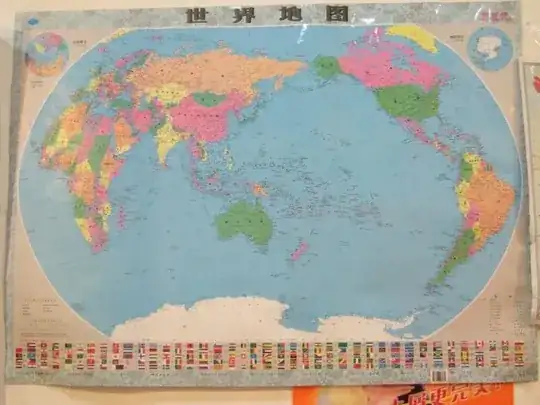
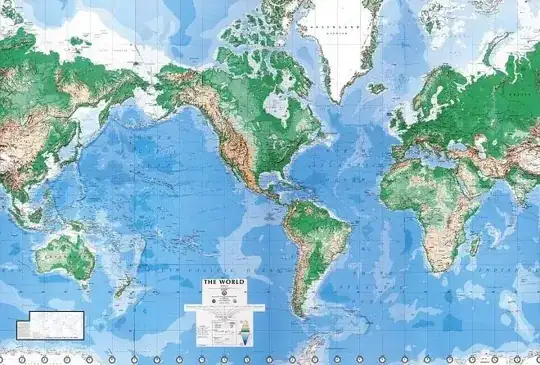
While this is an interesting fact, it doesn't really change much. For example, take a look at these world maps printed in different countries:

enter image description here enter image description here

See the difference? ;)

However, we have the prime meridian which is about in the middle of Europe, and thus we can have "western" and "eastern" countries. So referring to Asian countries as "far east" is neither incorrect nor offensive. Also (just a side note) here in Russia the Asian countries are being referred to as "Far East" a lot, including news, newspaper articles and so on.

Also consider the wiki article about "far east".

  • "...we have the prime meridian which is about in the middle of Europe," so at least some of Europe is the "East"? – Kris Oct 17 '12 at 05:27
  • @Kris, well, technically, I believe it is. It's not the reason for calling Asian countries the "Far east though", I just mentioned it as a possible way to find the "center". "The term Far East was popularized during the period of the British Empire as a blanket term for lands to the east of British India. In pre-World War I European geopolitics, the Near East referred to the relatively nearby lands of the Ottoman Empire, the Middle East denoted northwestern South Asia and Central Asia, and the Far East meant countries along the western Pacific Ocean and eastern Indian Ocean." – SingerOfTheFall Oct 17 '12 at 05:36
  • Wow, never thought about the way maps are printed in different countries. That's funny (: (I'm more used to 'Soviet' view) – Xentatt Oct 17 '12 at 05:37
  • 1
    @Dmitriy, yes, I was very surprised to see them for the first time too ;) People are used to the maps they saw and used in school, so the other ones feel a little weird when you first see them. – SingerOfTheFall Oct 17 '12 at 05:39
  • On the question of map-centrism, you really need to see "MacArthur's Universal Corrective Map of the World". Too bad you can't zoom in. http://odtmaps.com/detail.asp_Q_product_id_E_McA-23x35 On a more serious note, the UN Flag is obviously "nordo-centric" http://en.wikipedia.org/wiki/File:Un-flag-square.png – Merk Oct 17 '12 at 05:40
  • 2
    didn't you people learn it already? The only people who by definition can be politically incorrect, and chauvinistic, are those from European descent. :P – vsz Oct 17 '12 at 06:08
  • Another interesting fact, in the same way China is called "the central country", America is called "the rice country" in Chinese. – rurouniwallace Oct 17 '12 at 13:54
  • It's not particularly surprising that people would make maps that put their own country in the center. After all, they probably want to know where other places are in relation to them. That said, I think American maps that put America in the center and thus break Asia in half are a little silly. Why not put the Western Hemisphere on the left and the Eastern Hemisphere on the right, and the only thing you'd have to break would be some Pacific Island chains. (Okay, maybe the idea that those aren't important is insulting to Pacific Islanders.) – Jay Oct 17 '12 at 20:56
  • I'd always heard that the Chinese name for China was "Middle Kingdom". Now I'm wondering if "Central Country" is just an alternative translation of the same words, or if there are two different but similar terms. – Jay Oct 17 '12 at 20:58
  • BTW I haven't done a study of this, but I think most world maps made in the United States put the Western Hemisphere on the left and the Eastern Hemisphere on the right, breaking about the middle of the Pacific Ocean. Second most popular is to put the Western Hemisphere in the middle and break the Eastern Hemisphere into two pieces, some on the left and some on the right, with a break through central Asia somewhere. Like the map shown above. – Jay Feb 10 '14 at 21:39
  • How come world maps always put north at the top? Why does no one put the south pole at the top? Or the north pole on the left and the south pole on the right? On the rare occasions when a map does not have north at the top, it's usually at an angle with north NEAR the top, just skewed to fit what the map-maker wanted to fit on the sheet of paper. – Jay Nov 21 '14 at 14:19
3

Calling Asia "the East" and the Americas "the West" is not arbitrary, nor is it politically incorrect. Most maps place the Americas on the west and Asia on the east because the center of the map is the prime meridian. So I regret to inform you that Europe is indeed the "center of everything" in the sense that it falls right on the prime meridian, although I find it strange that you didn't suggest that Africa is the center of everything as well.

The politically incorrect term that you may be thinking of is "oriental" or "the orient", which comes from oriens, the Latin word for "East". This term is sensitive at best and has been phased out of modern English usage. Best not to use it. But "Far East" is fine, as is "the West" to describe the Americas.

  • 3
    I'm shocked that no one's yet mentioned the Mediterranean sea, which means "the sea of the middle of the earth." – Merk Oct 17 '12 at 05:43
  • Well, but who decided to put the prime meridian going through Greenwich, Britain? There's nothing inherent in the nature of geography about that. It's there because that's where the Royal Observatory of Britain is. – Jay Oct 17 '12 at 13:43
  • 1
    @Jay Because they happened to write the standard that we all use and accept today. – rurouniwallace Oct 17 '12 at 13:46
  • 3
    Of course this post raises the question, Why is "the East" perfectly acceptable, but "the Orient", which means "the East", is not? And whenever words are classified as offensive to some ethnic or whatever group, I always wonder whether it's that the people of that ethnic group said they were offended, or white male college professors and political activists who said that people of that group ought to be offended. – Jay Oct 17 '12 at 13:51