2

In the song "Tea for the Tillerman", there are two things that baffle me.

  1. The pronunciation of the word "Tillerman". It sounds to me that he is saying /tilman/. Why is that?

  2. What does a tillerman do by profession? What is its meaning in the context of the song?

Paola
  • 3,129
iddober
  • 679
  • 1
    Taken from the movie The African Queen where Rosie make tea for Mr Alnutt , the Queen's tillerman –  Sep 06 '14 at 19:16
  • Looking at the lyrics, there are really no clues as to what is meant by the imagery. The fire engine tillerman seem highly unlikely, though. – Hot Licks Jul 29 '15 at 22:31

9 Answers9

9

Although the OP's question has already been answered, I'd like to catch the opportunity to elaborate on the specifics of the tillerman word.

  • True, tiller is the farmer who tills the land.
  • True, a tiller is the lever that operates the rudder on a small watercraft.
  • True, in the US a "tillerman" is the man who steers the rear wheels of a fire truck.

But there is a lot more to it. We can trace back the story (if not the word itself) thousands of years ago. Here is how I see it.

Tillerman as farmer

Lets start with the origin of till in English.

As reliable as ever, the OED points us in the right direction: the word till is to be traced back to Middle English þylle, thyl or thyll and is the

"The pole or shaft by which a wagon, cart, or other vehicle is attached to the animal drawing it, esp. one of the pair of shafts between which a single draught animal is placed."

Various Germanic languages (and even non Germanic ones) have cognates of þylle, the general meaning of which seems to be that of a crafted piece of wood. Here are a few of them:

  • In German Diele (plank) => dielen (to plank).
  • In Old English, þilian is "to plank" (source)
  • In Old Norse þilja (plank, deck) => wich gave Middle French Tille (smaller compartment in a box) => hence our cash till and tillac (deck of a boat in French)
  • Icelandic þilfar (deck)

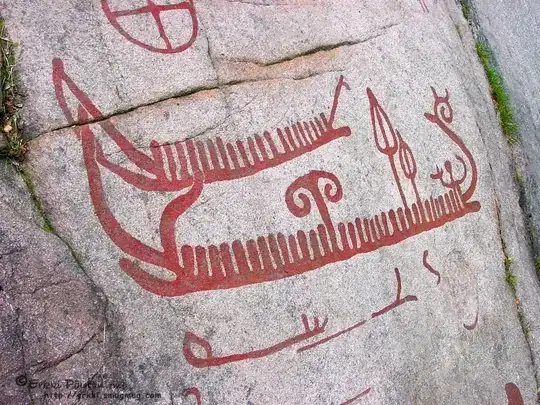
Here is a picture of a Bohuslän carving showing a farmer tilling his land. Please note that this place is at the heart of the Götaland (the German people Urheimat) and is of the Nordic Bronze Age (1700-500BC). Similar petroglyphs are also actually found in the South East of France (Mt Bego).
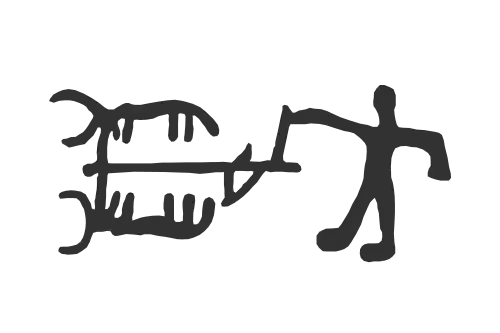
Bohuslän Bronze Age Tiller-man

Tillerman as helmsman

If one accepts that þilja is a plank of wood then it is easy to understand that it can be used as a primitive rudder. And the person who holds it is the... tillerman of course. Here is a Viking example next to an older representation from the same bronze age site.
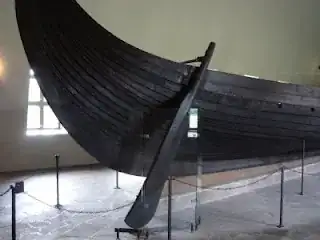
Viking tillerBohuslän boat petroglyp

Tillerman as tiller-ladder operator

More recently, in the US, a tiller became a kind of plough plow either pulled by an animal or even operated by a single man tilling his land.
Later still as fire engines became ever larger they were designed with directional rear wheels so that they could take more acute inner angles. To operate these rear wheels, you needed a second driver at the back of the trailer who had his own steering wheel and would make sure the rear wheels would follow in the front wheels tracks.
Here is an example. You can see the rear wheels in a different direction than the trailer itself.
The analogy with the tiller-farmer is quite obvious if you think of these farmers sitting on top of their tillers and also trying to take hairpin turns from one furrow to the next.
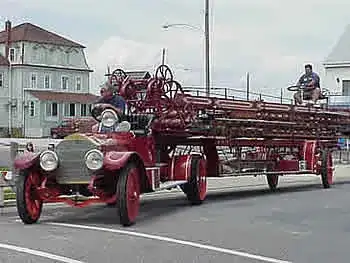
1913 Tiller ladder

In non Germanic languages

Funnily enough there is another very similar situation occuring with romance languages.

In Latin, the pole in front of the plough used to be called the temo.
This word followd several paths.

  • Le timon in French is the tiller (the shaft between the two oxen/horses).
  • Le timon in French and Spanish is the rudder wheel (hence the timonier, the helmsman).
  • El timon in Spanish is now the steering wheel.

May be there is a deeper link than one can see for now.
However, at least for Latin I can think of two words that could be related to the germanic þylle (reputed unexplained etymologies)

  • talea (cutting, thin piece of wood [de Vann 2008], scion),=> Italian Talea. A tiller being also a sapling.
  • telum (javelin, spear).
5

Regarding pronunciation of tillerman, Cat Stevens (originally, Steven Demetre Georgiou, from London, England; known as Yusuf or Yusuf Islam since 1978) says tillerman in a non-rhotic way; that is, he mostly drops the r. Also, because he says the second syllable softly it may be difficult to hear it.

While wiktionary defines tillerman as "A person who steers the rear wheels of a fire truck or controls its ladder", I think it more likely the word is used here as tiller via etymology 1: farmer + man, ie, farmer-man. The first meaning that occurred to me – a helmsman or steersman – seems unlikely to be correct. It would apply if tiller (via etymology 3) were used in the nautical sense.

  • 1
    This Wiki article on tiller ladders might help shed some light on why they call them "tillermen," but I think you are right that in the song, he is referring to "a man who tills (the soil)." – Kit Z. Fox Aug 07 '12 at 12:17
  • Although I might have given a contrary impression, I didn't mean that "tillerman" only means farmer. I imagine all three senses – firetruck or ladder steerer, helmsman, farmer – are used, but as you indicate, in the song the latter. – James Waldby - jwpat7 Aug 07 '12 at 16:00
  • 1
    Reading the lyrics in context, we have rewards for the bringer of the rain, the sun itself, and the "tillerman". What goes with the rain and the sun? The tiller of the soil. – Bob Aug 09 '12 at 16:09
4

I think the album cover art is the answer here. Cat did the cover art himself. Clearly a farmer. Not a boatman or fireman.

Mitch62
  • 41
3

Look at the cover drawing for the answer. It looks to be a farmer.

Dr Bob
  • 41
  • Looking at cover art does not seem a reliable way to discern the meaning of a word, especially when dictionaries disagree with you. If you have a source for your claim that is less subjective, please add it to your answer. – Matt E. Эллен Jul 30 '15 at 08:05
  • This does not provide an answer to the question. To critique or request clarification from an author, leave a comment below their post - you can always comment on your own posts, and once you have sufficient reputation you will be able to comment on any post. – Dog Lover Jul 31 '15 at 05:36
  • 1
    @DogLover This is arguably a relevant answer to the last question of the OP, what is the meaning of the word in the context of the song. – Chris Sunami Aug 25 '15 at 14:18
1

I've heard this phrase in Scottish usage definitely referring to tillerman as in "boatman". It was used in reference to death, so I assumed they were referring to the mythical "boatman" taking one across the river to death. "Tea for the tillerman" seemed to be to ensure a peaceful & quiet passage to eternity... now, where in world did I read that? Who knows. Anybody?

1

Tillerman as in Charon (The Ferryman). "Tea" would have been used as payment instead of Coins to "pay" the Ferryman to cross the River Styx, Tea for the Tillerman. Coinage was not available when Greek Mythology first spoke of "Paying the Boatman, Ferryman or Tillerman as a Tiller would be used to propel the ferry across the river

Lesscash
  • 11
  • 1
1

Here is another definition. In Eric Sloane's "Museum of Early American Tools", there is an illustration of a Frame Pit Saw. Two workers are cutting a suspended beam lengthwise; one above and one below. The Box Man, below, wears a big hat because of the sawdust. The Tiller Man is the worker standing on top of the beam.

1

A tiller is the lever that operates the rudder on a small watercraft. A tillerman is therefore the small-boat equivalent of a helmsman.

  • No, that's a steersman. The first usage of tillerman seems to have been for fire trucks. – Peter Shor Aug 07 '12 at 18:45
  • All the uses for steersman (except as a figurative synonym for helmsmen) I have seen are for boats too primitive to even have a rudder; the steersman uses a modified oar to steer the boat. I've never been on such a boat. On boats with tillers, we called the guy on the tiller "the guy on the tiller". – Michael Lorton Aug 07 '12 at 19:01
0

Since the underpinning theme of the album is Yosif's separation from his girlfriend D'Arbanville. Also he was interviewed at this time noting the simultaneous feeling of looking forward with curiousness and observation of the past with clarity. This defines this album as a transitional piece, helping to define his use of the word tillerman as the ferryman crossing the river Styx. Since death was commonly seen as a transition in the music culture at that time.