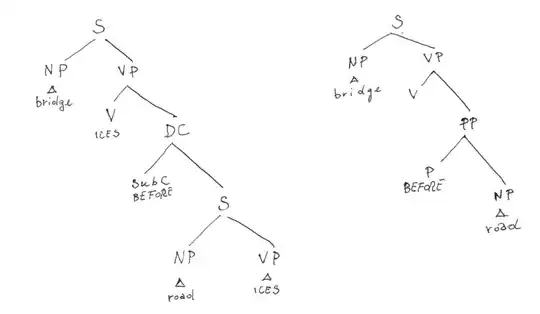
Easy. One tree is deeper structure than the other, so they're both valid, but at different stages of the derivation.
The one on the right, with the complete transitive clause, is what it means, pretty clearly; that's a "deep structure". The one on the left, after the verb is deleted by Conjunction Reduction, is a "surface structure". The terms refer to the meaning and fully-marked structure of an utterance as being "deep", and the syntax that actually occurs after syntactic changes as being on "the surface", part of A Mind is A Container metaphor theme (and since thought is fluid, this comes out as A Pool).
The issue is apparently how the tree node over before should be labelled. That's of no particular consequence; it's the same structure either way. Since it is inconsequential, however, linguists argue about it constantly, though they'd all agree:
- it's a node in the tree
- it's a node in that place in the tree
- it's a node that governs before
The important things are the things that they would agree on. Many syntactic phenomena change the grammatical class of words; There-insertion makes a Subject (and therefore a Noun Phrase) out of there, for instance, which is at least surprising. Temporal and locative prepositions, conjunctions, and adverbs (and phrasal verb "particles") like up change their role to suit their usage in a construction.
So how you label that node is up to you. This is one big reason why I keep saying that asking what Part Of Speech a given word is tells you nothing at all about that word; only about the particular construction with the word. It's constructions that are important.