3

Recently I noticed a strong increase in the usage of the word "awesome" between around 1760 to 1790. Then this word became again absolutely uncommon for a while. See the usage graph below.
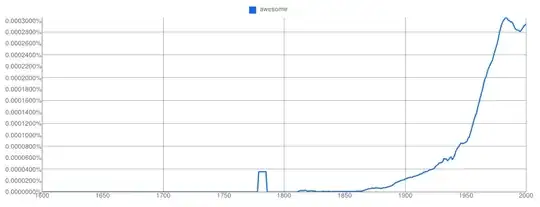
What happened there?

James McLeod
  • 9,207
Michael
  • 480
  • 2
  • 4
  • 12
  • 1
    I don't think that blip in the graph constitutes a "strong increase" of the word. It could have been anything that made the news: a bad storm, or a quote from a sermon, perhaps. This might help. – J.R. Jun 24 '12 at 18:16
  • To find out what it was is the question. – Michael Jun 24 '12 at 18:19
  • 4
    The problem here is that many people disregard the scale on the vertical axis of these graphs. In your example we are talking in the range of 0.00002% as a ratio that is 0.0000002.(six zeroes!) This probably amounts to a single usage found in a single book surrounded by no occurrences. And if you look below the graph you will see some date ranges. Clicking on the range containing your "abnormality" you will find a single occurrence. Try searching with the two words "awesome,common" and see what that looks like. Then add "awesome,common,the" and see what that looks like. :-) – Jim Jun 24 '12 at 18:20
  • 1
    @Jim: you're correct (except that it's three uses, not just one). The link I provided in my first comment points to them. – J.R. Jun 24 '12 at 18:27
  • @JR, yeah, I did a finer search and found one occurence in 1713 and one in 1714. I tried to edit my comment but hit the "5 minute limit" – Jim Jun 24 '12 at 18:28
  • I believe Google has tuned Ngrams so it discounts single occurrences. But a handful of coincidental occurrences is not so rare an event. – Peter Shor Jun 24 '12 at 19:34
  • 3
    Don't forget that non-final S's were represented before 1800 by ſ, aka "long S", and that OCR usually reads that as a lowercase f. What does the graph for awefome look like? – John Lawler Jun 24 '12 at 19:40
  • @JohnLawler that was my first thought as well, after having read this question, but (to save other readers from looking) the Ngram for awefome is totally flat. – Cameron Jun 24 '12 at 19:55
  • Thanks. I searched to see if anybody had mentioned awefome before commenting. – John Lawler Jun 24 '12 at 20:01
  • 1
    Also, don't forget that the publication date is being OCR'd, too - quite often I've seen 'hits' in the 1600s or so that, if I clicked through to the actual work, turned out to be misreadings of '1985' or something. Google Books - along with nGrams - is an awesome tool for research, but don't trust it implicitly. – MT_Head Jun 24 '12 at 20:54
  • @MT_Head: "Date switches" the other way around are even more common (such as when a hit from an 1985 book that turns out to be a 250th anniversary reprint of some classic work). – J.R. Jun 24 '12 at 22:06
  • J.R. - I've seen that as well. – MT_Head Jun 24 '12 at 23:02

1 Answers1

9

"To find out what it was is the question."

Very well, from the "teach a man to fish" series...

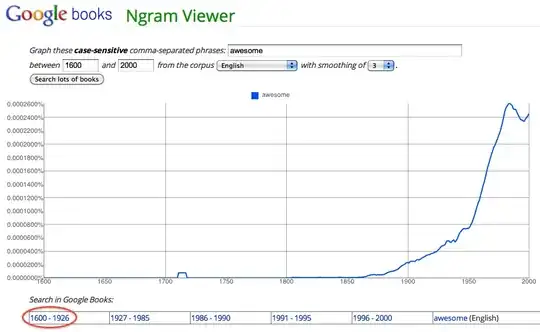
Here's the original Ngram:
enter image description here

Notice the link at the bottom. Click on that, and you'll get all the results between those dates. Problem is, most of those results will be between 1900 and 1926. But notice how the dates are embedded in the URL:
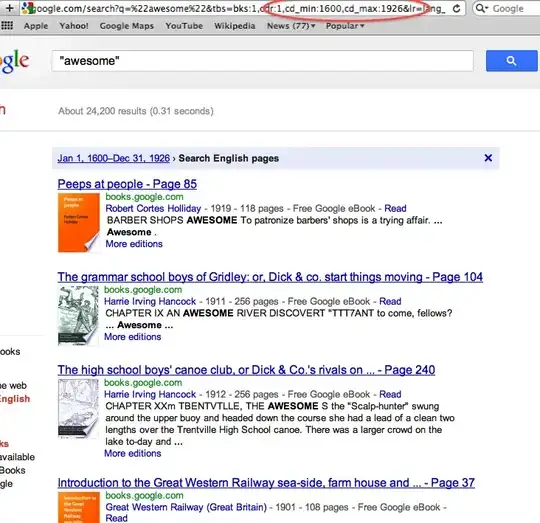
enter image description here

Next, all we need to do is change the URL to reflect the dates that we want to examine (in this case, the late 18th century):
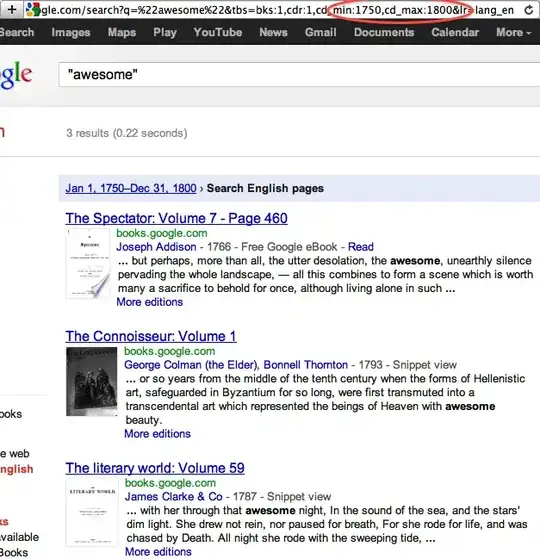
enter image description here

and now we can see what is responsible for the so-called strong increase of the word in the late 1700s.

Remember, this only searches through published works. There's no way to tell (from this tool) whether or not the word was commonly uttered in pubs, churches, homes, farms, or courthouses – not unless someone transcribed those quotes, so that they were subsequently published in searchable articles or books.

J.R.
  • 58,828
  • 5
  • 95
  • 196
  • 2
    In addition to changing the URL, there's also a "custom range" thingy on the left to let you change the year range. – Hugo Jun 24 '12 at 19:54