5

I have often seen the following expressions:

[ex.] 1. I have no allergies or any medical issues. 2. John serves a chicken with no sauce or any kind of seasoning.

I suspect that such a use is wrong from a prescriptive grammatical point of view, because "no" modifies "allergies" in (ex.1) and the sentence is split as follows: "I have no allergies" or "I have any medical issues". But this is not what sentence (ex.1) means. (ex.1) means that I have no allergies or (and?) no medical issues.

Probably, I think that (ex.1) is reanalyzed as "I don't have any allergies or any medical issues".

My question is: (1) Is the use like (ex.) correct (in prescriptive grammatical terms)? (2) If not, what is the correct expression to tell the expressions like (ex.1) and (ex.2)? (3) Or is there some grammatical rule where when "no" is used, the word that comes after "or" may be "any".
(4) Given that I am wrong and the use like (ex.) is correct, why is this so?

RegDwigнt
  • 97,231
foolnloof
  • 489

3 Answers3

11

First of all, you can analyze the sentence as

I have no (allergies or any medical issues)

and your uneasiness about the negation can be resolved. The Corpus of Contemporary American English (COCA) has a few examples of people using this. However, you could also use "nor" instead of "or":

I have no allergies, nor any medical issues.

The COCA has examples of that as well. Some people are uneasy with the use of "nor" without "neither" so for full prescriptive correctness you could say

John serves a chicken with neither sauce nor any kind of seasoning.

which is indisputably standard and grammatical, but in casual speech it sounds a bit stuffy and many normal humans don't speak that way.

  • Nor makes sense here. I see no reason to restrict its use to a “neither ... nor” construct alone. – tchrist May 10 '12 at 13:35
  • Very sensible analysis, but the problem in your first sentence is precisely the extraneous any; I would be happier with 'no allergies or medical issues'. – Tim Lymington May 10 '12 at 13:43
  • 1
    @TimLymington "any" serves as an intensifier here, to make it clear that all possible medical issues are under consideration. – Mr. Shiny and New 安宇 May 10 '12 at 13:45
  • But that leaves you saying ?no ...any medical issues. – Tim Lymington May 10 '12 at 13:47
  • I am not sure I understand how analyzing the sentence as "I have no (allergies or any medical issues)." resolves the uneasiness about the sentence. Can you explain what you mean? Do you consider the OP's [ex. 1] a grammatical sentence? – JLG May 10 '12 at 13:47
  • @JLG: yes, I have no problem with ex. 1, though I'd prefer the "nor" version. The OP analyzed the sentence as "I have (no allergies) or (any medical issues)". To me, that analysis doesn't make sense and can be discarded, leaving only one valid analysis that does make sense. – Mr. Shiny and New 安宇 May 10 '12 at 13:53
  • I think I'm following that, but how are you able in your analysis to leave "no" outside of the parentheses, but include "any" in the parentheses? I hope I'm being clear in what I'm asking. I think I would have analyzed it the way the OP did. – JLG May 10 '12 at 13:56
  • @JLG: The question is "what does 'no' negate?" And the only analysis of the sentence that makes sense to me is the one where "allergies or any medical issues" is one big negated unit. English doesn't have order of operations so sometimes we have to infer the "brackets", right? – Mr. Shiny and New 安宇 May 10 '12 at 14:01
  • Thank you very much. I see. But you cannot analyze "I have no (allergies or any medical issues)" from a prescriptive grammatical point of view, because you cannot say "I have no any medical issues." So if you split (ex.1), you have no choice but to cut it like this: "I have no allergies" and "I have any medical issues", although its semantics is awkward. This is why I asked this question. – foolnloof May 10 '12 at 14:02
  • Thank you. That makes sense. Is "any" in this case a kind of amplifier? If you leave it out, "I have no allergies or medical issues.", there is no grammatical problem. Interesting. – JLG May 10 '12 at 14:06
  • I should have confirmed this: Can you say "I have no any books" to emphasize "I have not a single book"? – foolnloof May 10 '12 at 14:11
  • @foolnrony: No, definitely not. I have not any books is possible though clumsy; I have no allergies nor any medical issues is fine. In both cases any fills a slot that could be held by all or some; it's not an intensifier at all. – Tim Lymington May 10 '12 at 14:35
  • @JLG,Mr. Shiny and New: I think the underlying analysis for the secondary component is "nor do I have* any other allergies". Effectively, "I have"* is being elided, which allows (non-pedants, at least) to ignore the fact that putting it back would require other adjustments to maintain grammaticality. – FumbleFingers May 10 '12 at 15:38
  • This is another example of Conjunction Reduction. And any is the prototypical Negative Polarity Item, which can be triggered by a negative in most syntactic positions. – John Lawler May 10 '12 at 16:04
  • @John Lawler: Agreed any often turns up in constructions such as "I haven't got any money" and "Don't you have any regrets?", where we might use "some" if it weren't for the negation. But in both my examples, you could feasibly omit the word, so perhaps one could say it functions as a kind of "negative intensifier". I don't know if the same applies to Coleridge's Water, water everywhere, / nor any drop to drink (which has always slightly bothered me, so I just say "It's poetic licence" :) – FumbleFingers May 10 '12 at 16:31
  • 2
    It's a quantifier (which is what some is, too), and has interesting interactions with negatives -- the example sentence is an example of one formulation of DeMorgan's Law: Not (p Or q) ≣ (Not p) And (Not q). Another formulation is Not (For Some/Any p) ≣ (For All p) (Not p). See http://www.umich.edu/~jlawler/logicguide.pdf for more. – John Lawler May 10 '12 at 16:50
1

Arguably the more "technically correct" form would be...

I have no allergies nor any [other] medical issues.

...but in practice OP's examples are quite common.

Note that in both these examples the word "other" is at least implicit (even if not actually present), in that both "denied possibilities" (allergies|medical issues, and sauce|kind of seasoning) consist of a specific example, followed by the general classification for "other things of that same type".

The word "any" simply conveys optional emphasis (definitely nothing of the type referred to applies). I feel this strengthens the case for using nor rather than or, because nor also emphasises the negatory nature of the statement.

It's a fine point, but looking at a similar construction without an implicit "other"...

I have no ability or|nor [any] desire to answer this question...

...it seems to me that in the absence of any other context, we might more often expect or to be used if the statement continued with something like "...but since I'm legally obliged to, I will answer". Whereas the more explicitly negative nor might be followed by "...and therefore refuse to answer".

FumbleFingers
  • 140,184
  • 45
  • 294
  • 517
0

The construct no NOUN or any NOUN is commonly used with the same general meaning as no NOUN or NOUN. It is parsed according to logical rules: no (A or B) => (no A) and (no B).

I have no chicken or fish.

I have no wealth or ambition.

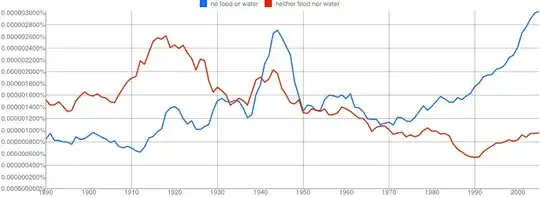
While I was instructed in grade school (as a native U.S. speaker) that I could say I have neither chicken nor fish I do not recall ever being told not to say I have no chicken or fish. If it had been at some point considered informal or wrong to say I have no chicken or fish it does not matter today as it is by far the most common usage.

Comparison of "no food or water" to "neither food nor water"

Adding any to the beginning of the second noun phrase is generally short for any other and is used to prevent confusion as to why you mentioned two things where the first is part of the second. If I say I have no chicken or food it seems like I'm implying chicken is not food, so I'll say I have no chicken or any (other) food.

In your first example, "allergies" could be considered a medical issue, so people hedge by including any. (Indeed, the reason for specifically naming "allergies" is that some people will consider allergies a medical issue and some will not, so the questioner wants to make sure the latter group answers about allergies anyway.)

Your second example uses any kind of, which is a different kind of phrase which emphasizes the totality of seasonings you are speaking of. Saying John does not use any kind of seasoning is stronger than saying John does not use seasoning. So it is not really an example of the general use of any.

Old Pro
  • 3,169