2

There are several good answers to a question entitled What is the etymology of a pair of trousers but more generally why are many items of clothing worn below the waist also described as "a pair" such as jeans, leggings or tights whilst other garments worn above the waist (but topologically nearly identical) never have "pair" associates with them, such as shirt, pullover or vest? The only exception I can think of is a pair of handcuffs.

Obviously things like gloves and shoes, as they come as two separate items worn together, are naturally referred to as "a pair of.."

On a slightly broader topic, why is "pair" applied to many bifurcated items, often tools, such as pliers, scissors or tongs?

In general I would speculate that all the items that take "a pair of.." end in the letter "s" (that is the plural form) but there are some that end in "s" which don't such as table of contents or city outskirts. There was an entry in the OED which discussed nouns that are always plural but I can't find it again. There is this Grammaring web page https://www.grammaring.com/nouns-which-are-always-plural, but it doesn't answer my question.

  • 1
    These are all examples of the category Dual. Humans are organized in binary symmetry, which means that our parts often come in pairs - two eyes, two ears, two hands, two feet - and that things we do and things we come in contact with often either come in pairs, like earbuds or mittens, or have parts that do, like glasses and trousers. Anything that takes a pair of as a quantifier can be called a dual. Some languages have special pronoun and verb forms for duals - "we two, those two". English has a few words like couple and pair available as quantifiers, but not many. – John Lawler Nov 20 '22 at 17:42
  • Leggings were originally 2 separate parts, fastened together. Jeans etc are modelled after trousers. Tights might relate to stocking or trousers (compare pantyhose). I'm not sure what the precise question is. – Stuart F Nov 20 '22 at 18:59
  • @JohnLawler Yes, but it doesn't answer the question why don't we say "a pair of pullover" – Peter Jennings Nov 20 '22 at 19:27
  • 2
    Because arms are different from legs, and clothing for upper and lower body is different. We have two nostrils, but we don't say a pair of nose, either. – John Lawler Nov 20 '22 at 19:31
  • @StuartF I think one of the answers in the question I quoted pointed out that somewhere between Otzi the Ice Man who was wearing two separate parts 5,300 years ago and a one piece garment dating from about 1,700 years ago found in Germany, the two parts joined. This was well before "a pair of trousers" became part of the English language (or any of the languages that preceded English). So the idea of trousers still being a two part garment may have to be traced back to Old English around 200 AD. – Peter Jennings Nov 20 '22 at 19:41
  • "The only exception I can think of is a pair of handcuffs." Glasses (sunglasses, goggles, etc.) are another exception. Earmuffs are another. I think that shoulder pads are another (even when connected, such as protective equipment used in sports). So I don't think that that is a rule. – MarcInManhattan Nov 20 '22 at 21:48
  • @MarcInManhattan A pair of handcuffs are a single item "worn" on the upper part of the body, but as has been pointed out, a pair of glasses etc also fits, so I was mistaken. – Peter Jennings Nov 20 '22 at 23:25
  • 4
    The reason pants come in pairs but shirts do not probably has to do with where our belts are: The vast majority of a pair of pants covers the legs, which come in a pair. The vast majority of a shirt - even a long sleeve one - covers the torso, not the arms. Shorts - especially short shorts - still come in pairs because they are evolved? from pants, not skirts and the name is short (hah) for "a pair of short pants" – No Name Nov 21 '22 at 05:01
  • 1
    I should probably add: the reason skirts and kilts don't come in pairs is because they don't cover the legs separately, but as a single garment. And this is all speculation, hence comment, not answer – No Name Nov 21 '22 at 05:11
  • umm, no mention of the fact that most of a [pullover|shirt|(and especially )vest| is not in the pair of limbs it covers, but the torso? Imho, they are not topologically nearly identical – mcalex Nov 21 '22 at 05:15
  • 1
    @No Name, comment upvote for mentioning skirts and kilts. May I add loincloth. – banuyayi Nov 27 '22 at 11:03
  • @mcalex You are technically correct, but not for the reason you think: Pants have three holes, shirts have two or four, depending on if they button down or not. Topology does not care about the relative area covered by certain parts of the shape – No Name Nov 28 '22 at 17:23
  • 1
    @NoName pants are two rectangles merged at one end. Shirts are two rectangles bolted onto another rectangle - this causes the hole count difference. You're not wrong, but I'm right for the reasons i think – mcalex Nov 28 '22 at 17:40
  • @mcalex Fair enough – No Name Nov 28 '22 at 17:50

2 Answers2

9

The use of the expression “a pair of” appears to have developed to refer to items that are actually formed of two parts. Linguistically they are referred to as plural tantum:

The Oxford English Dictionary defines plurale tantum, which is Latin for “plural only,” as a “noun which is used only in plural form, or which is used only in plural form in a particular sense or senses.” Bifurcated items (things that can be divided into two), such as pants, fall into this category. Think of items that are usually referred to in plural—often preceded by “pair of” or something similar, even when there is only one item: pliers, glasses, scissors, sunglasses, tweezers, etc. So, pants is a type of noun that is used only in its plural form, even when there is only one item being discussed.

(Britannica.com)

Pair:

Originally of things. Of persons from late 14c., "a couple, a sexual pair." Used from late 14c. with a plural noun to denote a single tool or device composed essentially of two pieces or parts (shears, tongs, spectacles, etc.).

(Etymonline)

user 66974
  • 67,349
  • 1
    Thanks, that was the OED definition I was refering to and had lost. – Peter Jennings Nov 20 '22 at 19:24
  • 4
    @PeterJennings You can certainly wear a pair of gloves or mittens or a pair of glasses. But you can also wear just one glove or just one mitten, which with glasses or pants you cannot do. You can even wear one of a pair of his-and-hers rings. – tchrist Nov 20 '22 at 20:01
  • Interestingly shears composed of a single piece of metal (two flat blades joined by a curved strip) such as those used for shearing sheep before the invention of electric clippers are still referred to as "a pair of shears". I can believe that a blacksmith would make the blades and connecting strip separately then weld them together by hammering but most users of the shears would only ever see them as a single piece of metal. – BoldBen Nov 21 '22 at 05:48
  • 1
    @BoldBen a pair of shears is, as you noted, made of a pair of shearing blades, connected for user convenience by some mechanism, usually a spring or pivot. Something like a bench shear only has the one sharpened shearing blade, so does not form a pair https://www.chronos.ltd.uk/product/6-metal-cutting-bench-shear/ – Pete Kirkham Nov 21 '22 at 13:15
  • @PeteKirkham My point was that a pair of manual sheep shearing shears are, for anyone not involved in making them, a single piece of metal but are still referred to as "a pair of shears". Also, to be accurate, a bench shear or guillotine does, actually, have two sharpened edges, it's just that one moves and the other is fixed. The difference is that the two blades are not identical so do not form "a pair". – BoldBen Nov 22 '22 at 20:04
7

The reason why a pair of is used for an item of clothing worn on legs is partly related to the history of clothing and tailoring. For example, pants (short of pantaloons, U.S. English) or trousers became a single garment late in the history. Before modern tailoring, such garments were made in two pieces, two seperate sleeves of fabric called a hose which were tied to a belt with braces and the open crotch was covered with breeches. The plural usage of these garments persisted out of habit even after they had started being made in one piece in modern tailoring. A shirt and similar upper-body garments were always a single piece of clothing, so they were singular.

Here is a diagrammatic reference of how trousers were made in the history before modern tailoring, from the article "Oldest known trousers found in China" of thehistoryblog.com:
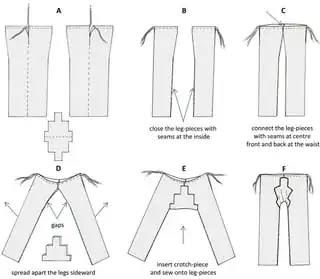
enter image description here

Etymologically, the usage of a pair of is connected to how pair was borrowed from Anglo-Norman French (where the etymon is paire) around 1300; and ultimately from Latin paria. French uses the preposition de as seen in an Anglo-Norman example "deux peir de plates" from 1354, listed in the Middle English Compendium. In modern English, pair is restricted to meanings referring to 'two' or 'sets'. It is usually followed by plurale tantum nouns like pants, jeans, trousers or morphologically singular nouns that often come in sets of two like eyes, shoes, gloves. Historically, pair could be used without a preposition, sometimes with an unmarked plural; and it could also mean 'a few'. With the preposition of, pair was first used by Chaucer as "a paire of legges and of feet" (a pair of legs and of feet) in c1395 per OED. Chaucer's usage may have influenced the language also, as he has been called the father of English literature; and the semantic extension of the usage a pair of for garments worn on legs may be an analogy to its usage with legs.

Here are the definition of the original sense and usage of pair and the earliest citations from OED:

I. A couple; a set of two.
1.
a. A set of two individual things of the same kind, that are associated or complementary in use, purpose, position, etc.
Used esp. with reference to things worn or adapted to the right and left limbs or sides of the body (also colloquial with reference to the parts of the body themselves), and to other things used side by side or disposed symmetrically, as curtains, folding doors, etc.
to show a clean (also fair) pair of heels: see show v. Phrases 1a. to show a red pair of cheeks: see show v. 12b.

(a) In singular, preceding the noun complement without of. Now only in abbreviated style.
c1300 St. Thomas Becket (Laud) 20 in C. Horstmann Early S.-Eng. Legendary (1887) 107 (MED) Euere he hadde ane peire feteres faste him up-on.

(b) In singular and plural without complement or with of.
c1395 G. Chaucer Wife of Bath's Tale 597 He hadde a paire Of legges and of feet so clene and faire.

(c) With unmarked plural (with or †without of). Now regional and nonstandard.
1432 Bailiff's Acct., Grantchester in Middle Eng. Dict. at Clouting For clowtyng of ij peyre schon.

Here are the definition of the relevant sense and usage of pair in question and the earliest citations of this sense from OED:

3. A single tool, instrument, or item of clothing, consisting of two joined or corresponding parts not used separately. Usually with of and plural noun complement, as pair of scissors, pair of trousers, etc.

a. In singular, preceding the noun complement without of. Now only in abbreviated style.
1391 in L. T. Smith Exped. Prussia & Holy Land Earl Derby (1894) 91 (MED) Pro furracione, j pair pynsons.

b. In singular and plural without complement or with of.
▸ a1438 Bk. Margery Kempe (1940) i. 90 (MED) On was a maner of sownde, as it had ben a peyr of belwys blowyng in hir ere.

c. With unmarked plural (with or †without of).
1543 in J. Raine Wills & Inventories Archdeaconry Richmond (1853) 43 Iij payre of pynsowrs, vid...ij cawkers, ijd.

ermanen
  • 62,797
  • Thank you for that explanation, but it partly hinges on when tailoring changed from two separate leggins to a single joined up garment. Archaeological evidence would appear to indicate that this was before 400AD. So why was "a pair" still being used over 1000 years later. Even Old English was not in use until the mid 5th century. Maybe it was a carry over from the language's forerunners, but it has lasted nearly 2000 years beyond the change in the garment's construction and through all the changes in English. – Peter Jennings Nov 20 '22 at 23:41
  • @PeterJennings Initially, the logic behind the plural usage and the spoken usage carried over to the written language. I've mentioned that the plural usage persisted out of habit. In the times when Middle English was spoken, trousers were still made from two pieces and it later became a single piece of clothing; possibly, more noticeably after French Revolution. I've explained the logic behind it and the etymology separately. – ermanen Nov 21 '22 at 10:14
  • In the middle ages sleeves were also separate items, held on with ties. Ladies would give men a sleeve as a token of regard. Are there examples of "a pair of sleeves"? – RedSonja Nov 21 '22 at 14:12
  • 1
    @RedSonja Yes, there are examples of "a pair of sleeves" as well; as a sleeve was a separate article of dress which could be worn at will in early use, and can still be used in this sense today. The earliest example I could find is in the citation "My beste paire off scleves." from 1544, as provided by OED. – ermanen Nov 21 '22 at 14:25