3

Consider the following pun:

"What do you say when you see an empty parrot cage?" "Poly-gone"

It's funny in the way that bad puns are, but it had a sense of novelty when my grade school teacher told it shortly after we started learning geometry. The pun was relevant then, the concept it referenced was on the cutting edge of the classrooms knowledge. Now that I'm older and take the definition of a polygon for granted, the novelty of the reference is gone. Even if I'd never heard it before and it was presented in the proper context for a geometry pun (whatever that would be) it wouldn't be the same. I could say that I've become jaded to describe how I feel about the pun now, but is there a word to describe the original impact?

Edit: To clarify, I'm not referring to the fact that the pun wouldn't have been funny unless I understood it, like with an inside joke. I'm looking for a word to describe a concept that is perceived as being novel lending it's novelty to an otherwise uninspired joke or statement which references it.

Edit 2: A better example would be a remark about a current event. For example, if I was to watch a current episode of the Daily Show, it would be funnier now than it would a year from now even if I clearly remembered the news items that were being satirized. The jokes are funnier because I find the topics, which are not funny per se, interesting.

Edit 3: Another way of saying this would be a joke that is funny because it aligns with my interests. In the original example, students who were in the same class but found math boring would have found the pun boring, even though they understood it just as well.

  • Sorry that was clear from the outset my mistake! I know just the type of joke you mean. Would it be slang? A word that started out in a joke that we now use to refer to something? – Rachel Feb 06 '12 at 04:39
  • Following your edits, I think you're just talking about "dated humour", or "things that were funny at the time". – FumbleFingers Feb 06 '12 at 05:18
  • @FumbleFingers "Dated humor" would be considered "topical humor" before it becomes dated, which is an example of what I'm trying to describe. – Jordan Bentley Feb 06 '12 at 05:25
  • @Jordan Bentley: Not necessarily - we never know what aspects of today's apparently topical/ephemeral popular culture will turn out to last well into the future. Or indeed what aspects of seemingly more enduring culture will be become hopelessly passe in a few years time. Despite it clearly being "topical" at the time, and now 2400 years old, I recently had a good laugh at Aristophanes' The Birds, for example. But even last year's "popular news quiz/comedy" on TV often leaves me quite cold - you just can't tell what will stand the test of time. – FumbleFingers Feb 06 '12 at 13:05
  • @FumbleFingers: I was going to say to the commenter, “But PLEASE don’t tell Fumble I’dexpectthattrendtocontinue Fingers – He’s got future trends all mapped out for the next million years!” – based on your previous posts, but, sheesh, I see it’s YOU again. http://english.stackexchange.com/questions/57358/idiom-about-tackling-smaller-problems-instead-of-tackling-the-root/57379#57379 – Hexagon Tiling Feb 13 '12 at 22:04
  • @Hexagon Tiling: Sorry to spoil your fun there! I suppose you're right that I do tend to read too much into slight deviations from straight lines in NGrams - but it's just such a great tool for (non-scientifically) trying out/proving/discovering unexpected/spurious trends, I suppose I've just gotten a bit addicted! – FumbleFingers Feb 13 '12 at 22:11
  • Humor is being surprised by the truth. A joke which revolves around a new-to-you topic, where the terms have not "worn grooves" in your thinking process, will lead to a more intense surprise, at least with "plays on words" such as you describe. – Hot Licks Mar 24 '16 at 22:50
  • (I actually find some on the jokes on Saturday Night Live shows from 8 years ago funnier now than then, though likely because of the funny-sad fact that nothing has really changed.) – Hot Licks Mar 24 '16 at 22:52

4 Answers4

4

Mostly when we "outgrow" jokes we call them "childish". But in the more general case it's called an in-joke - a joke that is appreciated only by members of some particular group of people.

An in-joke (also known as an in joke or inside joke) is a joke whose humour is clear only to those people who are "inside" a social group, occupation or other community of common understanding; an esoteric joke. It is humorous only to those who know the situation behind it.

FumbleFingers
  • 140,184
  • 45
  • 294
  • 517
  • 1
    "Inside joke" implies, at least to me, that the joke is notable despite it's esoteric nature. I'm looking for a word that implies a joke is notable only because of it's esoteric nature. – Jordan Bentley Feb 06 '12 at 04:39
  • 1
    @Jordan Bentley: I have no idea why you would think that. As Rachel says, an in-joke can be something totally silly - not at all "notable" or worth repeating outside the immediate context where it arose. If you specifically want to differentiate those in-jokes which were only funny because of the particular assembled company and circumstances, you'll have to go for some more roundabout phrasing along the lines of "You had to have been there!" – FumbleFingers Feb 06 '12 at 04:49
  • Is an in joke notable despite it's esoteric nature? Unless people were laughing I don't think one would pick up on an in joke. Say you and I were best friends and we were talking to another person, you could make an in joke and we could exchange a look but unless we both laughed the other person wouldn't notice. We could even make a joke at the other person's expense. :-) – Rachel Feb 06 '12 at 04:58
  • @Rachel the exclusivity is a common side effect of what I'm trying to describe, but not a requisite condition. – Jordan Bentley Feb 06 '12 at 05:06
  • @Rachel: Well, I know that in your answer text you mainly focussed on "silly" in-jokes, but how about Two hydrogen atoms walk into a bar. One says, "I've lost my electron." The other says, "Are you sure?" The first replies, "Yes, I'm positive...". You might lose the humour if you have to explain it, but I still think it's "notable". – FumbleFingers Feb 06 '12 at 05:15
  • I wouldn't call that an in joke though? You could say it to anyone. Some people mightn't get it but that doesn't make it an in joke. – Rachel Feb 06 '12 at 09:29
  • It could perhaps be an in joke (although it's a stretch) if two scientists were talking and one said the joke while in company of someone who would not know what an electron is but generally speaking I wouldn't call it an in joke. Feel free to explain though because I might be misled :-) – Rachel Feb 06 '12 at 09:51
  • @Rachel: Do you mean to you it's only an "in-joke" if told in the company of someone who doesn't "get it" because they lack relevant contextual knowledge? To me, it's enough that some/many/most people wouldn't get it if they did hear it. I don't see it as relevant that no such people might ever come across the joke anyway - the attribute attaches to the joke itself (and possibly the highly-localised temporal circumstances), rather than the particular audience at any given (re-)telling. – FumbleFingers Feb 06 '12 at 14:13
  • I know the electron one isn't a very good example because most reasonably-educated people would probably get it. But I'm not good at recalling jokes, so I couldn't think of a more apposite one. – FumbleFingers Feb 06 '12 at 14:17
  • I know what you mean but that is really just a joke. An in joke is a joke that wouldn't be a joke to anybody unless you were there with certain people at the time it came up or unless it's something private between you and a friend or something like that. I'm not good at recalling jokes either so I can't give you one I'm afraid. I didn't really mean that it's only an in joke in the company of someone who doesn't get it I was just trying to come up with an idea of how that joke could be an in joke :-) – Rachel Feb 07 '12 at 00:02
3

an inside joke/high context joke

An inside joke is also sometimes called a private joke. The concept of this type of joke is that only a select number of people inside a certain social group understand the joke's meaning. Therefore, those on the outside of the group that understands the joke usually don't have any clue as to what the inside joke actually means. An inside joke is often just a word or a phrase.

also see the comments regarding high-context jokes:

It is common to British humor to have jokes which are hard for most people to understand. This kind of humor is blurred even further when jokes which are impossible to understand, or completely random (as in much American humor) are interchanged with high-context jokes. High context jokes require a previously understood context to understand, and could be considered to be regional inside jokes.

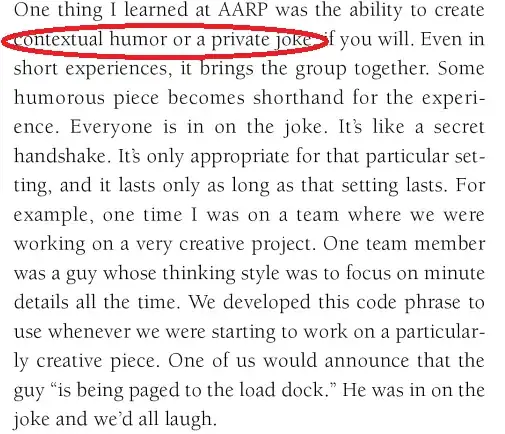
or contextual humor/private joke

enter image description here

  • 1
    The copied comment doesn't make a lot of sense to me. First the guy says British humour is often hard to understand (because it's high-context), then he says much American humour is "impossible to understand" - presumably for the same reason. – FumbleFingers Feb 06 '12 at 04:58
  • 1
    @FumbleFingers the comment might be high-context haha :) – Paul Amerigo Pajo Feb 06 '12 at 07:19
  • I recall that as a young(er) man I always thought Monty Python was "obscure British humour" that Americans could never appreciate. But a couple of days ago I watched MP Live at the Hollywood Bowl (1983), for the first time. I now realise it's actually pretty "low-context" (plenty of slapstick/theatre of the absurd). Still made me laugh though - in fact I nearly pissed myself at John Cleese's Just one more 'wafeur', monsieur! – FumbleFingers Feb 06 '12 at 13:26
0

Those are topical jokes:

top‧ic‧al: a subject that is topical is interesting because it is important at the present time

topical subject/issue/theme etc

a new TV comedy dealing with topical issues

topical jokes (=jokes about topical subjects)

0

In Australia we call it an 'in joke'. That's probably not the official term for that type of joke but it's common here in casual speech. Imagine that you're at a party with your cousin and his/her group of friends and one of fhe friends says something like your example and they all start laughing. You look at your cousin in confusion because you really don't understand what is funny about that which was said. Your cousin may say to you, 'oh don't worry it's just an in joke'.

The fact that it's an in joke doesn't necessarily mean that it's exclusive and you cannot be involved. Quite often it just means that it's a silly joke and you probably had to be there to understand - it might be too hard to explain of not worthy of an explanation.

Rachel
  • 762