0

Everybody knows the iconic joke, which goes like this:

Why was 6 afraid of 7?
Because 7 8 9.

When I search 'why was 6 afraid of 7 etymology' my results are irrelevant, mostly explaining the humor behind the joke or even new versions of it. What is the origin and first use of the joke?

Laurel
  • 66,382
1ctinus
  • 27
  • 10
    This isn't really a question about English. – Hot Licks Jan 08 '21 at 00:58
  • I do see an 'origin of [joke]' question here. It was well-received at the time. – JEL Jan 08 '21 at 06:39
  • 4
    I’m voting to close this question because it asks for an original appearance of something other than a word or fixed phrase. – Edwin Ashworth Jan 08 '21 at 19:18
  • 1
    @JEL Why don't you ask the other 4 people who agreed that 'This isn't really a question about English [within the scope intended for ELU] or indeed Hot Licks in person to defend their stance? I usually try to add a reason (origin of especially Christmas-cracker standard jokes is intuitively not what ELU is about), and get more flak for trying to come clean. I suppose I'm an easier target. (I have, before your flak, C-V'd the other similar question.) 'Origins of quotes' is off-topic, and jokes are far closer to these than to fixed phrases. – Edwin Ashworth Jan 08 '21 at 20:16
  • @JEL Then perhaps you need to add your close-vote. Are 'Who first said ...?' questions on topic? – Edwin Ashworth Jan 09 '21 at 12:34
  • The origin of the pun-riddle 'Why was 6 afraid of 7? ... because 7 8 9.' being seen as material suitable on a website aimed at accomplished linguists frankly astonishes me. I've nothing against such questions per se; I used to love reading the Beano. But not in an A-Level class. // The origin of even Shakespearean quotes that haven't reached idiomatic status, and of lyrics from Britten or the Beatles, are similarly off-topic. – Edwin Ashworth Jan 09 '21 at 19:44
  • 3
    In what sense of iconic can this joke be characterised as iconic? – jsw29 Jan 09 '21 at 22:21
  • 3
    I can't think of a joke more related to the English language than this one. This question here is the only place on the internet that attempts to answer this. Plus now there's research, for anyone who wanted some proof that this isn't a trivial question. (@JEL Do you want to see this reopened?) – Laurel Jan 11 '22 at 02:10
  • @Laurel I'm not here much anymore, but yes, I don't think this question about the origin of an English language riddle-joke should be closed here. Even if the nay-sayers are unwilling to credit me as an accomplished linguist (which from my informed perspective is a sheer nonsense unwillingness), Barry Popik is an acknowledged expert, and saw nothing untoward about investigating the origin. I was happy to be able to antedate Popik's research into the question. – JEL Jan 12 '22 at 05:08
  • Nut Screws and Bolts. – Lambie Jun 21 '23 at 14:21

1 Answers1

2

Barry Popik, in "Entry from May 09, 2016", mentions the joke is in the 19 January 1986, Chicago (IL) Tribune.

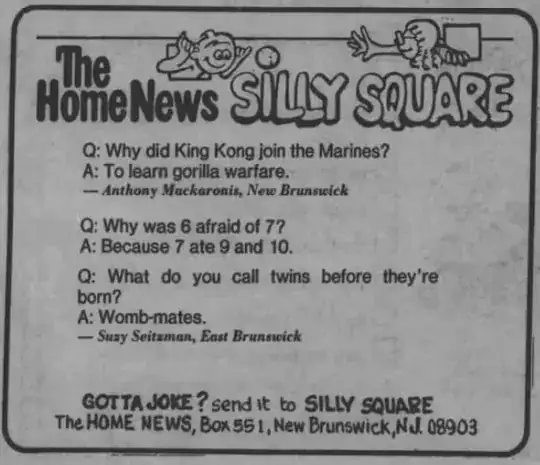
I observe an appearance of the joke in The Central New Jersey Home News (New Brunswick, New Jersey) of 11 May 1985 (paywalled):

The Home News SILLY SQUARE

Q: Why was 6 afraid of 7?
A: Because 7 ate 9 and 10.

why was 6 afraid of 7?

The joke is unattributed, so, at least until further evidence is found, the origin is unknown, sometime prior to 11 May 1985.

As I'm of a certain age, I tend to blame all jokes like this on the anonymous geniuses at Dixie Cup Corporation, who produced a line of riddle cups in the 1970s, and again in the 1990s. So far, I haven't been able to verify that the onus belongs with them. That I also blame the "Why do mice have such small balls?" joke on the same source, however, may argue against my speculation.

JEL
  • 32,781