9

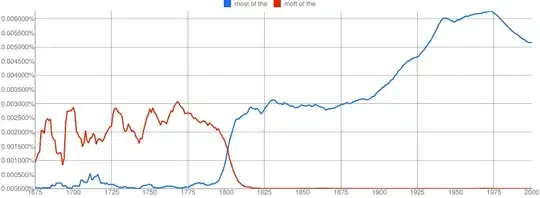
In the following graph, the long s accounts for the sudden rise in frequency of most of the; if you search for moft of the, the lines match up nicely. But what would be behind the sudden increase in the string all of the at the beginning of the 20th century?
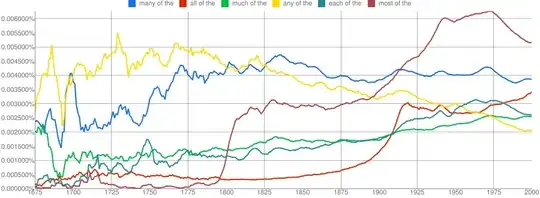
Frequency of various determinatives in the pattern "DET of the" Link here

The long s problem is illustrated here:Google Ngrams for "most of the" and "moft of the" Link here
tchrist
  • 134,759
  • 4
    -1 - Please add a link to the ngrams, not just a picture. Also, "if you search for moft of the, the lines match up nicely" means what? – James Waldby - jwpat7 Dec 28 '11 at 18:25
  • 3
    I think he means that the fashion for spelling s as ſ in most (moſt) would get picked up by Optical Character Scan software as an f. But the fashion died out about 1800. That accounts for the first maroon rise; but the red rise a century later is not a spelling matter. – John Lawler Dec 28 '11 at 18:32
  • Would it not be relevant to show 'all the' as well? – Barrie England Dec 28 '11 at 18:36
  • 3
    @ Barrie England: No, all the wouldn't be relevant for my purposes. I'm looking specifically at the partitive construction. In the phrase all of the people the head is all where in the phrase all the people the head is people. – Brett Reynolds Dec 28 '11 at 18:41
  • 1
    The OED has 736 citations for ‘all of the’. I suppose you could go through them, noting their dates, and try to establish a pattern of use. Do you have a particular reason for wanting to know? – Barrie England Dec 28 '11 at 19:02
  • 1
    Interesting!. The medial s issue is certainly explained in your second chart. Also, Google Ngrams says results outside the time interval 1800-2000 are not reliable (I'll get a link). But your inquiry remains. The only vague rationale that crosses my mind is increased use due to more legal publications, possibly post-Civil War effects too? Is this for the American English corpus? – Ellie Kesselman Dec 28 '11 at 19:04
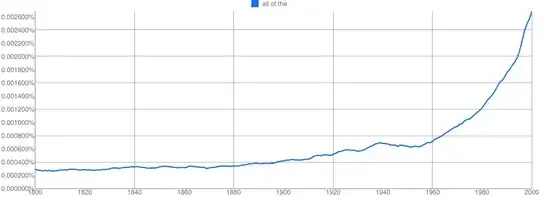
  • I am not sure the sudden increase is statistically significant. Just add "all the" to the mix and see what happens to the graph, for example: http://books.google.com/ngrams/graph?content=many+of+the%2Call+of+the%2Cmuch+of+the%2Cany+of+the%2Ceach+of+the%2Cmost+of+the%2C+all+the&year_start=1675&year_end=2000&corpus=0&smoothing=3 – JeffSahol Dec 28 '11 at 19:11
  • @Feral Oink: Civil War effects in the 1900s? – Brett Reynolds Dec 28 '11 at 19:12
  • @JeffSahol: Yes, all the is much more frequent and doesn't have the jump. But as I pointed out above, it's a completely different construction. I don't see it as relevant. – Brett Reynolds Dec 28 '11 at 19:13
  • 1
    Brett, I only mention it to note that the scale of the jump you noticed, along with all of the variations among the other phrases, is not that significant. – JeffSahol Dec 28 '11 at 19:18
  • Yes, post-Civil War effects is what I said. My rationale was because of Reconstruction in the South starting in the 1870's and plateauing around World War I. Just a guess. Also, you didn't clarify: Was this for the American English corpus? – Ellie Kesselman Dec 28 '11 at 19:28
  • @BrettReynolds Thanks for links; reversed -vote – James Waldby - jwpat7 Dec 28 '11 at 19:35
  • @FeralOink: It's the whole corpus. The American corpus shows a similar jump, but the British corpus delays the jump until the 1960s. – Brett Reynolds Dec 28 '11 at 19:48
  • @JeffSahol: significance in corpora is a difficult issue that I admittedly don't understand well. I don't think, however, that simply adding a much more frequent comparator has much to do with it. Perhaps I have misunderstood your meaning though. – Brett Reynolds Dec 28 '11 at 19:53
  • I can't see much difference between much/most of and much/most of the in respect of the "sudden" relative rise of most of over much of between the wars. But most was always more common overall - it just hadn't colonised the "idiomatic space" around "of" in the early days. – FumbleFingers Dec 28 '11 at 20:56
  • Wonder why the all-important most + moft curve is not in the graph. That should help a lot in comparison. – Kris Dec 29 '11 at 04:27
  • 1
    @Kris: because it would drown out everything else, being far more common, and because the question is about all, not most. – Brett Reynolds Dec 29 '11 at 12:23
  • Oh! right. Though from chart-2 it appears that they would largely cancel out each other. Only I couldn't figure out how to specify (sum of two sub-parameters) for Ngram. – Kris Dec 29 '11 at 12:51
  • Related: http://english.stackexchange.com/a/86775 http://english.stackexchange.com/q/37982 http://english.stackexchange.com/q/96408 – tchrist Dec 20 '13 at 02:39

3 Answers3

2

The popularity of certain words, phrases and idioms may see dramatic changes at certain points of history.

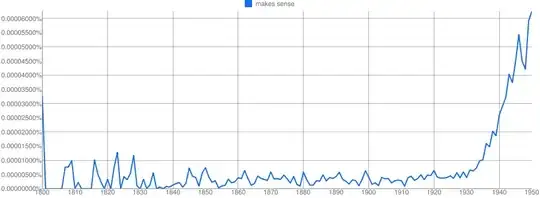
makes sense:
(1800-1950 AmE)

ngram for 'makes sense' 1800-1950 AmE

Wonder what triggered the spike post-1930. Some quote has caught on well and everyone scrambled to use the phrase? Makes sense to me.

Kris
  • 37,386
  • Yes, there's clearly a good deal of serendipity here. But there are also meaningful changes. I'm just curious to know if somebody can propose a plausible reason why all of the would behave this way. – Brett Reynolds Dec 29 '11 at 12:48
1

The question used English, corpus = 0 as the data set for the analysis.

I ran ngrams queries for your phrase "all of the" for each of the other corpora: American English, British English, English fiction and English One Million. All showed a similar, and quite smoothly increasing trend of rising frequency between approximately 1870 and 1920, with one exception: British English, corpus = 6

Google Ngram viewer result for British English, <code>corpus = 6</code>

Link to ngram

This might be worth pursuing. Without having the benefit of additional context, i.e. the motivation for your inquiry, I can't provide any more specific insights.

  • The motivation is mostly curiosity. Why do the other determinatives show reasonably smooth change in the partitive construction while this one has such a jump? – Brett Reynolds Dec 28 '11 at 20:05
  • 1
    From a cursory scan, I get the impression earlier instances of all of the show a higher percentage of "irrelevant" usages like are all of the same species, nothing at all of the manner, deperived them all of the, etc. In British English I think we just used to say/write all the more often, but we now tend to stick "of" in there. Perhaps copying Americans. – FumbleFingers Dec 28 '11 at 21:06
0

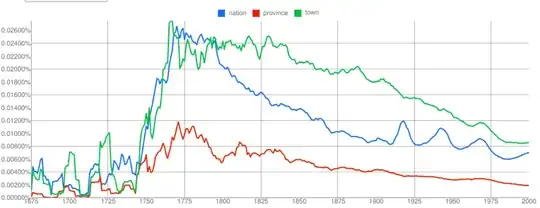
I imagine you're stressing a linguistic rather than a social/political explanation, but I read those phrases as reflecting more or less collectivist thought, and the first thing I thought of was the influence of ideas like nationalism.

Here's an ngram of nation, province, town:

enter image description here

Link to ngram

However, usage of words like nation don't seem to correlate as well for the late 18th century data shown on your ngrams.

  • I don't think this has anything at all to do with a change in the early 1900s. – Brett Reynolds Dec 28 '11 at 19:10
  • Keith, that was a clever idea, about the rise of nationalism (or populism?) in the 40+ year interval from the 1870's through 1920 or so. I would have tried checking that, if I'd thought of it! The results you got don't seem to support the idea, unfortunately. At least, not for the terms you ran. But I wonder if others would...? – Ellie Kesselman Dec 28 '11 at 19:59
  • In the graph, I'm (non-rigorously!) pointing at that brief rise in use of the term "nation" in the early 1900s, and contrasting that with the steadily declining use of what I think of as "local" words like "province" and "town". Whether "nation" usage reflects a rise in the popularity of a concept of nationalism or not I don't know, but I think the rebirth and reformulation of the concept at that time (early 1900s) is pretty well established historically. But maybe other better words could be found to reflect that more, as you say! – Keith Flower Jan 01 '12 at 18:50