40

I was asked an interesting question today, is there an English equivalent of the saying Zwijgen is instemmen, that is "since you didn't answer, then you agreed with me".

I could not come up with any good example; although I could think of a few similar, but not quite the same, including the following:

  • I'll take that as a 'yes' then.
  • I don't hear any No's.

The first is different, since you could also use it if an answer was given, but was not sufficiently clear. The second is different since it is much weaker, it is tacitly agreed that you didn't agree, but you also didn't disasgree.

Is there any idiom for your silence implies your consent?

Paul Wagland
  • 670
  • 1
  • 6
  • 11

10 Answers10

38

Speak now or forever hold your peace.

  • 1
    +1 This comes from wedding ceremonies, but is recognized and understood universally (in English). – BlueRaja - Danny Pflughoeft Dec 22 '11 at 16:44
  • @BlueRaja: I doubt the first occurence of Speak now or forever hold...peace was in the context of a wedding, but you're right that this is the context we're all familiar with today. – FumbleFingers Dec 22 '11 at 22:13
  • 1
    Probably adding a "May" or "Please" in front would look better? - Please speak now or forever hold your peace ~or~ May speak now or forever hold your peace – Larry Morries Dec 23 '11 at 00:43
  • 3
    This is too tied to the wedding ceremony. I would be very surprise to see this idiom in a contract, or in oral speech (without implying the reference to the wedding ceremony) – rds Dec 23 '11 at 10:56
  • 2
    @rds: on the contrary, I think it is used often, though perhaps a little tongue-in-cheek, in oral communication. – Reinstate Monica - Goodbye SE Dec 24 '11 at 21:29
32

I am not sure this qualifies as an idiom, but is a common enough expression: I would express it "unless I hear otherwise".

Unless I hear otherwise, I am going to leave at 4:00.

JeffSahol
  • 18,696
28

There is a legal phrase 'silence is acquiescence', which I have seen used somewhat in business.

The trick, in business, is to soften it a bit to show that it is trying to spare someone from being obliged to reply (to an email, for example).

I have used this, as an example:

Dear team,

I propose that we reboot the server in 5 minutes.

No reply necessary. Silence is acquiescence.

17

It's possible that the word you're looking for is tacit, which means to be understood or implied without being stated.

James
  • 171
14

I think this might be what you are looking for:

Silence gives consent.

Google it, I believe it's a direct translation of "Qui tacet consentire".

By the way, German/English Dutch/English is not the only language that has this phrase. I know for a fact that there is a Russian expression that, translated literally to English, sounds something like: "Silence is a sign of agreement".

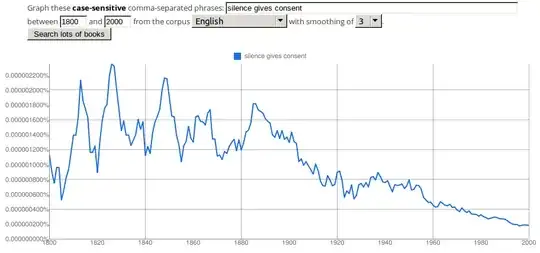
Also, here's what Ngram Viewer shows: enter image description here

0x4B1D
  • 321
  • 3
    In Sanskrit, which, like Latin, is a Indo-European language, it is "Maunam Sweekruti Lakshanan" which translates as "Silence is a sign of acceptance". – Dilip Sarwate Dec 22 '11 at 03:15
  • It's in classic and modern Hebrew as well. And I believe that the NGram of this version vs "silence is consent" as per above is even more telling. – sq33G Dec 22 '11 at 07:57
  • 1
    Didn't the same idiom exists in German and Russian, but I know the same idiom exists in Arabic language: Al-Sokoot 'Alamat Al-Ridha, meaning "The silence is the sign of acceptance." – Promather Dec 22 '11 at 10:30
  • The French version is "Qui ne dit mot consent". Wiktionary link : http://en.wiktionary.org/wiki/qui_ne_dit_mot_consent – Xavier T. Dec 22 '11 at 10:51
  • Uhm, where'd you get to German here? "Zwijgen is instemmen" is not, if that was what you referred to – Tobias Kienzler Dec 22 '11 at 12:31
  • @TobiasKienzler thanks for correction. It sounded German to me. Google translate detects it as Dutch. – 0x4B1D Dec 22 '11 at 12:35
  • In fact I don't think the idiom exists in German. The closest you get is "Keine Antwort ist auch eine Antwort" (no answer is also an answer), which is almost exclusively used when someone is suspected to have done something bad and, when accused of it, neither confesses nor denies but stays silent. "Keine Antwort ist auch eine Antwort" then concludes that they have done it. – leftaroundabout Dec 22 '11 at 13:30
  • @DilipSarwate thanks for the sanskrit translation, was actually looking for the same ;) – Baljeetsingh Sucharia Feb 03 '15 at 11:41
11

Sure. There is the phrase, "Silence is consent", sometimes given as "silence implies consent" or "silence is assent".

Jay
  • 36,223
6

The phrase "tacit consent" refers to the consent given by the failure to dissent, although that isn't a standalone phrase. "Speak now or forever hold your peace" is used in the context of weddings, but doesn't get much use elsewhere.

Other than those, simply saying, "Your silence implies your consent" works just fine.

fluffy
  • 1,061
5

"Without objection...". We use this in parliamentary meetings. for example: "Without objection, so ordered." Or "Without objection, it has been moved to table the matter of ..." this is an expedited way of obtaining unanimous consent without incurring the delay of formal and explicit agreement.

Canis Lupus
  • 22,017
2

There was an author of military thrillers that used the term UNODIR for this situation.

It means UNless Otherwise DIRected. The usage was that the character would send a report up the chain of command and end it with "UNODIR I am going to do something crazy and kill the bad guys".

Freiheit
  • 193
1

The direct translation of the latin Qui tacet consentit that has been thrown around here a few times is "He who is silent consents", but obviously that's not in common colloquial use -- nor, might I point out, is the latin phrase; not among your average English speaker.

In an informal setting, you're more likely to hear "he didn't say no" or "I never heard otherwise", which essentially carries the same meaning but without being a clearly-identifiable saying.

tylerl
  • 503