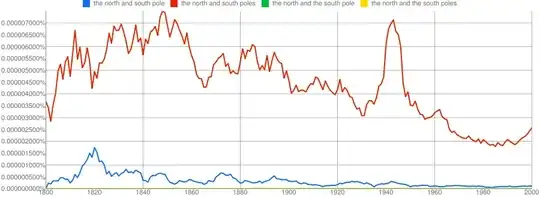
If I intend to say sentence 1 below, which of sentences 2 to 5 has/have the same meaning?
- What are the differences between the North Pole and the South Pole?
- What are the differences between the North and the South Pole?
- What are the differences between the North and the South Poles?
- What are the differences between the North and South Pole?
- What are the differences between the North and South Poles?
All of these are okay. Maybe some are better than others, but none of them are wrong.
I don't like 2 and 3, because when I see two "the"s I want to see two nouns, but that's just my personal preference.
Would you rewrite the following sentences to make them more concise?
- There are a red flag and a blue flag.
It should be, "There is a red flag." To understand why, rewrite it to make it less concise:
- There are a red flag and there are a blue flag. <-- wrong
- There is a red flag and there is a blue flag. <-- OK
Would I make it more concise? You can if you want, but I don't recommend it. "There is a red and a blue flag." is only a little bit shorter, and it's harder to read.
Of course, you mustn't write, "There is a red and blue flag." because that means there is one flag with two colors.
- South Korea and North Korea are located on the Korean Peninsula.
Hmm ... be careful.
Imagine that you are talking about two brothers, called John Smith and Bill Smith. Is it okay to call them "John and Bill Smith"? Of course!
Now, imagine that you are talking about two great politicians called John Smith and Bill Smith. They are not from the same family. In politics, they are enemies. Would you call them "John and Bill Smith"? Certainly not.
So what about North Korea and South Korea? Do you want to say they are like brothers?
- Which continent is bigger, North America or South America?
Again, you can abbreviate this if you want to, but I don't recommend it. When we put North America and South America together, we don't call them "America". ("America" means "The USA".) We call it "The Americas". We try to keep them separate in our language, because they are almost completely separate pieces of land.