2

There are many large areas covered in ice in the world, like in Yukon-Alaska and Patagonia. They are often referred as icefield or "ice field", but I don't know if one form is better that the other. I feel like "ice field" is more generic, it can be used for any area covered in ice, man made or not. For example, it is of common use for sailors when describing large areas of the sea surface covered in ice. Instead, icefield seem to me to be specific to the large ice masses that cover one or multiple valleys and mountain massifs.

Which form should I use when referring to large ice fields like the North Patagonian Ice Field in this image?Satellite image of large ice field

The answer on the question "When to use a hyphen to coin a new word and when to omit a hyphen?", suggest to keep the single word version if it is of common use, which is the case for icefield because:

  1. In a google search "Icefield" return about 5 times more results than "Ice field". Despite that in google scholar the difference is much narrower (20k vs 16k), it is still more common than "ice field".
  2. The Wikipedia page for Ice field consider Icefield as a valid spelling for the same thing. This issue is also mention in the Wikipedia talk page for that article, but with no clear answer or argumentation.
  3. Google Ngram, show that icefield is of common usage, becoming even more common than "ice field" in the later decades. Despite that "ice field" can be used other contexts too. Ngram of ice field forms
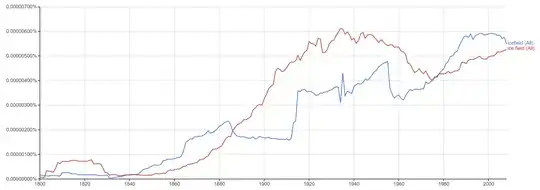
All the above suggest that I should use the single word "icefield". However, that world doesn't exist in the Cambridge Dictionary, and in the Oxford Dictionary (or this version) redirects to "ice field". Something that I understand as an statement on what is the right spelling.

So, should I follow what the dictionaries suggest? Or, should I follow the common use rule recommended in "When to use a hyphen to coin a new word and when to omit a hyphen?"

Chenmunka
  • 13,046

3 Answers3

1

It doesn't matter

Choose one form and stick with it.

Judging by the instances reported by Google Scholar, the meaning of the term is unaffected. The OP can choose to write icefield as one word or as two separate words, ice field.

Google Scholar returns about 16,900 results for ice field and ice-field

Abstract
The Patagonian Ice Fields are known to have undergone rapid retreat of frontal positions and significant thinning of its glaciers over the past decades. However, surface velocities have been measured at only a few of these glaciers. Thus, it remains uncertain if and to what extent the glacier dynamics has changed over time and contributed to ice loss in these ice fields. In this study, we examine the temporal evolution of flow velocities and ice-front positions at eight major glaciers in the Southern Patagonian Ice Field (SPI; Hielo Patagónico Sur)

ice-field

Abstract
Mapping along a transect from the southeastern margin of the South Patagonian Ice-field in Torres del Paine National Park (Chile) to the limits of fresh moraines of the last glacial cycle indentified [sic] eight glacier advances.

and about 19,500 results for icefield

ABSTRACT. We examine the deglaciation of the eastern flank of the North Patagonian Icefield between latitudes 46° and 48°S in an attempt to link the chronology of the Last Glacial Maximum moraines and those close to present‐day outlet glaciers.

Checking the written instances, reported by Google Scholar, since 2014: "Patagonian ice field" has about 183 results whereas "Patagonian icefield" attracts 291 results

Mari-Lou A
  • 91,183
0

The OED’s head word is ice field but all but one of its citations are with a hyphen.

It dates from 1694, when itfirst appears in a translation from the German Eisfeld as ice-field in an account of the voyages of Friderich Martens.

The two most recent citations are:

  • 1977 H. O'Hagan School-marm Tree ii. 25 — To the south, the high ice fields glowed green and pink and warm like a sudden garden against the sky.
  • 2004 Times Lit. Suppl. 30 Apr. 10/2 — He successfully navigated his ship through some of the world's most dangerous waters, through hidden reefs, Antarctic ice-fields, and home again.

The entry was last updated in 2012. There are zero citations for icefield, but searching for that term redirects to the entry for ice field.

tchrist
  • 134,759
  • But on those sites the seem to be mixing different meaning of "ice field", as the 2004 cite refers to ice covered sea surface, something different than an "icefield" as the one in the picture I posted. – Camilo Rada Jan 28 '18 at 01:10
  • @CamiloRada The OED definition is: A wide flat expanse of ice, esp. in polar regions. – tchrist Jan 28 '18 at 01:17
  • So maybe I'm referring to another meaning of "ice field" not considered by the OED. I'm a glaciologist and the whole community refers as icefield or "ice field" to ice bodies like the one in the image above, and non of them is flat really. – Camilo Rada Jan 28 '18 at 01:23
-1

"Ice shelf" is much more common than "ice field". See this ngrams.

OALD defines it as:

ice shelf noun (specialist)
a layer of ice that is attached to land and covers a large area of sea

Oxford Advanced Learner's Dictionary 9th edition © Oxford University Press, 2015

Ross Murray
  • 1,434
  • Are the two terms synonymous? The fact that the term ice shelf is more popular does not mean it is more precise or more appropriate than ice field. – Mari-Lou A Jan 28 '18 at 09:10
  • 1
    Ice shelf means something different, it is the floating portion of a large continental glacier. – Camilo Rada Jan 28 '18 at 14:50
  • I cited the term's more specific meaning. The fact that it is more popular, despite being more specific, suggests the OP should prefer it when its meaning does fit their need. – Ross Murray Jan 28 '18 at 15:40