7

In British English, is it acceptable to address a professor as "Dear Professor X" when writing a formal or informal letter? Does it sound natural?

Why I am asking this question:

I was looking through the list of differences between the British and American editions of the first Harry Potter book by J.K.Rowling.

In the first chapter of both editions, a character named Hagrid keeps addressing Professor Dumbledore as

Professor Dumbledore, sir.

However, when Hagrid writes a letter to Dumbledore, the two editions use different forms of addressing:

U.K. edition:

Dear Mr Dumbledore

U.S. edition:

Dear Professor Dumbledore

Edit: Everywhere else in the U.K. edition, he is still "Professor Dumbledore". This letter seems to be the only exception. If he normally calls him "Professor", why he would write "Mr" in the letter?

Why "Mr" instead of "Professor"? Is "Dear Professor X" inappropriate in the U.K. for some reason? Or it just doesn't sound natural?

JJJ
  • 7,148
rems
  • 583
  • 5
    What an interesting list of changes made for the US! I'm particularly intrigued that hamburger bar was changed to hamburger restaurant (I must admit the US version sounds something like an oxymoron to me). Do Americans also have sandwich restaurants? Was the US publication somehow funded using money from McDonalds, Wendys, etc.? – FumbleFingers Sep 05 '11 at 21:59
  • As an AmE speaker, 'hamburger restaurant' does not refer to any kind of fast food restaurant but rather a nicer restaurant, that primarily serves hamburgers. 'Hamburger Haven' is one chain. (but they are in no way as common as fast food burger places. AmEs do not have 'sandwich restaurants'. 'Burger joint' (pretty informal), or more blandly a 'burger place' would suffice. In some sense, a place that serves primarily burgers is pretty much McD's, BK, etc. and so there's not really anything more like that to be called that in the US. – Mitch Sep 05 '11 at 23:29
  • @Mitch: Right, we have a "restaurant" here that serves only Hamburgers (no fries at all—I asked), which cost about € 7 apiece. They are trying to be all hip and trendy, but I must say their seating area is not at all on par with a real restaurant. It is called De Burgermeester, which means mayor in Dutch but could be reinterpreted as burger-master. – Cerberus - Reinstate Monica Sep 06 '11 at 02:44
  • 2
    Probably in the US a hamburger bar would serve primarily alcohol, but also hamburgers. – GEdgar Sep 07 '11 at 02:23
  • A lot of the answers seem to not realize that Professor means "teacher (possibly on faculty)" in American English (and so may be lower than Dr), but in British English refers to a very senior, either ad-hominem, or faculty position and outranks a PhD. – james Mar 04 '19 at 09:13

5 Answers5

8

I think OP has the issue of "appropriateness" the wrong way round.

It's quite common in Britain not to address doctors and professors by that title. They're just plain "Mister", the same as the rest of us. I can't say exactly why - maybe we're a bit more egalitarian.

Clearly the change was made specifically for the US market, where I guess this usage is considered somehow "impolite" (disrespectful to either the office or the holder of the title).

I must admit I find it odd that such a change should be made to an English-language book in this way. But obviously the UK wording came first, so arguably the onus is on Americans to explain why they worry about such niceties (or why their book publishers think they might worry).

FumbleFingers
  • 140,184
  • 45
  • 294
  • 517
  • 8
    It seems ridiculous that they should change anything at all! A book should be read while immersing yourself into the culture behind it, not rendered bland by reducing its British flavour. Readers can learn something about cultural differences! I'd hate to read Hemmingway in a Briticised version. If a certain term is absolutely incomprehensible, a footnote should be added. If large parts of the text are incomprehensible, then, yes, a separate edition would be warranted, just like a translation into a different language. But, come on! – Cerberus - Reinstate Monica Sep 06 '11 at 02:49
  • @Cerberus: I couldn't agree more. If I were an American here on ELU I would feel slightly shamefaced about this Philistine "cultural protectionism". And if I were JK Rowling I'd like to think I'd be shamefaced about agreeing to it at all. I can only assume she acquiesced because she made more money that way, but she got where she is using my culture (albeit "low culture"), and I somewhat resent her allowing it to be bowlderised in this way. All I can say is "Not in my name!" – FumbleFingers Sep 06 '11 at 11:46
  • 2
    Everywhere else in the book, he is still "Professor Dumbledore". This letter seems to be the only exception. If he normally calls him "Professor", why he would write "Mr" in the letter? – rems Sep 06 '11 at 13:52
  • 5
    J.K.Rowling comments on the 'cultural adaptation' issue: "Very few changes have been made in the manuscript. Arthur Levine, my American editor, and I decided that words should be altered only where we felt they would be incomprehensible, even in context, to an American reader. I have had some criticism from other British writers about allowing any changes at all, but I feel the natural extension of that argument is to go and tell French and Danish children that we will not be translating Harry Potter, so they'd better go and learn English." – rems Sep 06 '11 at 13:55
  • @FumbleFingers: Hear, hear! Them again, I suppose we shouldn't expect anything better from mass media and commercial enterprise. I wonder whether there is a solution to the deterioration of the quality of the art that is consumed by the majority. Change copyright laws? It is interesting to note that both mass culture and copyright laws are more prominent in America than anywhere else. – Cerberus - Reinstate Monica Sep 06 '11 at 14:35
  • @rems: Well, at least this shows that she has given the issue some thought. But do you think the translation argument holds? I think a footnote every five pages would not impede the flow of reading significantly, while leaving the authenticity of the text intact. Her argument about incomprehensibility certainly does not hold for this "Professor". Oh, well, at least she is changing her own writings; that's better than being edited by someone else, though I hope she isn't doing it for the wrong reasons, influenced by the evil marketing business... – Cerberus - Reinstate Monica Sep 06 '11 at 14:40
  • @FumbleFingers: Obviously the "translation" justification is a ridiculous misapplication of reductio ad absurdum, which if taken to its logical conclusion would mean that we'd have to rewrite Shakespeare every couple of decades. I imagine the truth is more likely that Arthur Levine (her American editor) thought he had to do at least something to justify what (if I knew the sum involved) I would probably think is an obscene amount of money for him to have trousered from the deal. – FumbleFingers Sep 06 '11 at 15:29
  • 2
    While I generally agree that it is not necessary to "translate" literature from British English to American English, I think it does make sense to change a few things in the case of children's literature. I think the Mr/Professor thing here is kind of silly, but in general you have to cut the publisher a little slack. When the first Harry Potter book was released in the U.S. they had no idea if it was going to sell, so it surely seemed changing a few words in the manuscript of a children's book by a then-unknown author was a reasonable compromise. – nohat Sep 07 '11 at 03:38
  • @nohat♦: To the best of my recollection it was expected at the time that HP would do well in the US. Serious money was pumped into promoting it, and the movies were planned very early on. I would have thought it's unusual to make such gratuitous changes in the text of UK books for US publication, and I still find it hard to accept American children couldn't be expected to guess what a hamburger bar was. – FumbleFingers Sep 07 '11 at 04:10
  • @FumbleFingers of course you can quibble with individual choices, but the total number of changes is really quite small, and the attention paid to the whole matter is, in my opinion, grossly disproportionate. A few dozen words changed in a children's book—most books have more changes made before going into a second printing. – nohat Sep 07 '11 at 04:55
  • @nohat♦: If it were simply a matter of revisions before a reprint, this would indeed be trivial. But these changes to British text were specifically made to cater for the American market. I know HP isn't exactly "high art", but it does reflect British culture. It says a lot to me about American subversive "cultural imperialism" that it's considered okay to casually remove so many aspects of my culture while "raping" it for primarily commercial gain. This stance, as reflected in American foriegn policy, is an ongoing cause of real problems across the globe. – FumbleFingers Sep 07 '11 at 12:19
  • ...remember that today's American children will be tomorrow's politicians. What covert message are they being given about global cultural diversity? – FumbleFingers Sep 07 '11 at 12:21
  • @Fumbefingers Do you also complain about the cultural changes made to Harry Potter to suit the Japanese culture/reader? They did far more 'catering' to that market than simple Mr./Professor alteration. – Darwy Sep 11 '11 at 20:33
  • @FumbleFingers. Terry Pratchett allowed changes in the text of the Bromiliad, but not the Discworld series. – TRiG Apr 12 '13 at 21:20
  • 1
    I think the changes are BS. And the Americans are BS artists. I mean it was about the money where the Americans thought Britishisms wouldn't work. That is utter tripe. They should have put in a glossary if they were so worried....[I am American]. And the translation argument by JK Rowling is absurd. Despite her wonderful books (which I love), her analogy with translation is naive and silly. But imagine the pressures she must have faced... – Lambie Mar 19 '18 at 16:09
  • To be fair, the practice of making changes between international editions had been going on for a looong time before JKR, and in both directions. See this article about the British editorial changes to Moby Dick (including omitting "all of chapter 25, which speculated on the use of whale oil in English coronation ceremonies"), for example. If anything, it seems that the British taught the practice to Americans, back when Great Britain was the last word in imperialism. – 1006a Mar 19 '18 at 18:20
  • @1006a: “Voldemort,” said Riddle softly, “is my past, present, and future, Harry Potter . . .” That second comma (ironically, often called the *Oxford* comma) wasn't present in the original UK edition, and I do think it represents a bit of "cultural imperialism" that the US publishers thought it should be fiddled with. – FumbleFingers Mar 19 '18 at 18:35
  • (so much for my futile attempt to embolden an embedded comma! ;) – FumbleFingers Mar 19 '18 at 18:36
  • @FumbleFingers In general, I'd much rather publishers on both sides of the Atlantic leave the author's original language alone; I just don't think this is a uniquely US practice (and the "Oxford" comma is hotly debated within the US, so while it may represent editorial arrogance, I don't think that particular decision is an example of American cultural anything). – 1006a Mar 19 '18 at 18:39
  • @1006a: Maybe you're right. But I find it hard to believe any British publisher would actually go through and remove Oxford commas from a US-sourced text just because we don't usually use them these days. – FumbleFingers Mar 19 '18 at 18:55
4

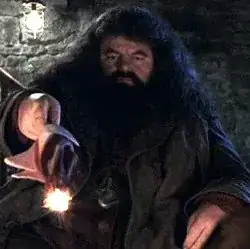
I think you may be barking up the wrong tree here. It is not a question of English vs American, or correct usage at all. It is simply part of the character. Hagrid, if given a choice, would always rather wield an umbrella than a pen:

enter image description here

Rowling is intentionally having Hagrid make a mild social blunder indicating his lack of finesse. This is the first time we see the character and the way he phrases his letter serves to introduce him to the reader. I don't think anything else can be read into this.

terdon
  • 21,559
3

In the US you address your GP as "Dr. X" and your teachers in school as Mr./Mrs./Ms. and in college they're Professors or Doctors. It's considered impolite to just say "Mr. X" when the person in question is a college professor or someone with their Doctorate.

Changing it in the books reflects the cultural norm of how to address a professor.

As a sidenote, it drives me nuts that the kids in Denmark call their teachers by his/her first name. I find it terribly impolite.

Darwy
  • 963
  • In Holland, it would be ridiculous to address professors by "Professor" rather than "Mister" in most fields (probably in all). Once students get to know a certain professor well enough, and if she isn't old or stiff, even first names will sometimes be used after a while, though by no means always. High-school teachers are mostly "Mister", but sometimes also first names in many schools, including some of the oldest, most reputable schools. I don't think "Doctor" is ever used any more by younger people. – Cerberus - Reinstate Monica Sep 06 '11 at 02:56
  • As I said; it reflects the cultural norm of how to address a professor in the US. The Harry Potter series is a work of fiction that's been 'translated' worldwide. As such, it's been altered slightly to 'fit in' to the culture it's being targeted to. For the US, the titles of characters. For France/Germany - use of the different 'you' pronouns. In Japanese, the characters were portrayed as 'stereotypically feminine' by the translators - something they are most definitely NOT in the original English. – Darwy Sep 06 '11 at 07:24
3

In the U.S., it is considered correct to use the address "Professor", but only in certain circumstances. You would only use the address "Professor" for someone who is a member of the faculty of a college or university (or retired). Further, I would say that you would only use it if you are addressing the faculty member in their capacity as a professor. That is, a bank teller wouldn't be expected to address a professor as "Professor" at the bank. But professors' students are generally expected to address their professors as "Professor" (or sometimes "Doctor"), even in nonacademic contexts, such as if they run into each other on campus. However, many professors tell their students to address them by their first name, and of course, once the issue has been discussed for a particular case, you do what the professor says.

I do know a number of college faculty members who are aghast at students who send them e-mails addressed to "Hey", so I would guess that many if not most college students these days have no idea what to call their professors. When I was in college 10 years ago I made certain to always address my professors as "Professor" (except for those who told me to call them by their first name), but I know many of my peers weren't sure what to call them.

nohat
  • 68,560
0

In the UK (outside academia) the title doctor is almost exclusively reserved for medical doctors. Often, if someone who isn't a medical doctor refers to themselves as "Dr. Smith", people around them might think they were putting on airs and inform those new to the social circle that they aren't "a real doctor".

I think in Britain PhD's are more likely to use "John Smith, PhD" than "Dr. Smith", if they use anything at all.

Kyudos
  • 417