Which is correct: electric bill, electrical bill or electricity bill?
Asked
Active
Viewed 3.1k times
5


-
1And in some places it's named after the utility company, for example, in Ontario we have hydro bills, because the power company used to be called Ontario Hydro (because they had a lot of hydro-electric generation plants) – Mr. Shiny and New 安宇 Aug 09 '11 at 11:53
-
1@Mr. Shiny and New: lordy, that must be confusing to people new to the area. I would have assumed the "hydro bill" was for water, not electricity. – Marthaª Aug 09 '11 at 14:29
-
@Martha: Yeah, as a child I never knew what my parents were talking about. – Mr. Shiny and New 安宇 Aug 09 '11 at 14:32
-
@Thursagen: Nice question ;) – roxrook Aug 09 '11 at 17:08
3 Answers
14
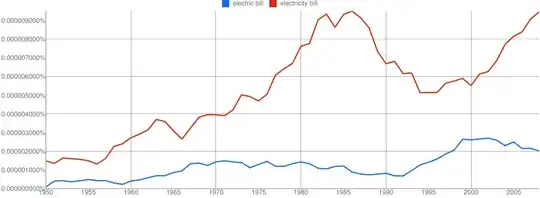
There is no such thing as an electrical bill. There's no difference in meaning between the other two, but Americans prefer electric bill...
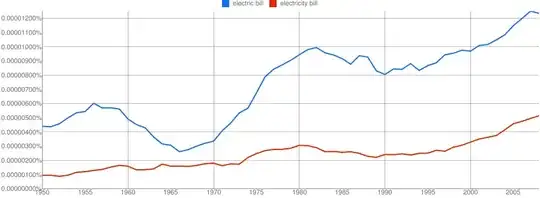
...whereas Brits prefer electricity bill...

FumbleFingers
- 140,184
- 45
- 294
- 517
-
1
-
@Mr. Shiny and New: I don't care how many people sneer at using NGrams to justify or establish a position. I think it's often an excellent way to go. Except I really do prefer the full form, so in retrospect as a Brit I wish I'd chosen green for that one, and red for what sounds like the "sloppy speech" version favoured by Americans! :) – FumbleFingers Aug 09 '11 at 14:46
-
Do people sneer? Are there significant drawbacks to n-grams? – Mr. Shiny and New 安宇 Aug 09 '11 at 15:05
-
@Mr. Shiny and New: It's not always clear whether people are being dismissive of NGram results in general, or the validity of results from specific queries. But see comments on Karl's answer here, where I posted an NGram I originally thought showed that "fuck all" was in use much earlier than turned out to be the case. There are other pitfalls besides the NGram scans of old books reading "suck" as "fuck", of course. – FumbleFingers Aug 09 '11 at 15:21
-
Great example of the usefulness of NGrams. Yes, here in the states we tend to say "electric bill", which doesn't make much sense. The bill is not "electric", and the bill is for electricity, not "electric". – Richard Kayser Nov 25 '16 at 14:49
-
@RichardKayser Similarly, company that sells the electricity is the "electric company" - which, contrary to its name, is not particularly dynamic or exciting. – John Feltz Nov 25 '16 at 16:58
-
2
Since electricity is what you're paying for, I'd suggest that it's "Electricity Bill", but the others are often used in conversation.

-
If we were coining a neologism your analysis would be valid, but both forms are so long-established it's a bit irrelevant to say it's more "correct" to use one or the other today. The guide must surely be "what do other people say?". – FumbleFingers Aug 09 '11 at 14:28
-
@FumbleFingers I suppose it depends on what "correct" means. If it means "in common usage for a reasonable period of time" as you suggest, then I agree. I suppose it comes down to whether "electric" can be used as a noun instead of "electricity" e.g. "the electric was turned off earlier in the day". To me, that sounds incorrect but from your charts it looks like it's a UK-US difference. – tinyd Aug 09 '11 at 15:09
-
@tinyd The usage of electric in this case is sense 6. in the entry on dictionary.com, and indeed can be used as a noun instead of electricity, as in the phrase gas and electric. It would be correct to say "The electric service was turned off earlier in the day." The phrase electric bill is synonymous with electric service bill and I agree that is common in North America. – ghoppe Aug 09 '11 at 18:34
-
@ghoppe - That sounds reasonable, but I don't think I've ever heard anyone (American or otherwise) say "this car is powered by electric" in a non-conversational way i.e. I don't think this sentence would make it into a newspaper or book as 100% 'correct' usage. But I'm sure I'll be inundated with counter-examples :) – tinyd Aug 11 '11 at 09:47
-
@tinyd I think electric is a synonym with electricity (as a noun) only in specific usages, mainly when referring to commercial service. It's a similar situation with many other words, for example economic/economical. I'm sure it was more common early in development of the technology and is falling out of favour. – ghoppe Aug 11 '11 at 18:17
1
"Electric bill" implies that the bill runs on electricity. "Electric" is used to mean that something uses electricity, and therefore would be inapprorpiate in this context.
"Electrical bill" is a bill that is concerned with electricity, and so would be appropriate.
An "Electricity bill" is a bill paying for electricity, and I believe this is the best option, (as do most electricalelectricity companies.)
To sum up, "electrical" and "electricity" are both appropriate in this context, and personally, I think "electricity bill" is the best option.

Thursagen
- 41,919
-
3I disagree strongly with the first two points: to me "electrical bill" implies that it runs on electricity, and "electric bill" less so. I think this may be a regional thing: "electric bill" is a common phrase in the UK. I agree that "electricity bill" is preferably to both. – Colin Fine Aug 09 '11 at 12:02
-
@Colin Fine: Absolutely agreed that "electrical bill" has no meaningful real-world referent. As for the other two, they mean exactly the same. They're both common on both sides of the pond, but you may be surprised to see that NGrams shows what I would call a significant difference in written usage figures. – FumbleFingers Aug 09 '11 at 14:23
-
I don't think it's all that common on this side of the pond. I don't know a single person who would call it anything but an "electric bill". – Aug 09 '11 at 15:00
-
@Al Everett: The problem with that statement is you only know some people, and most of them are probably from your own geographical and/or social context. NGram's classification of books as US or UK isn't bulletproof, but if it strongly suggests something that conflicts with your own perceptions you should at least consider the possibility that your sample base may not be representative of the country as a whole. – FumbleFingers Aug 09 '11 at 15:27
-
1Another data point, although far from canonical, is that there are three times as many google results for "electric bill" than "electricity bill" – ghoppe Aug 09 '11 at 18:41
-
Fair enough, @FumbleFingers, but your own NGram graph shows "electric bill" used far more often than "electrical bill" amongst us Merkins. Anyway, I've been hearing far more people calling it a "utility bill" instead. – Aug 09 '11 at 19:32
-
@ghoppe,Al Everett: I don't want to read too much into my NGram results, but superficially it suggests more than 1 in 3 Merkins pay electricity bills, and maybe 1 in 4 Brits pay electric bills. We each have our own "dominant" form, but the alternative seems to be at least "reasonably" common. Unlike, say, "automobile", something I doubt anyone in the UK has ever claimed to own. – FumbleFingers Aug 10 '11 at 13:23
-
@FumbleFingers Certainly I don't meant to argue that electricity bill is uncommon, I'm just suggesting that the phrase electric bill is slightly more common, which has been my experience. Surely there's a lot of regional variation as well. – ghoppe Aug 11 '11 at 18:20
-
@ghoppe: I think the problem is simply my use of the word "common". In this context, given I've already shown graphically that "electric bill" is the dominant form in the US, I'd happily describe any alternative that occured at least, say, 10% of the time as "common". But noting this NGram, I certainly wouldn't describe hydro bill as common, notwithstanding Mr. Shiny and New being familiar with it! :) – FumbleFingers Aug 11 '11 at 20:36
-
@FumbleFingers Another thing to be aware of, when looking at NGrams with small sample sets, is that there is no semantics in the search. I saw some weird peaks and in browsing through some entries found this fragment …"future at Western Electric. Bill Pickens"… and electric bill also matched legislation, as in the "Hydro-electric Bill." That said, I think we can say that both phrases are relatively common and correct. – ghoppe Aug 11 '11 at 20:43
-
@ghoppe: Definitions of terms again. I wouldn't call over 50,000 written usages "small sample sets", and as for the "false positives" you mention, if I didn't see several such in the first couple of dozen references, I think I'd be safe in assuming they wouldn't affect the overall picture even if there were more further down that I didn't look at. – FumbleFingers Aug 11 '11 at 20:58
-
@FumbleFingers I know we're picking nits here, but I enjoy it. I'll just make a couple further points. 50,000 citations over 100 years is 500 a year. The difference between the two phrases is about 9,000. That's 90 a year. I do consider that a small sample set. Many citations are from periodicals, and indeed it didn't take long for me to discover some citations are reprints of the same advertisement. Clicking on random pages, I found many with 20-30% of the citations on the page mentioning an "Electricity Bill" in the context of legislation. – ghoppe Aug 11 '11 at 21:11
-
@FumbleFingers Certainly I've only spent a few minutes glancing at the data, and while NGrams are an awesome tool, there is reason to consider them with a grain of salt. ;-) – ghoppe Aug 11 '11 at 21:12
-
@ghoppe: I agree your nits are well picked, but if you started by looking at older citations you'd probably get skew from that anyway. Look at just 1979-1999 (to avoid the 2000 legislation). I don't say every instance concerns payable bills, but there are enough for me to consider the usage "common". And yes, I do agree NGrams is rarely accurate, and can actually be misleading. I just think it's ok(-ish) in this case for showing that Americans do use electricity bill at least more often than "very rarely". – FumbleFingers Aug 11 '11 at 21:33