63

According to my grammar book, but at variance to the answer to this question, the correct singular possessive if a word ends in ‑s is:

James’s car

The grammar book allows exceptions for historical nouns, so the examples in the answer to the above-linked question would pass muster.

However, I’m sure that I learnt at school (which, admittedly, was a while ago) that for a singular (proper) noun ending in ‑s, the apostrophe went after the s and there was no additional s.

I don’t wish to start a flame war on which is correct, though my question doesn't really make sense if my grammar book is wrong! What I’m curious about is when the change occurred. :

So my question is when did James’s become the correct form and James’ the incorrect one?

7 Answers7

78

Since, 1810, forms like James’s (which I will call type A) have generally been more commonly used than forms like James’ (type B), according to my research using the Corpus of Historical American English (COHA).

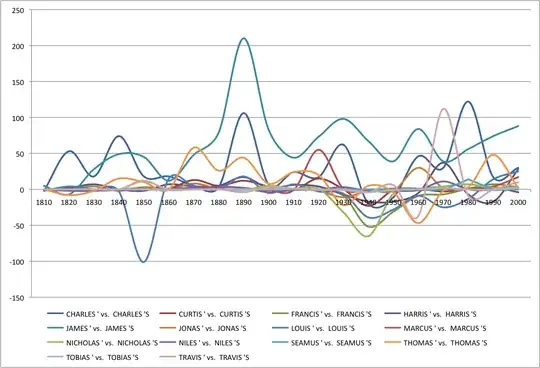
I compared a number of names ending in -s looking for possessive forms with and without a final s. Here is a graph comparing incidences of type A and type B forms:

graph showing forms with and without apostrophe since 1810. The y-axis shows the difference in incidence between types A and B. If it is above 0, that means that type A was more common in that period; if below 0, that means type B was more common. The raw data used to generate the chart is in this Google Spreadsheet.
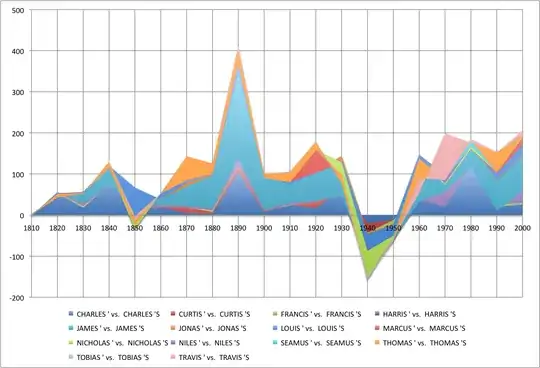
Here’s the same data, shown cumulatively:same data, shown cumulatively

For the 14 names tested, type A has been more common throughout the period beginning in 1810, except for the decades starting in 1850, 1940, and 1950.

Overall, it is quite clear that type A forms (e.g. James’s) predominate, and have done so for nearly two hundred years. Nevertheless, type B forms are also quite common, and during the 1930s to the 1960s, a number of names had more incidences using type B. But since 1970, most names have had a majority of usage in type A. As for the original question’s example of James, throughout almost the entire period, excluding 1820, incidences of James’s has strongly outnumbered incidences of James’.

nohat
  • 68,560
  • 16
    Amazing research and data representation. – Vaibhav Garg Sep 14 '10 at 11:44
  • 4
    COHA sounds like a place where one could seriously lose a few days! Now if only there was a COHB as well. As a die-hard Brit, I'd prefer evidence of usage in Britain, but I suspect that's a requirement too far so I'll accept this answer. – Andrew Stacey Sep 17 '10 at 08:00
  • Very nice answer. Btw, I just fixed a small typo: "181" to "1810" – b.roth Sep 17 '10 at 08:52
  • 3
    Sorry to always be a naysayer, but I'm suspicious of the data being used here. Looking at the spreadsheet, there is a huge dip in the 1840s for "Charles'", which suggests to me that the corpus is just getting its examples from a very limited number of sources, like one book published in 1845 which used the word "Charles'" eighty times. That would make the results and graphs meaningless. Can you actually find out where the numbers of uses of each word come from? –  Sep 17 '10 at 09:16
  • 9
    @Shinto, yes the data is noisy. That’s why I looked at 14 different names. Take it with a grain of salt. In aggregate, though, there is enough of a trend to say something. – nohat Sep 17 '10 at 16:11
  • @Shinto I have come to count on you to be the naysayer where appropriate. You have always had valid points, but your tone is much improved, and I (and I assume others) appreciate that. Your point is valid that the data here is quite noisy because a particular usage gets a lot of hits because it is the name of a character in a work of fiction in the corpus. However, I think in aggregate the data is sufficient to show that type A is somewhat more common, though both types are used frequently. – nohat Sep 17 '10 at 20:34
  • 2
    Personally, I have always written Ross' because it seems like Ross's has too many esses in it. I wonder what the COHA has to offer for names that already end in ss? – RBerteig Jan 24 '11 at 08:38
  • How can I get data on Gauss' vs Gauss's? – timur Feb 03 '11 at 03:44
  • 1
    @timur These days easiest with Google: http://ngrams.googlelabs.com/graph?content=Gauss+',Gauss's&year_start=1800&year_end=2008&corpus=0&smoothing=10 – nohat Feb 03 '11 at 05:17
  • How did this post ever garner a down vote? It's one sugar plum away from being a complete Christmas dinner, for Pete's sake. – Robusto Mar 11 '11 at 22:09
  • 2
    The problem with this answer is that it does not address the underlying law: that the way one writes possessives in English depends solely on pronunciation. I suppose I should write up a longer answer about this sometime, as it also involves suppressing duplicate /əz/ suffixes and completely explains things like one series’ protagonist, Achilles’ heel, states’ rights, this class’s superclass, this process’s memory, those processes’ memory, Ross’s idea, James’s father. There is only one rule, and it is not just a rule but a law, because it is completely predictive and has no exceptions. – tchrist Jan 09 '12 at 16:48
  • @RBerteig It turns out that there is no valid English possessive pronounced /səz/ that ends in a double-s plus a bare apostrophe; that must always be written ss’s instead. Even the somewhat archaic construct for righteousness’ sake does not violate this because the middle word is pronounced /ˈraɪtʃəsnəs/, and so does not end in /səz/ at all. There is just one simple overriding law that applies to all these cases, and it has no exceptions. – tchrist Jan 09 '12 at 16:59
  • @tchrist, interesting. I'll have to see if I can break a long standing habit... – RBerteig Jan 09 '12 at 19:59
  • @AndrewStacey: there is a British National Corpus, but it's far less extensive than COHA. – Colin Fine Aug 22 '12 at 15:46
  • 1
    I have always objected to anyone who tried to say "Francis'" rather than "Francis's" and that's how I say it :-) – Francis Davey May 14 '14 at 14:31
  • As a statistician - I'm impressed. Hence +1. As a human being I'm afraid and worried. As beautiful as it looks, where did you get the time to do that, mate?! :) – Konrad Viltersten Aug 20 '14 at 18:48
  • @KonradViltersten looking at the date, it looks like it was during my two-week notice period after quitting my previous job and before starting my new one. – nohat Aug 20 '14 at 23:49
  • @nohat Pfeeew. My faith in humanity's been restored. (Seriously though, I'd bounty you for that answer if I wasn't short on reputation - i.e. stingy, hihi). – Konrad Viltersten Aug 21 '14 at 05:57
  • @nohat Does that mean possessives of words are becoming more normalized to use 's instead of just the apostrophe without the s '? – RisingSun Oct 11 '21 at 20:55
13

I can’t speak to when, but I can say that Strunk and White’s Elements of Style specifically says to use the James’s form.

Since that is taken as gospel by — who knows, hundreds, thousands, millions? — of writers, I’m sure it has an effect on modern trends.

tchrist
  • 134,759
  • 9
    The Elements of Style (Strunk and White) puts this rule first precisely because it's the most controversial one — the goal of the book is to get you writing the way Strunk liked things. :-) – ShreevatsaR Dec 29 '10 at 03:03
  • @ShreevatsaR I suspect their injunction against the passive voice would be more controversial if more people actually understood the claim being made. – Casey Dec 02 '21 at 17:55
10

When I was taught grammar in school in the 90s and early 2000s in the northeastern United States, I was taught James's, to differentiate it from the plural possessive. (That's James's book; that's the Bryants' car.)

  • 1
    Must have changed around that time, then. In the 70s and 80s, "James's" would have been incorrect. "James'" was considered correct back then. I was also taught in the northeastern US (Connecticut). – ssakl Sep 13 '10 at 19:39
  • 4
    There is no merit in this argument, in my opinion. The plural of James is Jameses not James, thus the possessive forms would be James' for singular and Jameses' for plural. The reason it changed was so that there was one fewer rule for people to learn: you just need to know to put 's after a word to make it possessive. – J D OConal Sep 14 '10 at 01:03
  • 3
    Whether or not there's merit to the argument (I happen to think there is, both for consistency and for the written form mirroring the spoken form), my answer is an accurate, factual data-point to the question asked: not which is correct, but when changes in usage and teaching occurred. So I'm not sure why it was considered worthy of a down-vote. – In the Booley House Sep 14 '10 at 13:36
  • 4
    @In the Booley House, (I didn’t downvote your answer, but) I think the problem someone might have with this answer—same as with Antony’s, below—is that it doesn’t really answer the question, but just provides a data point that someone could use, along with many other data points, to answer the question. – nohat Sep 14 '10 at 17:41
  • 5
    That's fair, nohat, and your answer is certainly better than mine. Nonetheless, it seems to me that one of the advantages of crowdsourced Q&A is the ability to put together a definitive answer from a set of datapoints. – In the Booley House Sep 14 '10 at 19:21
  • One of the advantages of crowd-sourced Q & A is that the community gets to determine what is the best answer. While you did attempt to answer the question, you didn't go into enough depth. My answers have been down-voted before and I thought they were good -- that's the nature of the beast. No personal attack intended. – J D OConal Sep 19 '10 at 23:48
  • @JDOConal Maybe they intended for Jame to be a name? – Joe Z. Feb 24 '13 at 03:32
2

My recollection from school (UK, 1980s) is that the apostrophe-only version is used for Biblical names, and the apostrophe-plus-s is used for everything else. According to this rule, you would write "Jesus' friends and Seamus's friends" because the name Jesus appears in the Bible but the name Seamus does not.

Antony Quinn
  • 5,213
  • 13
    That's a cruel rule. How could I possibly know what names appear in the Bible? – RegDwigнt Sep 13 '10 at 22:24
  • 4
    Can you go back there and ask for your tuition back? They are paid to teach you things that make you smarter, not the opposite. – Mike Mooney Sep 14 '10 at 00:46
  • This argument is plainly false in my opinion. It is just a trend in English usage that Jesus' was used instead of Jesus's. Some common Biblical names may have been slower to change because of their frequent use in more archaic examples of English, but Jesus's is now used quite frequently, maybe even as frequently as Jesus'. James, of course, was a Biblical name. These days, people often pronounce it 'Jesuses' rather than 'Jesus' as well. – J D OConal Sep 14 '10 at 01:06
  • 1
    Same as the above: whether or not the argument is false, Antony's answer is an accurate, factual data-point to the question asked: not which is correct, but when changes in usage and teaching occurred. So I'm not sure why it was considered worthy of a down-vote. – In the Booley House Sep 14 '10 at 13:36
  • 1
    @In the Booley House. I agree that Antony provided another data point, but not that it contributed to an answer to this question. He only enlightened us to his experience, and gave no information as to when general practice changed. As I wrote in the comments to the question above, down votes are part of life at this type of site. Potential answers should at least attempt to thoroughly answer the question, as only one can be accepted as the correct answer. – J D OConal Sep 19 '10 at 23:50
1

Clearly, the rules (if they can be called rules) change over time. Therefore, you will be able to see the popular Christmas carol lyric '"Sire he lives a good league hence,/By St Agnes' fountain"'. The metre does not allow for "Agnes's" in order to scan.

0

Here is the justification:

For all SINGULAR nouns (other than some Bible names), add the apostrophe S, regardless of the ending letter.

For PLURAL nouns that end in S, add only the aposrophe.

Really, it's quite simple.

David Bowman
  • 1,809
  • 2
    That's not justification, that's an assertion. Moreover, it's not an answer to my question as the question was about changes in grammar, not about what was the "correct" behaviour. – Andrew Stacey Nov 02 '11 at 09:37
  • 2
    Your heart is in the right place, but technically what you have written is untrue: the singular nouns series and species take a simple apostrophe, as of course do Socrates and Achilles, which are certainly not ‘Biblical’ names. There is a greater law at work here that you are missing. – tchrist Jan 09 '12 at 16:54
0

Somewhere along the way, I recall a tip (likely designed to simplify matters rather than clarify them) that stated that single consonant names ending in S such as James would be adjusted to James's to indicated the possessive, whereas a polysyllabic name such as Oedipus would simply get the apostrophe as in Oedipus'. Perhaps this is more of an aesthetic tip, but I like it.

apaderno
  • 59,185