10

Recently, I experienced a communication failure talking to somebody about a "hard drive" until I could actually show the person what I was talking about.

"Oh, a hard disk! I thought you were saying something else, like 'hard drive.'"
"Yes, I probably did say hard drive."

What difference is there between these two, if any?

The title of the Wikipedia article uses the less concise "Hard disk drive" which I've also used, and could be disambiugated in this question/answer as well.

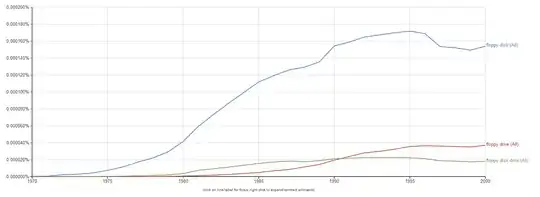
Here is a Google Ngrams view of the two terms, showing that "hard disk" used to be more common but "hard drive" is increasing in popularity and the edge that "hard disk" has now is mostly attributable to the fact that it comes first in "hard disk drive."
Cross-link to related question: Etymology of the use of "Drive" to refer to a digital storage medium

WBT
  • 3,544
  • 3
    "Good questions will attract more than 10 answers and poor ones will get nothing." This is just not true. – WBT Nov 14 '15 at 16:14
  • HD actually beats out hard drive by about 2007. SSD had yet to come up in the world by the the end of Google's data set. – Wayfaring Stranger Nov 14 '15 at 16:30
  • 1
    There is fundamentally no difference. Anyone who's been in the industry for maybe 15 years will recognize all three as being equivalent (even though certain writers may ascribe special powers to one term vs the other). Eventually something like "storage device" will take over and none of the terms will be recognized by relative newbies. Such is the way the language works. – Hot Licks Nov 14 '15 at 19:18
  • 1
    You might be interested to know that a user has posted a question on meta http://meta.english.stackexchange.com/questions/7311/what-is-the-purpose-of-answering-your-own-question. P.S I have no idea to whom you were conversing with, this is the first time I have visited this question as I know for a fact, I cannot answer, nor upvote any of the two answers provided. – Mari-Lou A Nov 15 '15 at 11:04
  • 'hard disk drive' doesn't sound like anything anyone would use in real life. It sounds like an Amazon subject heading. – Mitch Nov 15 '15 at 21:51
  • @Mari-LouA I had been exchanging comments with Rathony, who authored that meta post (thanks for the link!). Rathony first asked if answers were posted out of concern nobody else would be able to come up with answers, then wrote the quoted line (which I found statistics to disprove) followed by (in one comment) a strong instruction to delete the posted answers myself before the moderators did so. – WBT Nov 15 '15 at 22:21
  • There is another nearly duplicate question somewhere where I answered, pointing out that old storage devices consisted of separate "drives" and "disk packs". (And this is ignoring floppies, where the distinction is obvious.) So at one time the disk (the data) and the drive (the mechanism) were separate objects, and (since there was no single term in the formal manufacturer's parts list) all sorts of terms then developed informally to refer to the combination. – Hot Licks Nov 28 '16 at 22:34
  • @HotLicks I think you mean this broader and more recent question; cross-link added. – WBT Nov 28 '16 at 22:41
  • A technical response: https://superuser.com/questions/341497/whats-the-difference-between-a-disk-and-a-drive – Simon Woodside Jun 25 '18 at 19:04

4 Answers4

6

Hard disk refers to the data storage elements themselves.

Hard drive and hard disk drive refer to the data storage elements plus all the electronics that support, or drive, the reading and writing of data to/from storage. If, for example, the power electronics were removed, you'd still have a hard disk but not a hard drive.

The difference between hard drive and hard disk drive is that the former is more concise.

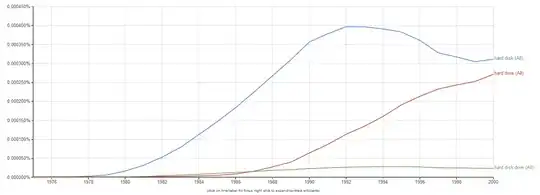
Edit (thanks to Misneac's comment!): The distinction becomes clearer when you consider the distinction between a floppy disk (something people used to carry around) and a floppy disk drive (a part of a not-so-portable computer that one would put a floppy disk into) or the short form floppy drive which apparently became more popular than floppy disk drive around 1991:

WBT
  • 3,544
  • Additionally, "hard disk drive" could be referring to out of date technology, and distinguished from a "floppy" disk drive by the use "hard". Hard in this case is a characteristic of the disk, not the drive. This doesn't apply to the question directly, but may help to explain variations frequency of use. – Misneac Nov 14 '15 at 15:43
4

I'm a computer engineer, and know intimately what these things are. I also know what my friends who aren't engineers understand.

From the engineering point of view, there is a huge difference between the disk and the drive, as WBT pointed out.

The difference is only important to the consumer for drives with removable disks (IOMega Zip, SuperFloppy, Drums, whatnot). For the consumer they often have a hard-enough time to distinguish between internal memory and the disk to get overly concerned with the drive/disk differentiation.

The term for the whole unit used to be 'hard disk drive', but over the years this has shortened to 'hard drive'. The recording 'hard disk' was used partly to distinguish from 'floppy disk', and partly because in its original 1960s incarnation it was really pretty hard: a 5mm thick disk of what amounted to solid iron oxide, usually mounted on a spindle, and very heavy.

Of course, 'hard disk' has itself mutated, normally to just 'disk' but more frequently nowadays to hand-waving 'cloud' terms: to 'flickr' or 'google docs'.

As for what is the difference between the terms, I'd say it depends on context. If you're working on computer parts, or in a relevant industrial setting, then there is a difference. In popular English, there is none, mostly because of (justifiable) ignorance.

Finally, of course, both terms are likely to disappear soon enough. Many computers now use "Solid State Drives" or SSDs, which have no 'disk' because they store data in (currently) Flash memory. Interesting note: Flash memory relies intimately on quantum theory.

rivimey
  • 217
  • The key point to me is made at the end of this answer: historically speaking, the word "disk" is probably going to be the transient part of this collection of concepts, while "drive" will endure. – JeremyDouglass Nov 28 '16 at 21:50
0

There is no difference.
Both terms are used interchangeably and with about the same frequency.

WBT
  • 3,544
  • Ah. I see. A clever way to conduct an opinion poll on ELU... – Jim Nov 14 '15 at 18:55
  • Except I don't think it's especially clever, and more than upvotes I'd prefer to see others editing/commenting/providing alternative answers with good explanations/sources/all the other things that make good answers :-). Although I'm aware of some possible answers, I don't actually know the correct answer to my question, so I thought I'd ask here. – WBT Nov 15 '15 at 22:10
  • Agreed - there is no practical difference (for the consumer) because of the nature of hard disks drives - they come in a single unit, the disks cannot be easily removed and interchanged (as for floppies), so unless you're a highly specialised engineer designing or manufacturing them, there is no need to distinguish between the storage medium and the equipment built around it. – Jeffrey Kemp Nov 18 '15 at 00:31
  • For additional support: if you bought a computer advertising a "hard drive", you would rightly take it back to the store and complain if you found that the "hard drive" didn't actually include any disks :) – Jeffrey Kemp Nov 18 '15 at 00:33
  • @JeffreyKemp Nor would you, in older days, buy a computer advertising a "floppy drive" and take it back complaining that it did not actually include any disks. (They would just sell you some floppy disks.) In contrast, if I bought a computer today advertising a "hard drive" that did not include any disks I would probably go back to ask the seller about that. – WBT Nov 18 '15 at 03:49
  • @Jim this strategy doesn't produce a valid opinion poll. I wouldn't upvote this answer, not because I disagree with it but because it's more of a comment. It doesn't support the position it takes. Regardless of who wrote it, it's a weak answer. – candied_orange Nov 21 '15 at 17:06
  • @CandiedOrange- I didn’t upvote it. I merely commented on the observed strategy. – Jim Nov 21 '15 at 17:11
  • The first line of the answer is supported by the second. The second line of this answer is supported by the Ngrams graph in the question. I would not object if someone wrote a better (i.e. more well-supported) answer arriving at the same conclusion. Getting such answers was the goal of writing the question; I'm sorry to see that was so controversial. – WBT Nov 21 '15 at 18:12
0

A hard drive is a storage device that, unless explicitly specified, resides inside the computer case. It is generally assumed that when you say hard drive, you mean a mechanical hard drive, which stores data by using magnetic read/write heads to write data to disks in binary format. There are SSDs, which stands for Solid State Drive, which works the same way as a flash drive, but on a larger scale. Hard disk drive is the mechanical hard drive. Disk drive is any type of storage device in which stores data on a disk. There are hard disk drives (HDD), optical disk drives (ODD), and Flexible/Floppy Disk drives (FDD). A RAID storage system is when you use multiple hard drives/SSDs at the same time to gain speed or data resiliency.

Source: Colin Wright, responding to virtually the same question asked at Quora.

Sven Yargs
  • 163,267
  • 1
    Hi Azzaz, welcome to ELU! One of the things that we look for is that answers not be "link-only" (just a pointer to information somewhere else that might be changed or deleted with no record), so if you could summarize the information from the linked webpage into your answer, that would improve the answer quite a bit. – Hellion Nov 28 '16 at 21:36