54

I'm always surprised when I hear the term white noise.

White noise itself sounds a little more "evil" than anything else, I would almost expect it to be called black noise.

  • Why is white noise called white noise?
Mou某
  • 5,377
  • 13
    White is not typically associated with evil in western culture. Black is. – TimR May 31 '15 at 11:23
  • 12
    @TimRomano - op means the noise itself sounds evil, not the name. – DanBeale May 31 '15 at 11:42
  • 3
    @DanBeale: you may be a better mindreader than I am, for it was not clear to me what sense could be made of *white noise sounds a little more evil than anything else, I would almost expect it to be called black noise". So my comment is just in case user3306365 comes from a culture where "white" is associated with evil. – TimR May 31 '15 at 11:49
  • Dan is absolutely right, though. People associate "noise" music with evil, in most cases, at least in the west, and white noise is almost the equivalent, so why "white"? – Mou某 May 31 '15 at 12:59
  • 11
    Why should white noise sound evil? It's just a neutral (the most neutral?) noise. Is it because white noise has been used in the media to represent evil, and we now associate the two? ( In the same way as church organ music is now used to suggest a satanic presence? Even the genial, humane music of Bach sometimes. What irony!) – Margana May 31 '15 at 13:45
  • 1
    Will those who discuss "white noise" be accused of racism? – GEdgar May 31 '15 at 19:49
  • 2
    While music is sometimes called noise, and yes, it happens that some people are likely to call what they think f as "evil" music noise, the noise in white noise has little to do with music. It simply means "sound", rather than "annoying, bad or "evil" loud nonsense that some people call music". "White noise" doesn't even have to be "loud". – oerkelens Jun 01 '15 at 07:36
  • 2
    This should probably be on [physics.SE]. – Raphael Jun 03 '15 at 08:05
  • You think that's funny, wait till you give "brown" noise a try.... – jkp1187 Dec 09 '19 at 15:34

3 Answers3

137

White noise, is called white in analogy to white light:

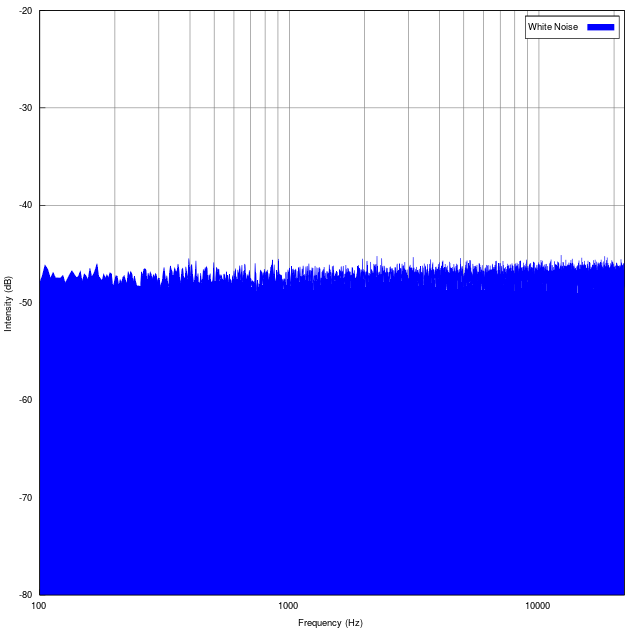
  • The background noise that is continuously present on electrical circuits or radio circuits due to the thermal agitation of electrons.White noise has a flat power spectral density, which is to say that it has equal power at any frequency in any given frequency band.

  • The term white noise comes from the fact that it is analogous to white light, which is a combination of all frequencies or wavelengths in the visible light spectrum. (Webster's New World Telecom Dictionary)

From: Atlantic Monthly Company, 1946

  • The purest and simplest noise of all, it should be noted, is what the scientist calls a white noise. Like white light, which Newton showed to be compounded of all the colors, white noise is the simultaneous sounding of all the pitches.
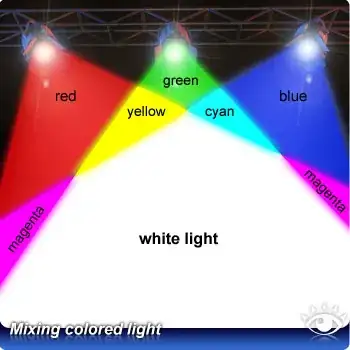
The mixing of colored light. Red + green = yellow. Green + blue = cyan. Red + blue = magenta. Red + green + blue = white.

200_success
  • 6,958
  • 5
    Quite correct. If you look at a frequency vs amplitude graph of "white noise" it looks like grass, with all the grass (roughly) the same height. Other "colors" of noise may slope or dip. Voice and other "real" sounds will appear rather "lumpy". – Hot Licks May 31 '15 at 12:02
  • 16
    (In other words, this is a term of science/engineering, and has no cultural implications.) – Hot Licks May 31 '15 at 12:05
  • Concise and brilliant. – Centaurus May 31 '15 at 13:13
  • 12
    @HotLicks: for the record, the “grass” appearance of a white-noise spectrum is an artifact from taking a finite sample of the noise. The “true” spectrum is in fact completely even, constant amplitude for all frequencies. – leftaroundabout May 31 '15 at 13:19
  • 1
    @leftaroundabout - That and the fact that common "white" noise is never really "white". It takes a fairly well-controlled environment to produce something approaching "pure" white noise (just as it's difficult to produce "pure" white light). – Hot Licks May 31 '15 at 13:26
  • 1
    I always thought "white noise" was an analogy to CRT televisions with poor reception. The picture component of static would be white/gray flecks appearing over the picture (or a black background if the TV were tuned to an empty frequency) giving the appearance of a blizzard. This was always accompanied by the sound of static, which sounds a bit like a rushing wind. Snowfall + static = white noise. But I'm pretty sure I just made reasoning up myself when we still bothered to watch analog TV. Your answer is much better. – Patrick M May 31 '15 at 17:17
  • 12
    The graph is misleading as it indicates that white light is the combination of only three colors. In nature it is the combination of all colors like shown in the rainbow. To the human eye however, the three colors combined look like white. – Thorbjørn Ravn Andersen May 31 '15 at 17:39
  • 6
    @leftaroundabout No! The expected value at each frequency is the same across all frequencies, but the Fourier transform of white noise is in fact white noise in the frequency domain. – Sanchises Jun 01 '15 at 17:01
  • 2
    @ThorbjørnRavnAndersen human vision only has 3 dimensions, and multiple combinations of three different (spectrally pure) colors can produce "white" (there is no one "white" because it depends on color temperature, but that's beside the point). This is sometimes a problem because different "white" lights have different spectra to approximate "white", and can cause two objects with the same color under one "white" light to appear differently under another "white" light, a phenomenon known as metamerism. – Nick T Jun 02 '15 at 03:43
39

Noise is called "white" when it has the same intensity at every frequency. Its name is derived by analogy to light, which is called "white" when it contains all visible frequencies.

Note that there are other "colors" of noise, also named by analogy to frequencies of light:

  • Red/brown noise is weighted towards the bass; pink noise is less so.
  • Violet noise is weighted towards the treble; blue noise is less so.
  • Grey noise is noise that is perceived as white by the human ear.

In informal usage, there is also "black" noise, whose definition is context-sensitive:

Black noise is also called silent noise.

  1. Silence
  2. Noise with a 1/ƒβ spectrum, where β > 2. This formula is used to model the frequency of natural disasters.
  3. Noise that has a frequency spectrum of predominantly zero power level over all frequencies except for a few narrow bands or spikes. Note: An example of black noise in a facsimile transmission system is the spectrum that might be obtained when scanning a black area in which there are a few random white spots. Thus, in the time domain, a few random pulses occur while scanning.
  4. Noise with a spectrum corresponding to the blackbody radiation (thermal noise). For temperatures higher than about 3×10⁻⁷ K the peak of the blackbody spectrum is above the upper limit to human Hearing range. In those situations, for the purposes of what is heard, black noise is well approximated as violet noise.
200_success
  • 6,958
  • 4
    There is also "Pink noise"... From WikiPedia: Pink noise or 1⁄f noise (sometimes also called flicker noise) is a signal or process with a frequency spectrum such that the power spectral density (energy or power per Hz) is inversely proportional to the frequency of the signal. In pink noise, each octave (halving/doubling in frequency) carries an equal amount of noise power. The name arises from the pink appearance of visible light with this power spectrum.[1] – Baard Kopperud Jun 01 '15 at 13:53
  • 3
    @BaardKopperud This answer already mentions pink noise. – starsplusplus Jun 01 '15 at 20:51
  • @starsplusplus - The reference is minor and useless. Baard’s information is useful and not redundant. – Jim Dec 02 '19 at 06:09
-6

I can tell the people answering this question are not old. The term "White Noise" comes from the days of black and white tube televisions. The hissing noise heard was always accompanied by white streaks across the screen. Hence the term "White Noise".

Bob
  • 29
  • 1
    Heh... I don't consider myself old (maybe I should), but this was the first explanation that came to my mind. – Paul Rowe Jun 01 '15 at 18:07
  • And what about the same noise coming from a radio? –  Jun 01 '15 at 19:55
  • 5
    The purest and simplest noise of all, it should be noted, is what the scientist calls a white noise. Like white light, which Newton showed to be compounded of all the colors, white noise is the simultaneous sounding of all the pitches. Atlantic Monthly Company, 1946 : https://books.google.it/books?id=4aYGAQAAIAAJ&q=%22white+noise%22&dq=%22white+noise%22&hl=it&sa=X&ei=IblsVe-3F8Lc7AbGo4HoBA&ved=0CB4Q6AEwAA –  Jun 01 '15 at 19:59
  • 7
    What evidence do you have for this? – curiousdannii Jun 02 '15 at 03:00
  • 2
    Note also that the appearance of "white noise" in literature began at approximately the same time as the Atlantic issue @Josh61 mentions. Available evidence strongly implies that the static noise accompanying television signals was simply casually (and likely inaccurately) referred to as "white noise" due to its similarity to actual white noise. – Jason C Jun 02 '15 at 03:54
  • Television wasn't very common in the early 40s when engineers started to call sound with effectively equal energy intensities at all frequencies within a frequency range of interest, "white noise". While those who came up with the term would certainly have been among those who had seen televisions in use, they'd have spent much more of their time looking at spectrum analysers than televisions, and the spectrum analyser output for white noise is very much like that for white light; it looks "white". – Jon Hanna Jun 03 '15 at 11:10