13
  • Can anyone tell me why the Tuscan city of Livorno used to be called Leghorn in English?

An increasing number of British writers, artists, philosophers, and travelers visited the area and developed the unique historical ties between the two communities. The British referred to the city as Leghorn.

Wikipedia

I believe nowadays English brochures, foreign travellers etc. call the city by its traditional Italian name. So did the name Leghorn simply fell in popularity or disuse as suggested by Google Ngram? Did the Livornese hold a petition or protested?! (I've been living in Italy for over thirty years, and I don't recall ever hearing them complain.)
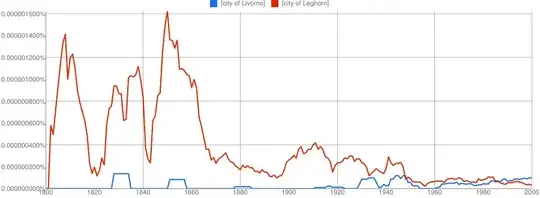
enter image description here

  • What term is commonly used when an anglicized city's name reverts back to the original?
Mari-Lou A
  • 91,183
  • Tough nut to crack. Can't speak to its ?"common-ness"? but it's the best (read: only) thing I could come up with: see “Realignment of the official Indian English name to an alternative local name” at wikipedia –  Apr 30 '15 at 07:53
  • 2
    Livorno was a major trading port until it became part of Italy in 1868. After that it probably figured much less in the minds of people everywhere, and references to it dropped off accordingly. Probably the anglicised name became so rarely used, many people didn't know that there was an anglicised name for the place and just used the local name. – Neil W Apr 30 '15 at 08:03
  • 1
    @NeilW I used to hear Leghorn mention occasionally when I was much younger; Italian middle school students learning English were taught the anglicized names of Italian cities e.g. Venice, Florence, Milan, Naples, and Leghorn used to be included. I doubt it is taught today, but I assure you I was born in the 1960s, not the 1860s :) – Mari-Lou A Apr 30 '15 at 08:27
  • 3
    Yes, In Britain it would sound pretentious to say that you're going on holiday to Venezia, Firenze or Milano, but Livorno/Leghorn has dropped off the radar. I have noticed some Brits referring to Napoli, however, and I think that's because of the football team. – David Garner Apr 30 '15 at 08:53
  • it's a great pity to base any thinking or enquiry on "something in wikipedia" – Fattie Apr 30 '15 at 14:40
  • Is this the same phenomenon as Mumbai for Bombay, and Chennai for Madras? What about St. Petersburg for Leningrad (though there is no translation there)? I think maybe 'reversion' is enough for the label. As to why, unless there is some individual who popularly made a pronouncement, answering that is speculative. (e.g. we know why Persia reverted to Iran (in the name the west gives) because the (last) Shah asked people to do so. – Mitch Apr 30 '15 at 17:53
  • 1
    Funny thing, but the Norwegians, on the edge of Europe – in the words of one medieval chronicler, making their living on the icy sea as if they were whales – use the native name for everything. IOW, they are Firenze-only folks. Perhaps only great imperial powers can afford to shit all over the map like the Brits. – David Pugh Apr 30 '15 at 18:04
  • And did you find an answer to that? –  Apr 30 '15 at 18:07
  • @Josh61 OK, I also wanted to know why it was called Leghorn. Checked. Why did it fell in disuse. Checked. What's it called when a city regains its original name. checked. Yep. Check out the links. Apparently some Britons arrived at the conclusion that the term Leghorn was a bastardization, an effrontery. – Mari-Lou A Apr 30 '15 at 18:09
  • 1
    In his memories Churchill wrote in 1944 I wanted to visit the port of Livorno which had been important in the history of our Navy . I think that once the contact between Livorno and the British became less and less relevant, the name Leghorn was less and less used. http://www.comune.livorno.it/_cn_online/index.php?id=299 –  Apr 30 '15 at 18:20
  • @Josh61 you should post that, I also believe that the term Leghorn made sense to those who remembered the city being called Legorno, once that memory died, there was too much dissonance between Livorno and Leghorn. – Mari-Lou A Apr 30 '15 at 19:02
  • @Josh: Calling everyone else's cities by their own funny names. Though we should give also the Germans a dishonourable mention in this context. I forget what they call Florence, but Venedig and Mailand, really. – David Pugh Apr 30 '15 at 19:03
  • @DavidPugh those are the two most horrible names I have ever heard. Venedig and Mailand? What about Florence and Sicily? I should also mention that Italians have the bad habit of giving Italians names to cities, and people too. So, it's Londra for London, Edinburgo for Edinburgh; La regina Elisabetta and principe Carlo for Queen Elizabeth and Prince Charles. Note the lowercase for principe and regina – Mari-Lou A Apr 30 '15 at 19:14
  • Advanced Googling gives me "Florence", and so "Sicilien". You might have a look at points further east, where every Slavic city has its totally different German name: Laibach, Pressburg, Breslau and so forth. This is probably because they were colonies, not tourist destinations, blame the Hapsburgs, but I think that a tourist still goes to Laibach not Ljubljana. Romania is funny, as you get Romanian, German and Hungarian names for the same city. So I have been in Cluj, Klausenburg and Kolosvar at the same instant. – David Pugh Apr 30 '15 at 19:18

2 Answers2

7

On the origin (also this):

Leghorn
breed of fowl, 1869, from Leghorn, city in Italy (modern Livorno, 16c.-17c. Legorno), from Latin Liburnus, from the native people name Liburni, which is of unknown signification.

[ Online Etymology Dictionary ]

Ferdinando I de' Medici wrote "Liuorno" in 1593 (Document Inviting Jewish Merchants to Settle in Livorno and Pisa). In any case here is a discussion about the Livorno/Legorno difference (see also note therein):

In the fine Portolano of Carachi already mentioned, Legorno, Florentia and Neapolis appear for Livorno, Firenze and Napoli of the present day; and assuredly the classic enunciation of the last two cities assimilates more with the English names - also our adjective, Neapolitan - than with the modern Italian. Leghorn he has even written in Greek characters Λεγορνο [...]; and others of the same epoch(circa 1550) term it Legorne, Ligorna and Ligorno which last was adopted by Crescentio, in 1607.*

[ The Mediterranean: A Memoir Physical, Historical, and Nautical, Rear-Admiral William Henry Smyth, 1854(John W. Parker and Son), p. 409 ]

Aside from the "similar" spelling, Leghorn (even more so when /ˈlɛɡɔrn/) resembles Legorno (somewhat), at least more so than it does Livorno.

Maybe Leghorn was an exonym based on the classic enunciation and geographical renaming occurred.

  • Legorno, well I never... I have never heard that name. – Mari-Lou A Apr 30 '15 at 08:53
  • Thank you! Didn't know about exonyms and got to look at what Medici wrote. Cheers. –  Apr 30 '15 at 18:52
  • Someone has made a mess of the Greek. – fdb Apr 30 '15 at 22:36
  • Λεγορνο (someone has half corrected it now; only the initial upper-case Λ is still required.) – fdb May 01 '15 at 10:43
  • @fdb wouldn't it have been simpler, and faster if you had done the editing the first place? I am not going to meddle with ancient Greek or its characters, I have no idea if what you are saying is true. But if it is, please edit. I'm sure Amphiteóth won't mind. – Mari-Lou A May 02 '15 at 16:40
1

The genoese version is Ligorna... so maybe this is where it comes from.

KillingTime
  • 6,206
Doug
  • 19