53

So there I was, trying to ask a question (now on SO) on Webmaster.SE partly involving a 'header' and a 'footer'. One part of my code defines shared aspects of both the header and the footer.

Anyway to cut a long story short, I became somewhat stuck as to what I wanted to name the class they share. All I could come up with was Xer, HeaderFooter and sandwich. Similar word groups like 'suffix' and 'prefix' give me the same issue, coming up with Xfix which is just awful nomenclature!

What categorically describes both headers and footers?

Commentary: I am *not* concerned about the web design/coding aspect of this at all. 
I could easily just use:
div.CantThinkOfName

for my particular case if that were the issue. I'm referring to header/footer as it applies to any document or setting in the English language.

Final Results: Best coinage is Running Marginals with runner-up, Horizontal Ribbons. I've chosen Running Sections as the correct answer as this phrase is already in use while awarding bounty to Marginals (which eventually became running marginals)

This conveys attachment to the document's margins as well as the concept of "going along" said document flow. A sub-component could potentially have its own running marginals.

"Running sections" and "running elements" imply a potential to exist in contexts other than the margins of a document/component. Sections are slightly more generic in terms of the content they hold as well.

"Marginals" alone may not necessarily run with the document, such as dropdowns, map legends, scales, graph metrics, etc. This new word is handy in other contexts besides the "running" variety of marginals.

11 Answers11

41

This is a somewhat late answer. Not because I'm suddenly interested in the bounty, but because I assumed someone else would know the 'correct' answer.

It's now become clear there isn't currently any single term with established significance that specifically means 'headers and footers', so we're looking for a new coinage or specialised use of existing words.

I therefore propose marginals.

In principle headers/footers might be vertical marginals, as opposed to horizontal marginals on the sides of the main text. In practice you'd rarely need to reference the horizontal type, because we don't usually put 'repeating' text there in print (that's where the reader pencils in his own notes).

We could replace headers with top marginals, and footers with bottom marginals. So we'd end up with one less specialised term to remember, rather than one more.

FumbleFingers
  • 140,184
  • 45
  • 294
  • 517
  • This and some variation of 'running' seem the most plausible to me thus far. Plan to leave this open to get as much feedback as possible, and in case of someone knowing other words. Thanks~ – That Realtor Programmer Guy May 12 '11 at 23:19
  • 1
    @Garet Claborn: I think running only gets in on the act to avoid confusion between, for example, footers (which run the same text page after page), and footnotes (which are peculiar to the page they appear on). It's a bit misleading anyway, because 'marginals' often include stuff like 'Section Title', 'Page Number', etc., which change across pages. – FumbleFingers May 12 '11 at 23:29
  • I've had a number of headers using similar 'autotext' sort of features. Should I have been calling them headnotes? ;p I had never heard of this distinction between footer and footnote. I thought a footnote simply went in the footer. – That Realtor Programmer Guy May 12 '11 at 23:34
  • 1
    @Garet Claborn: I don't really do much Desktop Publishing, or even Word Processing, but I doubt footnotes would go in the footer from any package's point of view. You generally define the contents of the footer once per document, possibly including 'variables' for stuff like 'PageNo'. Footnotes may be present on some pages, but whatever goes in one is highly unlikely to appear on any other pages. – FumbleFingers May 13 '11 at 00:42
  • Ooooh, right. Like when you have * or a superscript 1,2,... or something to that nature in the main document? – That Realtor Programmer Guy May 13 '11 at 00:44
  • 1
    Exactly. Sometimes all the actual notes are at the end of the chapter or book, but sometimes they're right there at the bottom of the page refering to them. It's not unusual to have both types in a single document, in which case there may be different symbols next to the 'reference numbers' so you know where to go. – FumbleFingers May 13 '11 at 00:53
  • 1
    Hmm, what about "running marginals" to distinguish headers and footers from "static marginals", which might be footnotes or such? Neologisms are so exciting! And not to be nitpicky, but given the site, I feel I should suggest that it's one fewer specialised term to remember, rather than one less. ;-) – Kit Z. Fox May 13 '11 at 01:04
  • 3
    @Fumble: +.5, if you want to see the other .5, add some pictures to your answer ;) – Callithumpian May 13 '11 at 02:28
  • 1
    @Kit: A hit! A palpable hit! I think. But I can't deny fewer in that context seems a bit 'formal' to me. I'll search EL&U to see if it's been looked into already. If not I might just ask about it. – FumbleFingers May 13 '11 at 15:40
  • Thanks for the help on this one Fumble, Call, Kit. My mind is at ease. =P Also I had neglected to post link to that question so I updated my original post. – That Realtor Programmer Guy May 16 '11 at 06:05
  • I definitely like the "running marginals" term for page boundary elements that remain consistent across pages, but I still think you have the vertical and horizontal subcategories the wrong way around :) – ncoghlan May 16 '11 at 16:07
  • @ncoghlan: I think see what you mean. I guess it depends how you look at it whether you call 'side' marginals horizontal or vertical. But to me they're most naturally horizontal, which leaves the less-than-intuitive vertical for top & bottom (headers/footers). Which, as I said before, doesn't really matter because WP/DTP is rarely concerned with side text. – FumbleFingers May 17 '11 at 16:11
  • Yeah, it depends on if you view the horizontal/vertical as referring to the marginals' position on the page (i.e. left and right as directions in the horizontal plane), or to their layout (i.e. the left and right marginals parallel the vertical edge of the page, while the header and footer parallel the horizontal edges). Since I think of the header and footer as providing horizontal space to write in, while the left and right marginals provide vertical columns for info boxes and the like, I lean towards the latter interpretation. – ncoghlan May 18 '11 at 04:44
  • oh snap. here all these years I never saw these comments. I was thinking of a "vertical [running or not running] marginal" according to the section's aspect ratio.. such that if the vertical side is largest it is a vertical marginal haha – That Realtor Programmer Guy Sep 21 '20 at 21:48
25

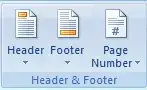
The guys and girls at Microsoft couldn't think of a single good unambiguous name either, so they settled on Header & Footer

MS Word Header and Footer

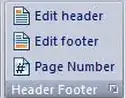
Neither, apparently, could the folks at Corel Write

enter image description here

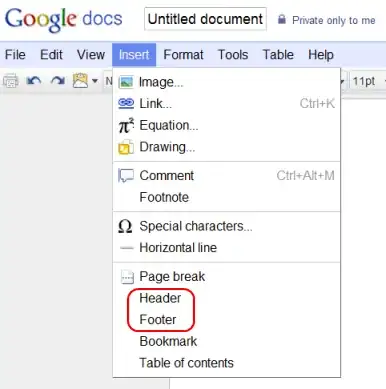
While over at Google they didn't bother grouping them at all (the red circle is mine)

Google Docs didn't bother grouping them

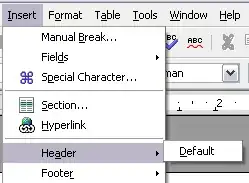
Neither did the Open Office team

Open office did't bother either

Ed Guiness
  • 8,923
  • 5
    @Ed Guiness: I don't get it. Does your post get updated because of the pretty pictures? OP asks for an alternative to headers and footers, you suggest headers and footers, and this is apparently the best answer. I don't want to seem contentious, but how is this an answer at all, let alone the best? – FumbleFingers May 12 '11 at 20:37
  • 9
    @FumbleFingers: What's the problem here? This answer provides clear visual proof that user interface designers for word processing programs, who have reason to care about this particular topic more than just about anyone else in the world, have been unable to come up with any such word; therefore, there probably isn't one. Sounds good to me. – phenry May 12 '11 at 22:40
  • I will say I found this pretty useful and at least on topic, but at the same time I was really hoping to get away from the developer side of things into just plain old vocabulary. Still I really liked knowing that something has stumped these folks ;P – That Realtor Programmer Guy May 12 '11 at 23:22
  • @phenry: The problem is OP didn't ask whether it's true that there's no existing term with widespread currency - by implication, he already knows that. He asked for a word that he could use. – FumbleFingers May 12 '11 at 23:34
  • @FumbleFingers: While I agree that the OP probably knew that there was no single word for this, often an OP won't know that there isn't a single word. I think it helps to show that there might be good reasons for it. This post shows that there doesn't appear to be a word that most people would understand, necessitating a coining of a new word, thus risking that nobody will understand it. – Mr. Shiny and New 安宇 May 13 '11 at 14:13
  • Curses, I've been rumbled. I confess my intention to get 100k rep by only ever pasting pictures. – Ed Guiness May 13 '11 at 14:19
  • 1
    @Ed Guiness: I didn't mean to be critical of your post in and of itself. Even though I don't really think it's an Answer, you obviously couldn't put all that in a Comment, and it's certainly relevant to the question. It was the upvotes I was questioning, but I guess I just looked at things the wrong way. If there is no actual answer, saying that is a perfectly good response. – FumbleFingers May 13 '11 at 15:35
17

From publication: Running head and footer.

Running sections?

Edit So this would become div.Running or equivalent.

  • 5
    I currently work as a typesetter (all digital, but still) and we call header/footers Running Elements, and the veterans of yesteryear refer to them as Running Blocks. So I agree with some variation of "Running" – WSkid May 12 '11 at 09:52
  • 3
    Maybe "Runners" – Kit Z. Fox May 12 '11 at 17:06
  • So far this and marginals seem pretty closely the best. Interested in hearing others' opinions. – That Realtor Programmer Guy May 12 '11 at 23:20
  • 2
    @Garet, when you go with something derived from margin(s), remember that it usually indicates space around the content (by definition in typography) and not content/information around the content. – Derk-Jan Karrenbeld May 13 '11 at 20:33
  • Thanks for your help Derk-Jan. I would have never known about running in a million years. @Kit, runners is pretty good for a class name too. Now I'm going to have to think :) – That Realtor Programmer Guy May 16 '11 at 06:06
  • 1
    @Garet, you are welcome. I only know it because I designed my highschool yearbook. Good luck with your code! – Derk-Jan Karrenbeld May 16 '11 at 19:53
  • 1
    Thanks! Had a hard time to find a word, and "margins" just doesn't cut it because it can also define horizontal spaces, or in case of code, often define blank spaces around an item. – LightStriker Jul 04 '14 at 19:43
6

There is no commonly used name regrouping both footers and headers, so the question you have to ask yourself is “do I want to create a new term, or will this new terminology put off users?”

If you want to create a word for that, I would suggest:

  • banners: the obvious drawback is that it's already taken, at least in the context of a webpage
  • ribbons: emphasizing that those are horizontal blocks of text
  • if you talk about all elements which adorn the page without being the core of the page itself, you could go with adornments, ornaments, etc.
  • the most generic term I can think of would be blocks, as in blocks of text, which you can qualify to your heart’s desire: fixed blocks, title blocks, etc.

But no solution seems perfect.

F'x
  • 38,736
  • Sorry, I'll think about this but I am almost positive there is a rather obscure terminology I read a loooong time ago. It is vaguely possible I saw it in an old version of Corel.. If you're right and I'm just too stubborn you have my apologies. – That Realtor Programmer Guy May 09 '11 at 13:43
  • 1
    do I want to create a new term... - he's choosing a name for a css class, so users will never see it, whatever he uses. – UpTheCreek May 10 '11 at 13:17
  • Seems rather obvious you are right there is no presently standard term :) – That Realtor Programmer Guy May 16 '11 at 00:03
  • 1
    @UpTheCreek I know this thread is old enough to go to high school soon, but when naming css classes, other collaborators are the users – Viktor Sec Feb 03 '21 at 16:41
  • @ViktorSec seeing this again so many years later; I'd definitely say that is correct. With programming concepts like "traits" and "mixins" pouring over into design stylekits; developer-users face a ridiculous barrage of naming conventions. There are tons of concepts that exist at relational boundaries between other concepts and just have no name in normal conversation -- but do (or should) show up in data or class logic . I can boil down logic of any kind, but naming oh geeze. That's really much more difficult and turns out to set the way we think about solutions. Coinage rules are handy. – That Realtor Programmer Guy Jul 12 '22 at 07:30
4

To be able to find a word for this, we need to look at what headers and footers have in common. What characterizes headers and footers? Well, they are both text segments located in either the top edge or the bottom edge of a document. Maybe something like "edge text" or "margin text"?

Shathur
  • 643
  • @Shathur: It seems pretty clear by now there isn't currently any single term with established significance, so we're looking for a new coinage or specialised use of existing words. I quite like your thinking, and wonder if marginals might be a good contender. In principle headers/footers might be vertical marginals, as opposed to horizontal marginals on the sides of the main text. – FumbleFingers May 11 '11 at 16:36
  • @FumbleFingers marginals as in margins? In publishing, margins, bleed, header and footer are all different things. Yet I get what you're thinking... – Derk-Jan Karrenbeld May 11 '11 at 17:24
  • @Derk-Jan Karrenbeld: Absolutely as in margins. My thinking being that horizontal (or side) marginals are far less common anyway. So you'd rarely need to specify the slightly awkward vertical, because that would be the default. Which is handy, because I can't think of a short common word corresponding to side in the vertical plane. – FumbleFingers May 11 '11 at 17:43
  • @FumbleFingers Yes, something like that. "Margin" isn't used that much, anyway, to the extent of my experience. Still, I think it would be possible for a header and a footer to be coexistent in a document, which isn't too good for our new term. Additionally, it is only two things, which decreases the need for a single term. I think that explains why there isn't one already. – Shathur May 11 '11 at 17:56
  • @Shathur: OP actually asked for a single term to cover both headers and footers, so the fact that you'd sometimes need to distinguish between those isn't relevant to whether marginals would fly. And now I come to think of it, we could dispense with header and footer altogether, and just start calling them top and bottom marginals. – FumbleFingers May 11 '11 at 18:21
  • 1
    @FumbleFingers: Hmm, I would equate side marginals with vertical marginals (since they run from the top to the bottom of the page), while top and bottom marginals would be horizontal marginals (since they run across the page). I quite like the collective term for all four, though. – ncoghlan May 12 '11 at 06:13
  • The "marginal" suggestion also fits with the term "marginalia", for notes and annotations that are actually within the margins, rather than merely near them. "Inner marginal" (near the spine) and "outer marginal" (away from the spine) would also work for layout columns in a bound book context. – ncoghlan May 12 '11 at 06:19
  • @Fumblefingers: a random psych tidbit: we likely have "sides" to combine "right" and "left", but no word that covers both "top" and "bottom" due to the fact that gravity makes "up" fundamentally different from "down", while there is no specific aspect of the world that strongly differentiates left from right. – ncoghlan May 12 '11 at 06:23
  • @ncoghlan: cf hayfoot/strawfoot – FumbleFingers May 16 '11 at 15:36
  • @FumbleFingers: Interesting! I hadn't seen that particular discussion before, but that's the kind of thing I was talking about. – ncoghlan May 16 '11 at 16:05
3

The terms come from typesetting and printing originally, and to my knowledge there is no term describing both header and footer.

However if you wanted to be creative, perhaps something like (though none are very good):

  • cap (as in ice cap)
  • ends
  • extremities
3

In the CSS3 Layout module these regions are called "slots". You could also call them regions, or end-regions.

You could also just make up something that combines the "there is no word for this" and the fact that you're coding and not speaking and just call it "hfRegion" or "affixRegion" or something similar.

2

I would consider the header and footers to be 'blocks' of content or data.

Ambo100
  • 1,894
2

what if you try (vertical) bookends? :)

2

The bits of a web browser around the main display window is called the "chrome". As I build web applications for a living, I have taken the same approach when dealing with web apps/sites. That is, the bits around the main content are the "chrome", and that includes the header and footer. I don't think I'm alone in using this terminology; when I've used this term with other webby-type people they knew exactly what I meant.

  • I think I've heard of this somewhere, could you give any references? – That Realtor Programmer Guy May 12 '11 at 23:19
  • 1
    Unfortunately, no. My experience is almost entirely within conversations with other "webby" people. –  May 13 '11 at 15:23
  • I like "chrome", especially the implication that these parts subtly enhance the content with some shininess, but I think this would be easily confused with the web browser given the usage context. – Kit Z. Fox May 15 '11 at 10:51
2

What about annotation panes/zones?

My inspiration for that suggestion comes from the user interface of an electron microscope that I operate, which allows placement of one or more floating "datazones". These areas are intended for static annotations (such as sample description, job no. and company logo,) as well as real-time image metadata (scale bar, detector ID, date, etc.), which are analagous to autoupdate fields that you would typically assign to the header or footer of a document page layout.

There is nothing that prevents placement of a datazone away from the edges of the image area, (i.e. outside of the top, bottom, left & right margin postions). However, there are unwritten laws of aesthetics, keeping with convention, and minimising disruption to/distraction from the main "content", etc., that lead to them nearly always being used to generate either a header or a footer bar.

bracho monacho
  • 2,430
  • 3
  • 20
  • 21