2

I'm thinking that the singular verbs "is" and "has" are correct below because we're referring to a singular lump of precipitation. Although the subject "inches" is plural, I think the singular verbs are correct below. We wouldn't say, "Fifty dollars are a lot of money." I think this is basically the same concept.

Good for the singular verbs below?

One to 3 inches of snow "is" expected. (Not: ... are expected.)

Ten inches of snow "has" fallen. (Not: ... have fallen.)

whippoorwill
  • 2,401
  • 1
    You don't expect individual inches to fall, what falls is the uncountable noun snow. HTH. – Kris Jan 11 '15 at 12:26
  • So the singular verbs are correct as I have them, right? – whippoorwill Jan 11 '15 at 12:27
  • 1
    Yes. Except for the overly technical weather-guys "An additional 1-4 inches of snow are forecast, bringing total accumulations up to 8-12 inches" (Talks of the inches here http://www.mlive.com/news/grand-rapids/index.ssf/2015/01/west_michigan_buried_under_foo.html). Do also some research with help from Google Search. – Kris Jan 11 '15 at 12:31
  • 1
    On the other hand, "3 inches of snow makes mess of Metro Detroit roads" http://www.detroitnews.com/story/news/local/michigan/2015/01/09/metro-detroit-weather/21490407/ – Kris Jan 11 '15 at 12:34
  • 1
    I think (in the US) it could go either way, though only for the forecast. I suspect this is because, as the snow is falling, you first get one inch, then two, then three, so people view a forecast as a countable plural. Once it's on the ground it's a different matter. – Hot Licks Jan 11 '15 at 13:30
  • (Note that my above statement may only apply in areas of the country where snow actually falls.) – Hot Licks Jan 11 '15 at 13:51
  • Even if they say "2 inches" of rain, which seems OK to me, I am annoyed by "0.2 inches" of rain, for some reason. – GEdgar Jan 11 '15 at 14:17
  • It just depends on whether you consider the thing individually or as a unit. It's the same for other things that are measured, including money (dollars and cents, for example) and weight (pounds, ounces). 33 pounds is a lot to lose considers the sum altogether, 33 pounds are a lot to lose conceives of each pound individually. See Quirk, et al A Comprehensive Grammar of the English Language. So people can say 15 dollars are a lot (to take care of), for example. – Arm the good guys in America Dec 28 '16 at 15:35

2 Answers2

1

"Three inches of snow is expected" is current usage and "are expected" sounds unusual to my ears.

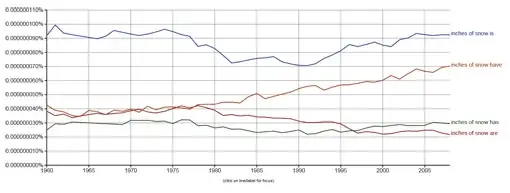
Taken with a gram of salt, Google ngram viewer displays "inches of snow is" as having a much higher count than "inches of snow are". Strangely enough, a search for "inches of snow has/have", shows the plural form having the higher count. A Google search, however, produces "has fallen" rather than "have fallen". I would conclude that current usage prefers "three inches of snow is expected" as well as "three inches of snow has/have fallen".

enter image description here

parameters: books from 1960 to 2010, smoothing of 10.

Centaurus
  • 50,047
0

My general intuition would be:

  • where the number is a small and especially where you're using a verb such as 'fall' (rather than just stating an equivalence with 'be'), then speakers are likely to use the plural: "Two inches of snow have fallen";
  • in other cases of larger numbers, or when stating an equivalence, the singular is more likely: "13cm of snow has fallen", "2 inches of snow is a lot for this time of year".

In some cases, you might argue that an apparent noun phrase subject of the sentence actually has an implicit verb phrase subject (or, depending on your analysis, at least something other than a "simple" noun phrase involving just the words actually stated) that actually leads to the singular agreement. So e.g. if I say:

"3 inches of snow seems a lot for this time or year"

what I'm saying underlyingly is something more like:

"[(there existing/the presence of/etc) 3 inches of snow] seems a lot for this time of year"

Neil Coffey
  • 19,622