-1

Because of English's lack of a gender neutral third person singular possessive pronoun, whenever the need for such a referent presents itself in the course of writing, we seem to be left with alternatives that are either cumbersome or otherwise awkward. There is the informal gender neutral "himself", and the informal singular "themself", and of course there is the more formal "himself or herself" which is both grammatically and politically correct but has the disadvantage of being incredibly annoying to write very quickly.

Are there any other ways to truncate this expression, particularly (but not limited to) ways that stay within the bounds of standard correct English usage and grammar?

For example, I thought of shortening it to "his or herself", but upon second thought this feels akin to what mathematicians would call can abuse of notation.

David H
  • 137

4 Answers4

5

Because of English's lack of a gender neutral third person singular possessive pronoun.

Originally English had him in this role. In the 1300s they started to also be used for this. While some grammarians have criticised it since the 1790s, others have defended it since the 1890s not least on the ground that they'd had a century and didn't succeed in convincing all great writers to abandon it.

Another 120 years later and the silly needless innovation of banning singular they has still not succeeded and at least beginning to move from the point where people say it's not allowed but use it anyway to increasingly plain honest use of it.

If you don't want to use him, then use they.

By extension, use themselves. It's in no way novel to do so:

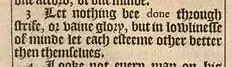
Let nothing bee done through strife, or vaine glory, but in lowlinesse of minde let each esteeme other better then themselues. — Philippians 2:3 KJV (First edition, 1611)

Some people like to revive the even older themself for singular use (though themself and themselves had a long coexistance as variants of each other, both covering both plural and singular), which is a fair enough matter of personal style.

Of course some style guides do prohibit it, but they generally prescribe their own solution to this banning too.

Jon Hanna
  • 53,363
  • 1
    I'm curious Jon as to why you chose to use diacritics in rôle and coëxistance. They are certainly valid alternative spellings, but the unadorned are surely more common, and a lot easier to type. FWIW, I found their presence made me think about your spelling more than your content. – Fraser Orr Jan 06 '15 at 22:53
  • @FraserOrr an adolescent affectation that has become a habit even now I'm old enough to know better, though whether I use it or not depends on the keyboard I'm using at the time. (Or rather, I always use it, because that's how I type them, but it doesn't always work). – Jon Hanna Jan 06 '15 at 23:01
  • 1
    @FraserOrr Hmm. Though actually, coëxistance is the only one I'll own to as an affectation. I came by rôle honestly, and I'm less unusual in that, though admittedly still unusual. I do try to edit them out in cases like this where forms of word are themselves the topic, and being conventional gains an additional benefit. – Jon Hanna Jan 06 '15 at 23:05
  • Really!!? KJV uses then instead of than? I thought that was a recent lazy habit. – Jim Jan 07 '15 at 01:25
  • @Jim note the rest of the spellings, most of them have also changed since. Spelling than as then is like the spelling of its that spells it it's died out, but can still happen as a mistake. – Jon Hanna Jan 07 '15 at 01:31
  • Of course, not everything that was done in the KJV should be done today, but there's never been a time between then and now when themselves wasn't used singularly. – Jon Hanna Jan 07 '15 at 01:33
  • Jon, I get that, but I have always believed that using then for than was just plain igonrant or lazy, I never dreamed of the excuse, "I'm just using an older spelling..." – Jim Jan 07 '15 at 01:36
  • @Jim, it's not really a good excuse, that was a time when "correct spelling" didn't really exist, and to the extent that some words were well-agreed on there was still a lot more variation from region to region or school-teacher to school-teacher than today. – Jon Hanna Jan 07 '15 at 01:41
  • 1
    @Jim in fact funnily enough, the KJV has done a pas de deux with English spellings through its later editions as it was updated in that regard but also influenced a lot of people's idea of the "correct" spelling, though not the first edition which wasn't even consistent with itself, due to a mix of different writers being involved, and printers opting for longer or shorter spellings as suited the line. – Jon Hanna Jan 07 '15 at 02:22
2

There are a few possible approaches. To give a specific sentence I will choose this sentence out of "Chasing after the American Dream". which I picked up randomly from Google.

As long as a person measures their own worth by comparing themself with others,

Here the author uses "themself", but possible simple substitutes are the ones you gave:

As long as a person measures his own worth by comparing himself with others,

This would be traditionally correct, but not politically correct.

As long as a person measures his/her own worth by comparing himself/herself with others,

This is traditionally not correct with the slash, but is politically acceptable.

As long as a person measures his or her own worth by comparing himself or herself with others,

Both correct grammatically and politically, but annoyingly wordy, and perhaps cloyingly politically correct.

As long as a person measures her own worth by comparing herself with others,

Here there is a deliberate breach of the traditional protocol of using the masculine as the generic, instead using the feminine as generic. Not correct, but politically laudatory or some, though again, depending on your point of view, rather cloying and distracting.

Often balance is sought by mixing up the gender. Which is fun, but can be even more distracting, leaving the reader with the impression that they are missing some semantic to the capricious gender.

As long as Mary measures her own worth by comparing herself with others,

Here we actually begin changing the sentence itself. By using a concrete person rather than a generic, we can solve the problem, however, obviously it needs to be properly integrated.

As long as a one measures one's own worth by comparing oneself with others,

Here we give a more specific substitution, using "one" instead of the third person. Again this is a change in meaning, but it can be used to convey the same sense (as it does here.)

As long as a person measures self worth by comparison with others,

Here we make a more dramatic structural change to the sentence to eliminate the use of the problem words, which is also a more difficult change, but can lead to the best results.

Finally, in certain circles you can use artificially created gender neutral pronouns, for example, "eir" for his/her, "emself" and for "himself/herself", though there are several alternatives. These are known as Spivak pronouns and are CERTAINLY not standard or appropriate for regular communication, but in certain specific, narrow circles might be considered appropriate:

As long as a person measures eir own worth by comparing emself with others,

I don't much care for this, and it exudes a political agenda, but it is one option you might consider.

See Wikipedia: Gender Neutral Pronouns for more.

Fraser Orr
  • 16,783
1

Two solutions spring to mind.

One is to use (as is done with standard gendered pronouns) the singular they:

They hit themself on the head.

The other (my personal favourite) is to use a gender-neutral pronoun, thon being the most English-sounding and simple to learn in my opinion:

Thon hit thonself on the head.

Note though that this latter suggestion may not be understood by very many English speakers. Thon, and its related thons and thonself forms, are pretty rarely-used words.

Jez
  • 12,705
  • Might want to include some corroboration as to provenance, if Wiktionary counts: https://en.wiktionary.org/wiki/thon#English – Andrew Leach Jan 06 '15 at 22:16
  • Done. (10 more to go...) – Jez Jan 06 '15 at 22:18
  • 1
    I've come across ze more in actual use, and find I can mentally slot it in with he and she while thon seems to want to sit beside they and hence offers no improvement on it. Still, I don't like any of those neologisms and only use any of them if someone prefers it as the pronoun used for zirself/thonself/emself as the case may be. Still, a +1 for a good answer regardless of my preferences differing. – Jon Hanna Jan 06 '15 at 22:59
0

I picked my law school, in part, because it has one the best and most demanding legal writing programs in the United States. Please excuse me for pointing you to a reference from my alma mater, but I believe it is clear, concise, and helpful.

Gender Neutral Language

The only thing I would add to the above is that you could merely switch to using "she" as your gender-neutral pronoun. When I am lazy, I use "she," and multiple women have kindly commented on it. No man has ever criticized me directly, but if that were to happen, it would say more about his bigotry than your writing choices. The only downside to switching exclusively to "she" is that it will distract some readers: but as I mentioned, the distractions will typically be to your benefit.

hunterhogan
  • 2,243
  • They could maybe clarify the second example in 6- which they labeled uniquely "more undesirable"; it should be in red, as not only does it disclose the marital status, worst it doesn't even show her own fist name. Or am I not understanding this properly? –  Jan 07 '15 at 00:36